

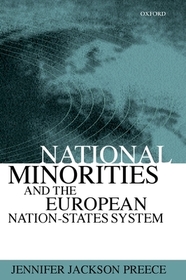
National Minorities and the European Nation-States System
-
10% KEDVEZMÉNY?
- A kedvezmény csak az 'Értesítés a kedvenc témákról' hírlevelünk címzettjeinek rendeléseire érvényes.
- Kiadói listaár GBP 187.50
-
89 578 Ft (85 312 Ft + 5% áfa)
Az ár azért becsült, mert a rendelés pillanatában nem lehet pontosan tudni, hogy a beérkezéskor milyen lesz a forint árfolyama az adott termék eredeti devizájához képest. Ha a forint romlana, kissé többet, ha javulna, kissé kevesebbet kell majd fizetnie.
- Kedvezmény(ek) 10% (cc. 8 958 Ft off)
- Kedvezményes ár 80 620 Ft (76 781 Ft + 5% áfa)
Iratkozzon fel most és részesüljön kedvezőbb árainkból!
Feliratkozom
89 578 Ft

Beszerezhetőség
Megrendelésre a kiadó utánnyomja a könyvet. Rendelhető, de a szokásosnál kicsit lassabban érkezik meg.
Why don't you give exact delivery time?
A beszerzés időigényét az eddigi tapasztalatokra alapozva adjuk meg. Azért becsült, mert a terméket külföldről hozzuk be, így a kiadó kiszolgálásának pillanatnyi gyorsaságától is függ. A megadottnál gyorsabb és lassabb szállítás is elképzelhető, de mindent megteszünk, hogy Ön a lehető leghamarabb jusson hozzá a termékhez.
A termék adatai:
- Kiadó OUP Oxford
- Megjelenés dátuma 1998. december 17.
- ISBN 9780198294375
- Kötéstípus Keménykötés
- Terjedelem208 oldal
- Méret 224x144x17 mm
- Súly 401 g
- Nyelv angol 0
Kategóriák
Rövid leírás:
The collapse of Yugoslavia, Czechoslovakia, and the Soviet Union has resulted in a proliferation of discontented minorities. Preventing the violent conflict triggered by such disaffection has become a driving issue in post-Cold War Europe. National Minorities and the European Nation-States System reveals that the contemporary international system is the root cause of the problem and viable solutions to it must acknowledge this structural limitation.
TöbbHosszú leírás:
The collapse of Yugoslavia, Czechoslovakia, and the Soviet Union has resulted in a proliferation of discontented national minorities. Thus, the possibility for destabilizing ethnic conflict has become acute. National minorities have accordingly emerged as a major focus of international relations in post-Cold War Europe.
Jennifer Jackson Preece's powerful new study offers an innovative analysis of these developments. Scrutinizing them within the historical context of changing practices and evolving norms, she reveals that the European national minority question is nothing new - rather its foundations extend deep into contemporary history. Moreover, the problem is intrinsically derivative of the nation-states system itself, a system which potentially intensifies minority disaffection.
Examining these issues against the backdrop of relevant treaties, diplomatic negotiations, and international practices, Jackson Preece presents the definitive assessment of the fate of national minorities in the European states system.
This book makes a novel contribution to understanding much of the puzzle of national minority rights in international relations ... this is a very useful and insightful study that should be of interest to scholars seeking to make sense of the place of national minorities in the international system. It provides an excellent background to and perspective on these issues.
Tartalomjegyzék:
Part I: National Minorities in Conceptual Perspective
Introduction
What is a National Minority?
Why are National Minorities a Subject of European r s4rnational Relations?
Part II: National Minorities in Historical Perspective
Minority Rights from Westphalia to Berlin (1648-1878)
The League of Nations System of Minority Guarantees (1919-1939)
National Minority Questions and the Cold War Human Rights Regime (1945-1989)
Part III: National Minorities in Contemporary Perspective
National Minority Rights Provisions (1990-1995)
National Minority Rights Enforcement Mechanisms (1990-1995)
Conclusion

