

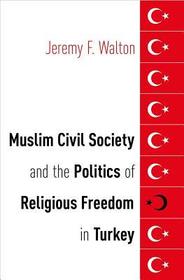
Muslim Civil Society and the Politics of Religious Freedom in Turkey
Sorozatcím: AAR Religion, Culture, and History;
-
10% KEDVEZMÉNY?
- A kedvezmény csak az 'Értesítés a kedvenc témákról' hírlevelünk címzettjeinek rendeléseire érvényes.
- Kiadói listaár GBP 125.00
-
59 718 Ft (56 875 Ft + 5% áfa)
Az ár azért becsült, mert a rendelés pillanatában nem lehet pontosan tudni, hogy a beérkezéskor milyen lesz a forint árfolyama az adott termék eredeti devizájához képest. Ha a forint romlana, kissé többet, ha javulna, kissé kevesebbet kell majd fizetnie.
- Kedvezmény(ek) 10% (cc. 5 972 Ft off)
- Kedvezményes ár 53 747 Ft (51 188 Ft + 5% áfa)
Iratkozzon fel most és részesüljön kedvezőbb árainkból!
Feliratkozom
59 718 Ft

Beszerezhetőség
Becsült beszerzési idő: A Prosperónál jelenleg nincsen raktáron, de a kiadónál igen. Beszerzés kb. 3-5 hét..
A Prosperónál jelenleg nincsen raktáron.
Why don't you give exact delivery time?
A beszerzés időigényét az eddigi tapasztalatokra alapozva adjuk meg. Azért becsült, mert a terméket külföldről hozzuk be, így a kiadó kiszolgálásának pillanatnyi gyorsaságától is függ. A megadottnál gyorsabb és lassabb szállítás is elképzelhető, de mindent megteszünk, hogy Ön a lehető leghamarabb jusson hozzá a termékhez.
A termék adatai:
- Kiadó OUP USA
- Megjelenés dátuma 2017. június 8.
- ISBN 9780190658977
- Kötéstípus Keménykötés
- Terjedelem270 oldal
- Méret 236x157x25 mm
- Súly 499 g
- Nyelv angol 0
Kategóriák
Rövid leírás:
In contemporary Turkey, a plethora of Muslim NGOs, spanning the sectarian divide between Sunni and Alevi Muslims, has called into question statist sovereignty over Islam. Muslim Civil Society and the Politics of Religious Freedom in Turkey is an ethnographic study of these institutions and their distinctive, nongovernmental politics of religious freedom.
TöbbHosszú leírás:
The sway of Islam in political life is an unavoidable topic of debate in Turkey today. Secularists, Islamists, and liberals alike understand the Turkish state to be the primary arbiter of Islam's place in Turkey--as the coup attempt of July 2016 and its aftermath have dramatically illustrated. Yet this emphasis on the state ignores the influence of another field of political action in relation to Islam, that of civil society. Based on ethnographic research conducted in Istanbul and Ankara, Muslim Civil Society and the Politics of Religious Freedom in Turkey is Jeremy F. Walton's inquiry into the political and religious practices of contemporary Turkish-Muslim Nongovernmental Organizations. Since the mid-1980s, Turkey has witnessed an efflorescence of NGOs in tandem with a neoliberal turn in domestic economic policies and electoral politics. One major effect of this neoliberal turn has been the emergence of a vibrant Muslim civil society, which has decentered and transformed the Turkish state's relationship to Islam. Muslim NGOs champion religious freedom as a paramount political ideal and marshal a distinctive, nongovernmental politics of religious freedom to advocate this ideal. Walton's study offers an accomplished, fine-grained perspective on this nongovernmental politics of religious freedom and the institutions and communities from which it emerges.
Though Walton's work has greatly assisted me in answering so many unresolved questions and assumptions that arose during my time in Turkey, its contribution goes beyond the benefits of explaining my own experiences back to me; Muslim Civil Society and the Politics of Religious Freedom in Turkish Politics and Society is a valuable piece of scholarship whose nuance towards understanding the religious politics of Islam and the state is often absent in much of the current literature.
Tartalomjegyzék:
Table of Contents
List of Abbreviations
Acknowledgements
Preface: Excursions to the Margins
Introduction: Islam, Secularism, and Civil Society in the Turkish Present
Chapter One: Varieties of Islam in the Turkish Public Sphere
Chapter Two: Confessional Pluralism and the Civil Society Effect
Chapter Three: Counterpublic Spatial Practices of Muslim Civil Society
Chapter Four: Temporal Practices of Muslim Civil Society, or the Dilemmas of Historicism
Chapter Five: Fashioning the Neo-Ottoman Chronotope of Istanbul
Afterword: A Panorama of Muslim Civil Society in Miniature
Bibliography

