

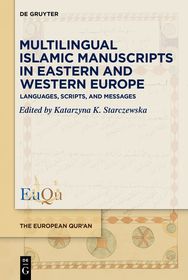
Multilingual Islamic Manuscripts in Eastern and Western Europe
Languages, Scripts, and Messages
Sorozatcím: The European Qur'an; 11;
-
5% KEDVEZMÉNY?
- A kedvezmény csak az 'Értesítés a kedvenc témákról' hírlevelünk címzettjeinek rendeléseire érvényes.
- Kiadói listaár EUR 99.95
-
39 040 Ft (37 181 Ft + 5% áfa)
Az ár azért becsült, mert a rendelés pillanatában nem lehet pontosan tudni, hogy a beérkezéskor milyen lesz a forint árfolyama az adott termék eredeti devizájához képest. Ha a forint romlana, kissé többet, ha javulna, kissé kevesebbet kell majd fizetnie.
- Kedvezmény(ek) % (cc. 0 Ft off)
- Kedvezményes ár 0 Ft (0 Ft + 5% áfa)
Iratkozzon fel most és részesüljön kedvezőbb árainkból!
Feliratkozom
39 040 Ft

Beszerezhetőség
Becsült beszerzési idő: A Prosperónál jelenleg nincsen raktáron, de a kiadónál igen. Beszerzés kb. 3-5 hét..
A Prosperónál jelenleg nincsen raktáron.
Why don't you give exact delivery time?
A beszerzés időigényét az eddigi tapasztalatokra alapozva adjuk meg. Azért becsült, mert a terméket külföldről hozzuk be, így a kiadó kiszolgálásának pillanatnyi gyorsaságától is függ. A megadottnál gyorsabb és lassabb szállítás is elképzelhető, de mindent megteszünk, hogy Ön a lehető leghamarabb jusson hozzá a termékhez.
A termék adatai:
- Kiadás sorszáma 1
- Kiadó De Gruyter
- Megjelenés dátuma 2026. február 2.
- ISBN 9783111678566
- Kötéstípus Keménykötés
- Terjedelem303 oldal
- Méret 230x155 mm
- Súly 555 g
- Nyelv angol
- Illusztrációk 56 Illustrations, black & white; 50 Illustrations, color; 6 Tables, black & white 759
Kategóriák
Rövid leírás:
The European Qur’an. Islamic Scripture in European Culture and Religion 1150-1850 is a peer-reviewed book series with the EuQu project results. The volumes analyze the important role that the Qur’an has played in the formation of medieval and early modern European religious diversity and identity, deeply imbedded in the political and religious thought of Europe and part of the intellectual repertoire.
TöbbHosszú leírás:
The book is a collective work that addresses a critical gap in understanding the role of Islamic populations in European history through their manuscript cultures. By examining a diverse array of Islamic texts—particularly those preserved only in manuscript form—this book highlights the multifaceted interactions between Islamic and European traditions.
The volume offers case studies based on four thematic cores: cataloguing and describing manuscripts, analyzing manuscript circulation and textual traditions, studying various scripts, and conducting diachronic linguistic analyses. The chapters delve into manuscripts of the Tatars of the Grand Duchy of Lithuania, Ottoman influences on South-Slavic literature, and significant Arabic texts in European collections.
This collective volume not only enriches the scholarship on European Islam but also serves as an essential resource for historians, linguists, and manuscript scholars interested in the complex legacies of multicultural exchanges in Europe.

