

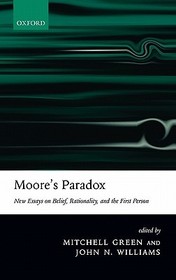
Moore's Paradox
New Essays on Belief, Rationality, and the First Person
-
10% KEDVEZMÉNY?
- A kedvezmény csak az 'Értesítés a kedvenc témákról' hírlevelünk címzettjeinek rendeléseire érvényes.
- Kiadói listaár GBP 112.50
-
53 746 Ft (51 187 Ft + 5% áfa)
Az ár azért becsült, mert a rendelés pillanatában nem lehet pontosan tudni, hogy a beérkezéskor milyen lesz a forint árfolyama az adott termék eredeti devizájához képest. Ha a forint romlana, kissé többet, ha javulna, kissé kevesebbet kell majd fizetnie.
- Kedvezmény(ek) 10% (cc. 5 375 Ft off)
- Kedvezményes ár 48 372 Ft (46 068 Ft + 5% áfa)
Iratkozzon fel most és részesüljön kedvezőbb árainkból!
Feliratkozom
53 746 Ft

Beszerezhetőség
Megrendelésre a kiadó utánnyomja a könyvet. Rendelhető, de a szokásosnál kicsit lassabban érkezik meg.
Why don't you give exact delivery time?
A beszerzés időigényét az eddigi tapasztalatokra alapozva adjuk meg. Azért becsült, mert a terméket külföldről hozzuk be, így a kiadó kiszolgálásának pillanatnyi gyorsaságától is függ. A megadottnál gyorsabb és lassabb szállítás is elképzelhető, de mindent megteszünk, hogy Ön a lehető leghamarabb jusson hozzá a termékhez.
A termék adatai:
- Kiadó OUP Oxford
- Megjelenés dátuma 2007. január 11.
- ISBN 9780199282791
- Kötéstípus Keménykötés
- Terjedelem260 oldal
- Méret 240x162x20 mm
- Súly 506 g
- Nyelv angol 0
Kategóriák
Rövid leírás:
G. E. Moore observed that to assert, 'I went to the pictures last Tuesday but I don't believe that I did' would be 'absurd'. Over half a century later, such sayings continue to perplex philosophers. In the definitive treatment of the famous paradox, Green and Williams explain its history and relevance and present new essays by leading thinkers in the area.
TöbbHosszú leírás:
G. E. Moore famously observed that to assert, 'I went to the pictures last Tuesday but I don't believe that I did' would be 'absurd'. Moore calls it a 'paradox' that this absurdity persists despite the fact that what I say about myself might be true. Over half a century later, such sayings continue to perplex philosophers and other students of language, logic, and cognition. Ludwig Wittgenstein was fascinated by Moore's example, and the absurdity of Moore's saying was intensively discussed in the mid-20th century. Yet the source of the absurdity has remained elusive, and its recalcitrance has led researchers in recent decades to address it with greater care.
In this definitive treatment of the problem of Moorean absurdity Green and Williams survey the history and relevance of the paradox and leading approaches to resolving it, and present new essays by leading thinkers in the area.
Contributors
Jonathan Adler, Bradley Armour-Garb, Jay D. Atlas, Thomas Baldwin, Claudio de Almeida, André Gallois, Robert Gordon, Mitchell Green, Alan Hájek, Roy Sorensen, John Williams
this very useful book . . . contains diagnoses, dismissals, and displays of the Moorean challenge. And it serves a well-defined philosophical purpose, gathering together a variety of views as to what Moore was really revealing. It does this well.
Tartalomjegyzék:
I. Introduction and Historical Context
Introduction
The All-Seeing Eye: A History of Moore's Paradox
II. Moore's Paradox and Knowledge
Moorean Absurdity: An Epistemological Analysis
The Normative Character of Belief
Moore's Paradoxes, Evans's Principle and Iterated Belief
III. Moore's Paradox, Belief, and Assertion
What Reflexive Pronouns Tell Us about Belief - A New Moore's Paradox De Se, Rationality, and Privileged Access
Moore's Paradox and the Transparency of Belief
IV. Moore's Paradox and Consciousness
Consciousness, Reasons, and Moore's Paradox
Moorean Absurdity and Showing What's Within
V. Arguments from Moore's Paradox
My Philosophical Position Says 'p' and I Don't Believe 'p'
Moorean Pretence

