

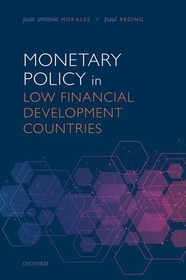
Monetary Policy in Low Financial Development Countries
-
10% KEDVEZMÉNY?
- A kedvezmény csak az 'Értesítés a kedvenc témákról' hírlevelünk címzettjeinek rendeléseire érvényes.
- Kiadói listaár GBP 110.00
-
52 552 Ft (50 050 Ft + 5% áfa)
Az ár azért becsült, mert a rendelés pillanatában nem lehet pontosan tudni, hogy a beérkezéskor milyen lesz a forint árfolyama az adott termék eredeti devizájához képest. Ha a forint romlana, kissé többet, ha javulna, kissé kevesebbet kell majd fizetnie.
- Kedvezmény(ek) 10% (cc. 5 255 Ft off)
- Kedvezményes ár 47 297 Ft (45 045 Ft + 5% áfa)
Iratkozzon fel most és részesüljön kedvezőbb árainkból!
Feliratkozom
52 552 Ft

Beszerezhetőség
Becsült beszerzési idő: A Prosperónál jelenleg nincsen raktáron, de a kiadónál igen. Beszerzés kb. 3-5 hét..
A Prosperónál jelenleg nincsen raktáron.
Why don't you give exact delivery time?
A beszerzés időigényét az eddigi tapasztalatokra alapozva adjuk meg. Azért becsült, mert a terméket külföldről hozzuk be, így a kiadó kiszolgálásának pillanatnyi gyorsaságától is függ. A megadottnál gyorsabb és lassabb szállítás is elképzelhető, de mindent megteszünk, hogy Ön a lehető leghamarabb jusson hozzá a termékhez.
A termék adatai:
- Kiadó OUP Oxford
- Megjelenés dátuma 2021. július 22.
- ISBN 9780198854715
- Kötéstípus Keménykötés
- Terjedelem384 oldal
- Méret 245x164x26 mm
- Súly 734 g
- Nyelv angol 139
Kategóriák
Rövid leírás:
This book gives a broad overview of the main monetary policy challenges faced by countries that are in the lower income range, have an underdeveloped financial sector, and are weakly integrated to the international capital market.
TöbbHosszú leírás:
Monetary Policy in Low Financial Development Countries provides a broad coverage of the monetary policy issues faced by developing countries with low financial depth. These low and lower middle income countries are characterized by the predominance of bank finance, shallow financial markets, low financial inclusion, weak integration with world capital markets, and a high degree of informality in economic activity. Monetary policy acquires special twists, making it different in many aspects from the policies followed in advanced and emerging market economies. This book covers the main facets of monetary policy making, using an approach that combines discussions of theoretical arguments, of results from empirical studies and of relevant policy experiences. It presents the monetary policy instruments that central banks rely on in these countries. It assesses the specificities of their monetary transmission mechanism, i.e. the way central banks' actions affect output and prices. It evaluates the advantages, drawbacks, and challenges of the different nominal anchors they may choose from: exchange rate targeting, monetary targeting, and inflation targeting. This discussion is set against the background of the three main goals pursued by central banks: price, output, and financial stability. Particular attention is devoted to the issue of the credibility of central banks and to the trade-offs they face when external shocks, to which these countries are very vulnerable, lead to conflicts among the three goals they pursue. The authors also cover more specific topics, such as the coordination between monetary and fiscal policy, the challenges raised by dollarization, the implications of informal labour markets and of microfinance institutions for monetary policy-making, as well as the role of models for forecasting and policy evaluation by central banks.
TöbbTartalomjegyzék:
Introduction
Money, central banks, and low financial development countries
The channels of transmission of monetary policy
Monetary policy instruments
Monetary policy trade-offs and monetary policy credibility
Monetary policy: dealing with fiscal constraints and external price shocks
The choice of nominal targets in an open economy
Modeling monetary policy: a brief overview

