

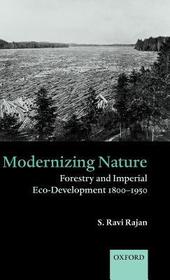
Modernizing Nature
Forestry and Imperial Eco-Development 1800-1950
Sorozatcím: Oxford Historical Monographs;
-
10% KEDVEZMÉNY?
- A kedvezmény csak az 'Értesítés a kedvenc témákról' hírlevelünk címzettjeinek rendeléseire érvényes.
- Kiadói listaár GBP 237.50
-
113 465 Ft (108 062 Ft + 5% áfa)
Az ár azért becsült, mert a rendelés pillanatában nem lehet pontosan tudni, hogy a beérkezéskor milyen lesz a forint árfolyama az adott termék eredeti devizájához képest. Ha a forint romlana, kissé többet, ha javulna, kissé kevesebbet kell majd fizetnie.
- Kedvezmény(ek) 10% (cc. 11 347 Ft off)
- Kedvezményes ár 102 119 Ft (97 256 Ft + 5% áfa)
Iratkozzon fel most és részesüljön kedvezőbb árainkból!
Feliratkozom
113 465 Ft

Beszerezhetőség
Megrendelésre a kiadó utánnyomja a könyvet. Rendelhető, de a szokásosnál kicsit lassabban érkezik meg.
Why don't you give exact delivery time?
A beszerzés időigényét az eddigi tapasztalatokra alapozva adjuk meg. Azért becsült, mert a terméket külföldről hozzuk be, így a kiadó kiszolgálásának pillanatnyi gyorsaságától is függ. A megadottnál gyorsabb és lassabb szállítás is elképzelhető, de mindent megteszünk, hogy Ön a lehető leghamarabb jusson hozzá a termékhez.
A termék adatai:
- Kiadó Clarendon Press
- Megjelenés dátuma 2006. február 16.
- ISBN 9780199277964
- Kötéstípus Keménykötés
- Terjedelem304 oldal
- Méret 223x146x23 mm
- Súly 490 g
- Nyelv angol
- Illusztrációk 4 figures, 1 table 0
Kategóriák
Rövid leírás:
Professor Rajan explores the origins, institutionalization, and politics of the sciences and systems of knowledge underlying colonial frameworks of environmental management. He disagrees with those historiographical and social scientific approaches that look upon science and scientific institutions instrumentally as 'tools of empire'. Rather, he argues that the 'colonial' sciences had cognitive, ideological, and interventionist traditions distinct from each other and from the colonial bureaucracy and that histories of science, environmental management, and indeed of the colonial state, must comprehend these distinct cognitive traditions.
TöbbHosszú leírás:
Modernizing Nature contributes to the debate regarding the origins, institutionalization, and politics of the sciences and systems of knowledge underlying colonial frameworks of environmental management. It departs from the widely prevalent scholarly perspective that colonial science can be understood predominantly as a handmaiden of imperialism. Instead, it argues that the myriad colonial sciences had ideological and interventionist traditions distinct from each other and from the colonial bureaucracy and that these tensions better explain environmental politics and policy dilemmas in the post-colonial era.
Professor Rajan argues that tropical forestry in the nineteenth century consisted of at least two distinct approaches towards nature, resource, and people; and what won out in the end was the Continental European forestry paradigm. Rajan also shows that science and scientists were relatively marginal until the First World War. It was the acute scientific and resource crisis felt during the War, along with the rise of experts and expertise in Britain during that period and the lobby-politics of an organized empire-wide scientific community, that resulted in resource management regimes such as forestry beginning to get serious state backing. Over time, considerable differences in approach and outlook towards policy emerged between different colonial scientific communities, such as foresters and agriculturists. These different colonial sciences represented different situated knowledges, with different visions of nature, people, and empire, and in different configurations of power.
Finally, in a panoramic overview of post-colonial developments, Rajan argues that the hegemony of these state-scientific regimes of resource-management during the period 1950-1990 engendered not just social revolt, as recent historical work has shown, but also intellectual protest. Consequently, the discipline of forestry became systematically re-conceptualized, with newapproaches to sylviculture, economics, law, and crucially, with new visions of modernity. This disciplinary change constitutes nothing short of a cognitive revolution, one that has been brought about by a clearly articulated political perspective on the orientation of the discipline of forestry by its practitioners.
Rajan's book is clearly a scholarly and significant contribution to the literature.
Tartalomjegyzék:
Introduction
A Contract with Nature
The Empire of Nature
The Empire Strikes Back
The Imperial Environmentalist
The Contested Legacy
Appendices 1-4
Bibliography
Index

