

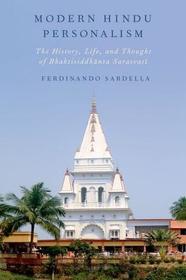
Modern Hindu Personalism
The History, Life, and Thought of Bhaktisiddhanta Sarasvati
-
10% KEDVEZMÉNY?
- A kedvezmény csak az 'Értesítés a kedvenc témákról' hírlevelünk címzettjeinek rendeléseire érvényes.
- Kiadói listaár GBP 48.49
-
21 893 Ft (20 850 Ft + 5% áfa)
Az ár azért becsült, mert a rendelés pillanatában nem lehet pontosan tudni, hogy a beérkezéskor milyen lesz a forint árfolyama az adott termék eredeti devizájához képest. Ha a forint romlana, kissé többet, ha javulna, kissé kevesebbet kell majd fizetnie.
- Kedvezmény(ek) 10% (cc. 2 189 Ft off)
- Kedvezményes ár 19 703 Ft (18 765 Ft + 5% áfa)
Iratkozzon fel most és részesüljön kedvezőbb árainkból!
Feliratkozom
21 893 Ft

Beszerezhetőség
Megrendelésre a kiadó utánnyomja a könyvet. Rendelhető, de a szokásosnál kicsit lassabban érkezik meg.
Why don't you give exact delivery time?
A beszerzés időigényét az eddigi tapasztalatokra alapozva adjuk meg. Azért becsült, mert a terméket külföldről hozzuk be, így a kiadó kiszolgálásának pillanatnyi gyorsaságától is függ. A megadottnál gyorsabb és lassabb szállítás is elképzelhető, de mindent megteszünk, hogy Ön a lehető leghamarabb jusson hozzá a termékhez.
A termék adatai:
- Kiadó OUP USA
- Megjelenés dátuma 2013. január 10.
- ISBN 9780199865901
- Kötéstípus Puhakötés
- Terjedelem360 oldal
- Méret 231x155x27 mm
- Súly 499 g
- Nyelv angol 0
Kategóriák
Rövid leírás:
Modern Hindu Personalism explores the life and works of Bhaktisiddhanta Sarasvati (1874-1937), a Vaishnava guru of the Chaitanya school of Bengal. Ferdinando Sardella examines Bhaktisiddhanta's background, motivation and thought, especially as it relates to his forging of a modern traditionalist institution for the successful revival of Chaitanya Vaishnava bhakti.
TöbbHosszú leírás:
Modern Hindu Personalism explores the life and works of Bhaktisiddhanta Sarasvati (1874-1937), a Vaishnava guru of the Chaitanya school of Bengal. Ferdinando Sardella examines Bhaktisiddhanta's background, motivation and thought, especially as it relates to his forging of a modern traditionalist institution for the successful revival of Chaitanya Vaishnava bhakti. Originally known as the Gaudiya Math, that institution not only established centers in both London (1933) and Berlin (1934), but also has been indirectly responsible for the development of a number of contemporary global offshoots, including the International Society for Krishna Consciousness (Hare Krishna movement). Sardella provides the historical background as well as the contemporary context of the India in which Bhaktisiddhanta lived and functioned, in the process shedding light on such topics as colonial culture and sensibilities, the emergence of an educated middle-class, the rise of the Bengal Renaissance, and the challenge posed by Protestant missionaries. Bhaktisiddhanta's childhood, education and major influences are examined, as well as his involvement with Chaitanya Vaishnavism and the practice of bhakti. Sardella depicts Bhaktisiddhanta's attempt to propagate Chaitanya Vaishnavism internationally by sending disciples to London and Berlin, and offers a detailed description of their encounters with Imperial Britain and Nazi Germany. He goes on to consider Bhaktisiddhanta's philosophical perspective on religion and society as well as on Chaitanya Vaishnavism, exploring the interaction between philosophical and social concerns and showing how they formed the basis for the restructuring of his movement in terms of bhakti. Sardella places Bhaktisiddhanta's life and work within a taxonomy of modern Hinduism and compares the significance of his work to the contributions of other major figures such as Swami Vivekananda. Finally, Bhaktisiddhanta's work is linked to the development of a worldwide movement that today involves thousands of American and European practitioners, many of whom have become respected representatives of Chaitanya bhakti in India itself.
Modern Hindu Personalism is a significant contribution to scholarship not only of the modern Gaudiya Vaisnava movement but also of the religious history of Bengal within the last half of the colonial period. Adding greatly to our understanding of the development of Hinduism in the late nineteenth and early twentieth centuries in the context of colonialism and a rising Indian nationalism, this book should be widely read by scholars of the history of colonial India and religion.
Tartalomjegyzék:
Foreword
Phonetic Guide
Introduction
Chapter 1: The Rise of Non-Dualism in Bengal
Chapter 2: Life and Works
Chapter 3: Bhakti Universalist
Chapter 4: Social Philosopher
Conclusions
Appendix A: Theoretical and Methodological Considerations
Appendix B: Images
Appendix C: Documents
Appendix D: Tour to Central Europe
Appendix E: Works by Bhaktisiddhanta Sarasvati
Notes
Bibliography
Index

