

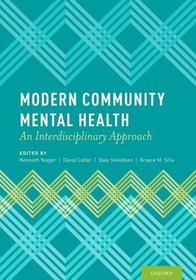
Modern Community Mental Health
An Interdisciplinary Approach
-
10% KEDVEZMÉNY?
- A kedvezmény csak az 'Értesítés a kedvenc témákról' hírlevelünk címzettjeinek rendeléseire érvényes.
- Kiadói listaár GBP 135.99
-
61 399 Ft (58 475 Ft + 5% áfa)
Az ár azért becsült, mert a rendelés pillanatában nem lehet pontosan tudni, hogy a beérkezéskor milyen lesz a forint árfolyama az adott termék eredeti devizájához képest. Ha a forint romlana, kissé többet, ha javulna, kissé kevesebbet kell majd fizetnie.
- Kedvezmény(ek) 10% (kb. 6 140 Ft)
- Kedvezményes ár 55 259 Ft (52 628 Ft + 5% áfa)
Iratkozzon fel most és részesüljön kedvezőbb árainkból!
Feliratkozom
61 399 Ft

Beszerezhetőség
Megrendelésre a kiadó utánnyomja a könyvet. Rendelhető, de a szokásosnál kicsit lassabban érkezik meg.
Why don't you give exact delivery time?
A beszerzés időigényét az eddigi tapasztalatokra alapozva adjuk meg. Azért becsült, mert a terméket külföldről hozzuk be, így a kiadó kiszolgálásának pillanatnyi gyorsaságától is függ. A megadottnál gyorsabb és lassabb szállítás is elképzelhető, de mindent megteszünk, hogy Ön a lehető leghamarabb jusson hozzá a termékhez.
A termék adatai:
- Kiadó OUP USA
- Megjelenés dátuma 2013. március 21.
- ISBN 9780199798063
- Kötéstípus Keménykötés
- Terjedelem648 oldal
- Méret 258x187x34 mm
- Súly 1261 g
- Nyelv angol 0
Kategóriák
Rövid leírás:
This is the first truly interdisciplinary book that examines how professionals work together within community mental health. It takes into account the key concepts of community mental health and combines them with current technology to develop an effective formula that redefines the community mental health practice.
TöbbHosszú leírás:
In 2012, we find ourselves just passing the 50th anniversary of the Eisenhower Commission Report (1961) and approaching the same anniversary of the Community Mental Health Act (1963). These landmark events launched the community mental health movement. The Rehabilitation Act of 1973 and the President's New Freedom Commission (2003) have continued this work by establishing funding sources and highlighting the importance of recovery and excellence in care. Modern Community Mental Health: An Interdisciplinary Approach integrates each of the key concepts contained within the presidential reports and landmark legislation into the context of today's community service delivery system.
This pathfinding textbook promises to revolutionize community mental health training by responding to the realities of modern health care delivery systems, presenting an integrated, interdisciplinary paradigm of care. Extraordinarily broad in coverage, it will open a door of possibilities to those caring for the mentally ill in the community. Recognizing that community-based services must be truly collaborative in order to be effective and efficient, the editors have assembled a cast of contributors from among the brightest lights in community practice. Chapter authors, who are currently doing interdisciplinary work successfully on a daily basis, will collaborate on writing teams to offer their insight into the problems and triumphs that are part of this approach. They will cover not only macro issues such as the economics of behavioral healthcare, reimbursement models, and quality improvement, but the specific skills necessary for competent practice such as treatment planning, clinical documentation, risk management, and partnering with members of a team that may include social workers, psychiatrists, psychologists, and nurses. Twenty additional chapters will provide detailed roadmaps to practices and programs that have been shown to be effective when delivered in a community setting--such as supported employment, assertive community treatment (ACT) teams, crisis intervention training (CIT), family psychoeducation, and supported housing--and will be grounded in educational benchmarks, healthcare reform opportunities, and cultural competencies.
By definition community mental health practice is never static. As communities change, the profession changes, and in recent years changes in funding have drastically impacted the system of care. We need empirically supported interventions, to include the voice of the consumers and their families, and have a way to educate current and future professionals so that we all truly work together.
This book is about the good news of deinstitutionalization. Too often we hear about the horror stories related to homelessness, incarceration, and violence in our community of individuals who are neglected in a very visible way. For the many who find an opportunity for life in the community with work, school, and family, this volume is a welcome contribution.
Tartalomjegyzék:
Section 1 Community Mental Health: Progress and Principles
Chapter 1 Introduction
Chapter 2 Public Mental Health in America: "Enlightenment" to Accountable Care
Chapter 3 State Psychiatric Hospitals in the Twenty-First Century
Chapter 4 Involuntary Civil Commitment: Applying Evolving Policy and Legal Determination in Community Mental Health
Chapter 5 Trauma Informed Care
Chapter 6 An Approach to Interdisciplinary Mental Health Work in South-Verona, Italy
Chapter 7 Bridging the Interdisciplinary Training Gap
Section 2 Preparation for Public and Community Work
Chapter 8 Recovery and Resiliency: Transitioning from the Hospital to the Community
Chapter 9 The Importance of Preparing Medical Students for Community Psychiatry
Chapter 10 The Power of Groups in Serious Mental Illness: Integrated Pathways to Recovery
Chapter 11 Cultural Competency
Chapter 12 Recovery Facilitating Service Planning: An Interdisciplinary Responsibility
Chapter 13 Consumer-Professional Partnerships During the Recovery Era
Chapter 14 Interdisciplinary Mental Health Consultation: A Key Skill for Mental Health Professionals
Chapter 15 Physical Health and Mental Health Care
Section 3 Best Practices And Current Evidence For Clinical Practice
Chapter 16 Evidence Based Practice in Community Mental Health
Chapter 17 Crisis Intervention and Support
Chapter 18 Early Intervention and Prevention of Long-Term Disability in Youth and Adults: The EASA Model
Chapter 19 Family Psychoeducation
Chapter 20 Assertive Community Treatment Teams
Chapter 21 Crisis Intervention Teams: A Boundary Spanning Collaboration Between the Law Enforcement and Mental Health Communities
Chapter 22 Case Management Contributions to Care
Chapter 23 Principles and Practices of Medication Management for People with Schizophrenia: Evolution Within a Recovery-Based Framework of Care
Chapter 24 Optimizing Medication in the Service of Recovery: Is There a Path for Reducing Over Utilization of Psychiatric Medications?
Chapter 25 Supported Housing, Socialization, Education and Employment
Chapter 26 Recovery and Community Mental Health
Chapter 27 Military Veterans and Families
Chapter 28 Mental Illness/Intellectual Disability
Chapter 29 Addressing Suicide Risk in Community Mental Health
Chapter 30 Jail Diversion: Using the Sequential Intercept Model
Section 4 Leadership, Administration, Management
Chapter 31 New Promises: Specialized Dockets as Partnerships Between Treatment and
the Criminal Justice System
Chapter 32 The Use of Technology in a Community Mental Health Setting
Chapter 33 Establishing a Comprehensive Continuous Integrated System of Care for Persons with Co-Occurring Conditions
Chapter 34 Transformational Leadership in Mental Health
Chapter 35 Psychiatric Risk Management: Efforts to Reduce Unforeseen Outcomes
Chapter 36 Quality Management and Program Evaluation
Chapter 37 A Social Systems Perspective on Leadership in Systems of Care

