

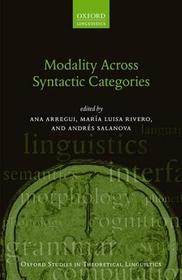
Modality Across Syntactic Categories
Sorozatcím: Oxford Studies in Theoretical Linguistics; 63;
-
10% KEDVEZMÉNY?
- A kedvezmény csak az 'Értesítés a kedvenc témákról' hírlevelünk címzettjeinek rendeléseire érvényes.
- Kiadói listaár GBP 115.00
-
51 922 Ft (49 450 Ft + 5% áfa)
Az ár azért becsült, mert a rendelés pillanatában nem lehet pontosan tudni, hogy a beérkezéskor milyen lesz a forint árfolyama az adott termék eredeti devizájához képest. Ha a forint romlana, kissé többet, ha javulna, kissé kevesebbet kell majd fizetnie.
- Kedvezmény(ek) 10% (kb. 5 192 Ft)
- Kedvezményes ár 46 730 Ft (44 505 Ft + 5% áfa)
Iratkozzon fel most és részesüljön kedvezőbb árainkból!
Feliratkozom
51 922 Ft

Beszerezhetőség
Megrendelésre a kiadó utánnyomja a könyvet. Rendelhető, de a szokásosnál kicsit lassabban érkezik meg.
Why don't you give exact delivery time?
A beszerzés időigényét az eddigi tapasztalatokra alapozva adjuk meg. Azért becsült, mert a terméket külföldről hozzuk be, így a kiadó kiszolgálásának pillanatnyi gyorsaságától is függ. A megadottnál gyorsabb és lassabb szállítás is elképzelhető, de mindent megteszünk, hogy Ön a lehető leghamarabb jusson hozzá a termékhez.
A termék adatai:
- Kiadó OUP Oxford
- Megjelenés dátuma 2017. február 16.
- ISBN 9780198718208
- Kötéstípus Keménykötés
- Terjedelem364 oldal
- Méret 247x177x27 mm
- Súly 658 g
- Nyelv angol 0
Kategóriák
Rövid leírás:
This volume explores the linguistic expression of modality in natural language from a cross-linguistic perspective, and demonstrates that modality involves many more syntactic categories and levels of syntactic structure than traditionally assumed.
TöbbHosszú leírás:
This volume explores the linguistic expression of modality in natural language from a cross-linguistic perspective. Modal expressions provide the basic tools that allow us to dissociate what we say from what is actually going on, allowing us to talk about what might happen or might have happened, as well as what is required, desirable, or permitted.
Chapters in the book demonstrate that modality involves many more syntactic categories and levels of syntactic structure than traditionally assumed. The volume distinguishes between three types of modality: 'low modality', which concerns modal interpretations associated with the verbal and nominal cartographies in syntax; 'middle modality', or modal interpretation associated to the syntactic cartography internal to the clause; and 'high modality', relating to the left periphery. It combines cross-linguistic discussions of the more widely-studied sources of modality with analyses of novel or unexpected sources, and shows how the meanings associated with the three types of modality are realized across a wide range of languages.
Tartalomjegyzék:
Introduction
Part I: Low Modality
Epistemic indefinites: On the content and distribution of the epistemic component
Modal indefinites: Where do Japanese wh-kas fit in?
The non-modality of opinion verbs
Modality in the nominal domain: The case of adnominal conditionals
Sublexical modality in defeasible causative verbs
Straddling the line between attitude verbs and necessity modals
May under verbs of hoping: The evolution of the modal system in the complements of hoping verbs in Early Modern English
Part II: Middle Modality
In an imperfect world: Deriving the typology of counterfactual marking
Dimensions of variation in Old English modals
Part III: High Modality
Aspect and tense in evidentials
Past possibility cross-linguistically: Evidence from 12 languages
A modest proposal for the meaning of imperatives

