

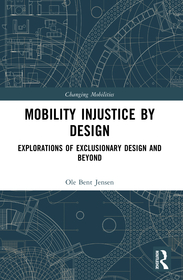
Mobility Injustice by Design
Explorations of Exclusionary Design and Beyond
Sorozatcím: Changing Mobilities;
-
10% KEDVEZMÉNY?
- Kiadói listaár GBP 44.99
-
20 312 Ft (19 345 Ft + 5% áfa)
Az ár azért becsült, mert a rendelés pillanatában nem lehet pontosan tudni, hogy a beérkezéskor milyen lesz a forint árfolyama az adott termék eredeti devizájához képest. Ha a forint romlana, kissé többet, ha javulna, kissé kevesebbet kell majd fizetnie.
- Kedvezmény(ek) 10% (kb. 2 031 Ft)
- Kedvezményes ár 18 281 Ft (17 411 Ft + 5% áfa)
18 281 Ft

Beszerezhetőség
Még nem jelent meg, de rendelhető. A megjelenéstől számított néhány héten belül megérkezik.
Why don't you give exact delivery time?
A beszerzés időigényét az eddigi tapasztalatokra alapozva adjuk meg. Azért becsült, mert a terméket külföldről hozzuk be, így a kiadó kiszolgálásának pillanatnyi gyorsaságától is függ. A megadottnál gyorsabb és lassabb szállítás is elképzelhető, de mindent megteszünk, hogy Ön a lehető leghamarabb jusson hozzá a termékhez.
A termék adatai:
- Kiadás sorszáma 1
- Kiadó Routledge
- Megjelenés dátuma 2026. november 1.
- ISBN 9781032605807
- Kötéstípus Puhakötés
- Terjedelem206 oldal
- Méret 234x156 mm
- Nyelv angol
- Illusztrációk 10 Illustrations, black & white; 10 Line drawings, black & white 700
Kategóriák
Rövid leírás:
Mobility Injustice by Design examines the social exclusion of vulnerable people in urban spaces, revealing how millions of citizens have their ‘right to roam’ curbed by design and planning decisions made either intentionally to facilitate immobility or social exclusion, or because of a lack of awareness of the aggregated consequences.
TöbbHosszú leírás:
Mobility Injustice by Design examines the social exclusion of vulnerable people in urban spaces, revealing how millions of citizens have their ‘right to roam’ curbed by design and planning decisions made either intentionally to facilitate immobility or social exclusion, or because of a lack of awareness of the aggregated consequences.
Ole B. Jensen’s insightful volume offers a theoretically informed framework, allowing us to ‘see’ mobility injustices more clearly, consider how new knowledge can mobilize design ethics, and think about how mobility justice can be brought about. It challenges us to reassess how choices of materials, design of spaces, and implementation of technologies afford or hinder particular mobilities. It explores a way of thinking about mobility and injustice that recognizes that everyone is assisted in their mobility practices and that human capacity for acting in the world is mediated by spaces, things, artifacts, and technologies. It examines not only the centrality of design but also the possibility that design may be working counter to the widespread cultural belief that design is in the service of ‘the good’. It locates thinking about mobility injustice between affect, experiences, and sensations on the one hand and reason, principles, and formal rules on the other. Focusing on three realms of practice, it reveals the ways in which the design of cities and urban spaces accommodates the needs of people living as unhoused, disabled, and aged and how these groups experience mobility injustice. Crucially, it provides insight into the potential to move toward a future, more mobility‑just society on a local, national, and global scale, in light of warfare, environmental, and migration crises.
Mobility Injustice by Design informs the future agenda of both critical mobilities research and the design fields and reflects on the potential for those in the arts and design to provoke public engagement in these timely issues. It is essential reading for all those concerned with the study and practice of mobilities theory, urban sociology, urban planning and design, architecture, urban geography, disability studies, and gerontology.
TöbbTartalomjegyzék:
Part I. Positioning 1. Introduction 2. Mobility Part II. Framing 3. Bodies 4. Design 5. Injustice Part III: Practices 6. Unhoused 7. Disabilities 8. Ageing Part IV: Globalizing the matters of concern 9. Towards a mobility just society? 10. Conclusion and perspectives
Több
