

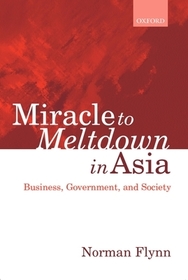
Miracle to Meltdown in Asia
Business, Government and Society
-
10% KEDVEZMÉNY?
- A kedvezmény csak az 'Értesítés a kedvenc témákról' hírlevelünk címzettjeinek rendeléseire érvényes.
- Kiadói listaár GBP 205.00
-
92 557 Ft (88 150 Ft + 5% áfa)
Az ár azért becsült, mert a rendelés pillanatában nem lehet pontosan tudni, hogy a beérkezéskor milyen lesz a forint árfolyama az adott termék eredeti devizájához képest. Ha a forint romlana, kissé többet, ha javulna, kissé kevesebbet kell majd fizetnie.
- Kedvezmény(ek) 10% (kb. 9 255 Ft)
- Kedvezményes ár 83 302 Ft (79 335 Ft + 5% áfa)
Iratkozzon fel most és részesüljön kedvezőbb árainkból!
Feliratkozom
92 557 Ft

Beszerezhetőség
Megrendelésre a kiadó utánnyomja a könyvet. Rendelhető, de a szokásosnál kicsit lassabban érkezik meg.
Why don't you give exact delivery time?
A beszerzés időigényét az eddigi tapasztalatokra alapozva adjuk meg. Azért becsült, mert a terméket külföldről hozzuk be, így a kiadó kiszolgálásának pillanatnyi gyorsaságától is függ. A megadottnál gyorsabb és lassabb szállítás is elképzelhető, de mindent megteszünk, hogy Ön a lehető leghamarabb jusson hozzá a termékhez.
A termék adatai:
- Kiadó OUP Oxford
- Megjelenés dátuma 1999. október 14.
- ISBN 9780198295525
- Kötéstípus Keménykötés
- Terjedelem180 oldal
- Méret 241x160x18 mm
- Súly 411 g
- Nyelv angol
- Illusztrációk line diagrams, 1 map 0
Kategóriák
Rövid leírás:
A fresh, informed, and careful analysis of the Asian crisis. How and why has the miracle of rapid economic growth and political and social stability given way to uncertainty and collapse? What can now be learnt from the business environment and governance systems of Asia? Norman Flynn examines the social, economic, and political modes of governance in the region, and shows us that special 'Asian' characteristics still exist to confront the powerful influences of globalization.
TöbbHosszú leírás:
The crisis in Asia has caused economic hardship and brought an end to the 'economic miracle' of fast economic growth in the region. This book asks whether the 1997/8 crisis marks a break with the past and signals an end to 'Asian' ways of running economies. During the period of rapid growth there were strong connections between governments and business in the region. 'Cronyism', or close connections between family, business, and government, was exposed when the stock markets and currencies dived. Pressure from overseas investors and international organizations has produced reforms in the region.
The book examines the social, economic, and political modes of governance in the region. It finds that there is a shifting balance between rule by the market, rule by connections, and rule by force. In the sphere of economic management, it shows that the period of the 'developmental state' in Japan and Korea has come to an end, but that it has not yet been replaced by a liberal market. Elsewhere the close connections between governments and business have been weakened but not yet broken. There are still special 'Asian' characteristics in economic management and in politics. The forces of 'Globalization' are strong, but they are confronted with political and economic cultures that are not rooted in liberal market ethics.
Tartalomjegyzék:
Introduction
1. Lessons from the Asian Crisis
What sort of 'miracles'?
How did the 'meltdown' happen?
Why did it happen?
Responses
Lessons
2. Expressive Relationships and Networks
Challenged assumptions
Expressive and instrumental ties
Mixed ties and networks
Implications
3. The Economy and the State
Intervention and the market
The 'developmental state'
'Good governance'
The development of the debate
Networks and economic development
The end of rule by connections?
4. The Final Victory of Globalization?
Homogenization
The supranational institutions
The global market
Globalization as power struggle
What is left for the state?
Global governance for a global economy?
5. Democracy, the Economy, and the Crisis
Democracy and the crisis
Democracy and the economy
Asian democracy?
6. The Family, the Company, and the State
Rights and obligations
Politics and culture
explanations of 'Asian' ways of welfare
The crisis
vulnerability of the self-reliant society in market downturns
7. Managing the Network State
Differences among states
Trends before the crisis
The crisis and public management
Convergence
the end of rule by connections?
Conclusions
Economy
Politics
Labour and welfare
Managing the state
After rule by force and rule by connections?
Stability
Global market rules?

