

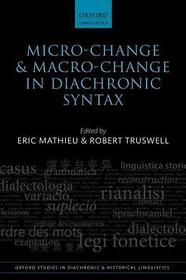
Micro-change and Macro-change in Diachronic Syntax
Sorozatcím: Oxford Studies in Diachronic and Historical Linguistics; 23;
-
10% KEDVEZMÉNY?
- A kedvezmény csak az 'Értesítés a kedvenc témákról' hírlevelünk címzettjeinek rendeléseire érvényes.
- Kiadói listaár GBP 127.50
-
60 913 Ft (58 012 Ft + 5% áfa)
Az ár azért becsült, mert a rendelés pillanatában nem lehet pontosan tudni, hogy a beérkezéskor milyen lesz a forint árfolyama az adott termék eredeti devizájához képest. Ha a forint romlana, kissé többet, ha javulna, kissé kevesebbet kell majd fizetnie.
- Kedvezmény(ek) 10% (cc. 6 091 Ft off)
- Kedvezményes ár 54 821 Ft (52 211 Ft + 5% áfa)
Iratkozzon fel most és részesüljön kedvezőbb árainkból!
Feliratkozom
60 913 Ft

Beszerezhetőség
Megrendelésre a kiadó utánnyomja a könyvet. Rendelhető, de a szokásosnál kicsit lassabban érkezik meg.
Why don't you give exact delivery time?
A beszerzés időigényét az eddigi tapasztalatokra alapozva adjuk meg. Azért becsült, mert a terméket külföldről hozzuk be, így a kiadó kiszolgálásának pillanatnyi gyorsaságától is függ. A megadottnál gyorsabb és lassabb szállítás is elképzelhető, de mindent megteszünk, hogy Ön a lehető leghamarabb jusson hozzá a termékhez.
A termék adatai:
- Kiadó OUP Oxford
- Megjelenés dátuma 2017. július 6.
- ISBN 9780198747840
- Kötéstípus Keménykötés
- Terjedelem348 oldal
- Méret 242x167x25 mm
- Súly 674 g
- Nyelv angol 0
Kategóriák
Rövid leírás:
This volume addresses syntactic change at the macro and the micro level, and explores how these different levels of change are related. It includes numerous case studies of changes in syntactic constructions including relative clauses, verb second, and negation, in a range of languages.
TöbbHosszú leírás:
The chapters in this volume address the process of syntactic change at different granularities. The language-particular component of a grammar is now usually assumed to be nothing more than the specification of the grammatical properties of a set of lexical items. Accordingly, grammar change must reduce to lexical change. And yet these micro-changes can cumulatively alter the typological character of a language (a macro-change). A central puzzle in diachronic syntax is how to relate macro-changes to micro-changes. Several chapters in this volume describe specific micro-changes: changes in the syntactic properties of a particular lexical item or class of lexical items. Other chapters explore links between micro-change and macro-change, using devices such as grammar competition at the individual and population level, recurring diachronic pathways, and links between acquisition biases and diachronic processes. This book is therefore a great companion to the recent literature on the micro- versus macro-approaches to parameters in synchronic syntax. One of its important contributions is the demonstration of how much we can learn about synchronic linguistics through the way languages change: the case studies included provide diachronic insight into many syntactic constructions that have been the target of extensive recent synchronic research, including tense, aspect, relative clauses, stylistic fronting, verb second, demonstratives, and negation. Languages discussed include several archaic and contemporary Romance and Germanic varieties, as well as Greek, Hungarian, and Chinese, among many others.
TöbbTartalomjegyzék:
Micro-change and macro-change in diachronic syntax
In defence of the child innovator
Where do relative specifiers come from?
Diachronic interpretations of word order parameter cohesion
The rise and fall of Hungarian complex tenses
Modelling transient states in language change
Modelling interactions between morphosyntactic changes
From Latin to Modern French: A punctuated shift
Case in diachrony: Or, why Greek is not English
Leftward Stylistic Displacement (LSD) in Medieval French
Diagnosing embedded V2 in Old English and Old French
The pragmatics of demonstratives in Germanic
Persistence as a diagnostic of grammatical status: The case of Middle English negation
The origins of the Romance analytic passive: Evidence from word order
Reconciling syntactic and post-syntactic complementizer agreement
On the grammaticalization of temporal-aspectual heads: The case of German versprechen 'promise'

