

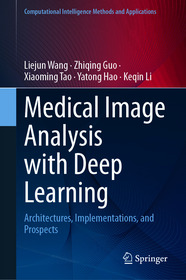
Medical Image Analysis with Deep Learning
Architectures, Implementations, and Prospects
Sorozatcím: Computational Intelligence Methods and Applications;
-
15% KEDVEZMÉNY?
- A kedvezmény csak az 'Értesítés a kedvenc témákról' hírlevelünk címzettjeinek rendeléseire érvényes.
- Kiadói listaár EUR 192.59
-
75 225 Ft (71 643 Ft + 5% áfa)
Az ár azért becsült, mert a rendelés pillanatában nem lehet pontosan tudni, hogy a beérkezéskor milyen lesz a forint árfolyama az adott termék eredeti devizájához képest. Ha a forint romlana, kissé többet, ha javulna, kissé kevesebbet kell majd fizetnie.
- Kedvezmény(ek) 12% (kb. 9 027 Ft)
- Kedvezményes ár 66 198 Ft (63 046 Ft + 5% áfa)
Iratkozzon fel most és részesüljön kedvezőbb árainkból!
Feliratkozom
66 198 Ft

Beszerezhetőség
Még nem jelent meg, de rendelhető. A megjelenéstől számított néhány héten belül megérkezik.
Why don't you give exact delivery time?
A beszerzés időigényét az eddigi tapasztalatokra alapozva adjuk meg. Azért becsült, mert a terméket külföldről hozzuk be, így a kiadó kiszolgálásának pillanatnyi gyorsaságától is függ. A megadottnál gyorsabb és lassabb szállítás is elképzelhető, de mindent megteszünk, hogy Ön a lehető leghamarabb jusson hozzá a termékhez.
A termék adatai:
- Kiadó Springer Nature Singapore
- Megjelenés dátuma 2026. szeptember 2.
- ISBN 9789819225477
- Kötéstípus Keménykötés
- Terjedelem208 oldal
- Méret 235x155 mm
- Nyelv angol
- Illusztrációk XII, 208 p. 85 illus., 83 illus. in color. 700
Kategóriák
Hosszú leírás:
Rapid advances in artificial intelligence have established medical image analysis as a cornerstone of intelligent healthcare. Deep learning techniques, including convolutional neural networks (CNNs), graph convolutional networks (GCNs), multi-layer perceptrons (MLPs), and vision transformers (ViTs) architectures, substantially enhance performance in medical image classification and segmentation. This progress advances diagnostic accuracy, robustness, and efficiency.
This book systematically surveys deep learning models for medical image analysis. It documents the evolution from MLPs and CNNs to hybrid attention architectures, with technical analysis of 9 recent methodologies. Core topics cover: multi-scale feature fusion, multi-branch CNN structures, graph-based feature modeling, region-aware attention mechanisms, adaptive positioning modules, and lightweight model design.
This book addresses: (1) MLP-based models for disease classification; (2) integrated CNN and ViT approaches for spatially contextualized learning; (3) GCNs for topological and relational representation; and (4) lightweight models for efficient deployment under resource constraints. Each chapter examines representative publications, summarizing methodological innovations, architectures, experimental results.
This work integrates theory with implementation, serving as a reference for researchers and professionals in medical imaging, computer-aided diagnosis, and biomedical AI. It establishes foundations for current deep learning paradigms and future development.
TöbbTartalomjegyzék:
.- Introduction
.- Technical Evolution in Medical Image Analysis
.- Multi-scale and Fusion-enhanced MLPs for Medical Image Classification
.- Hybrid CNN Transformer Models for Regional Representation in Medical Imaging Analysis
.- Graph Convolutional Networks for Structural Feature Integration
.- Lightweight Models for Efficient Medical Image Analysis
.- Conclusion and Future Prospects.
Több
