

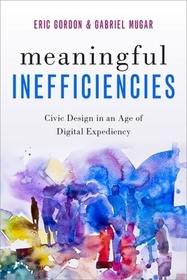
Meaningful Inefficiencies
Civic Design in an Age of Digital Expediency
-
10% KEDVEZMÉNY?
- A kedvezmény csak az 'Értesítés a kedvenc témákról' hírlevelünk címzettjeinek rendeléseire érvényes.
- Kiadói listaár GBP 102.50
-
46 278 Ft (44 075 Ft + 5% áfa)
Az ár azért becsült, mert a rendelés pillanatában nem lehet pontosan tudni, hogy a beérkezéskor milyen lesz a forint árfolyama az adott termék eredeti devizájához képest. Ha a forint romlana, kissé többet, ha javulna, kissé kevesebbet kell majd fizetnie.
- Kedvezmény(ek) 10% (kb. 4 627 Ft)
- Kedvezményes ár 41 651 Ft (39 668 Ft + 5% áfa)
Iratkozzon fel most és részesüljön kedvezőbb árainkból!
Feliratkozom
46 278 Ft

Beszerezhetőség
Megrendelésre a kiadó utánnyomja a könyvet. Rendelhető, de a szokásosnál kicsit lassabban érkezik meg.
Why don't you give exact delivery time?
A beszerzés időigényét az eddigi tapasztalatokra alapozva adjuk meg. Azért becsült, mert a terméket külföldről hozzuk be, így a kiadó kiszolgálásának pillanatnyi gyorsaságától is függ. A megadottnál gyorsabb és lassabb szállítás is elképzelhető, de mindent megteszünk, hogy Ön a lehető leghamarabb jusson hozzá a termékhez.
A termék adatai:
- Kiadó OUP USA
- Megjelenés dátuma 2020. március 26.
- ISBN 9780190870140
- Kötéstípus Keménykötés
- Terjedelem202 oldal
- Méret 224x146x19 mm
- Súly 332 g
- Nyelv angol 0
Kategóriák
Rövid leírás:
Meaningful Inefficiences describes an innovation culture within public serving organizations (government, news, civil society), where people, faced with silver bullet solutions involving big data and streamlined apps, are actually designing for trust. The resulting meaningful inefficiencies involve creating and nurturing inclusive, participatory, and accessible publics by opening up spaces for play and discussion.
TöbbHosszú leírás:
Public trust in the institutions that mediate civic life-from governing bodies to newsrooms-is low. In facing this challenge, many organizations assume that ensuring greater efficiency will build trust. As a result, these organizations are quick to adopt new technologies to enhance what they do, whether it's a new app or dashboard. However, efficiency, or charting a path to a goal with the least amount of friction, is not itself always built on a foundation of trust.
Meaningful Inefficiencies is about the practices undertaken by civic designers that challenge the normative applications of "smart technologies" in order to build or repair trust with publics. Based on over sixty interviews with change makers in public serving organizations throughout the United States, as well as detailed case studies, this book provides a practical and deeply philosophical picture of civic life in transition. The designers in this book are not professional designers, but practitioners embedded within organizations who have adopted an approach to public engagement Eric Gordon and Gabriel Mugar call "meaningful inefficiencies," or the deliberate design of less efficient over more efficient means of achieving some ends. This book illustrates how civic designers are creating meaningful inefficiencies within public serving organizations. It also encourages a rethinking of how innovation within these organizations is understood, applied, and sought after. Different than market innovation, civic innovation is not just about invention and novelty; it is concerned with building communities around novelty, and cultivating deep and persistent trust.
At its core, Meaningful Inefficiencies underlines that good civic innovation will never just involve one single public good, but must instead negotiate a plurality of publics. In doing so, it creates the conditions for those publics to play, resulting in people truly caring for the world. Meaningful Inefficiencies thus presents an emergent and vitally needed approach to creating civic life at a moment when smart and efficient are the dominant forces in social and organizational change.
Meaningful Inefficiencies is a valuable contribution to current debates and academic theory in the fields of communication and media studies.
Tartalomjegyzék:
Acknowledgements
Introduction
Chapter 1: Innovation
Chapter 2: Publics
Chapter 3: Play
Chapter 4: Care
Chapter 5: Practice
References
Index

