

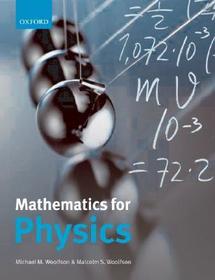
Mathematics for Physics
-
10% KEDVEZMÉNY?
- A kedvezmény csak az 'Értesítés a kedvenc témákról' hírlevelünk címzettjeinek rendeléseire érvényes.
- Kiadói listaár GBP 57.99
-
26 182 Ft (24 935 Ft + 5% áfa)
Az ár azért becsült, mert a rendelés pillanatában nem lehet pontosan tudni, hogy a beérkezéskor milyen lesz a forint árfolyama az adott termék eredeti devizájához képest. Ha a forint romlana, kissé többet, ha javulna, kissé kevesebbet kell majd fizetnie.
- Kedvezmény(ek) 10% (kb. 2 618 Ft)
- Kedvezményes ár 23 564 Ft (22 442 Ft + 5% áfa)
Iratkozzon fel most és részesüljön kedvezőbb árainkból!
Feliratkozom
26 182 Ft

Beszerezhetőség
Megrendelésre a kiadó utánnyomja a könyvet. Rendelhető, de a szokásosnál kicsit lassabban érkezik meg.
Why don't you give exact delivery time?
A beszerzés időigényét az eddigi tapasztalatokra alapozva adjuk meg. Azért becsült, mert a terméket külföldről hozzuk be, így a kiadó kiszolgálásának pillanatnyi gyorsaságától is függ. A megadottnál gyorsabb és lassabb szállítás is elképzelhető, de mindent megteszünk, hogy Ön a lehető leghamarabb jusson hozzá a termékhez.
A termék adatai:
- Kiadó OUP Oxford
- Megjelenés dátuma 2006. november 23.
- ISBN 9780199289295
- Kötéstípus Puhakötés
- Terjedelem806 oldal
- Méret 245x187x42 mm
- Súly 1535 g
- Nyelv angol
- Illusztrációk 360 black and white line drawings 0
Kategóriák
Rövid leírás:
Mathematics for Physics demonstrates the application of mathematical concepts alongside the development of the mathematical theory. This stimulating and motivating approach helps students to master the maths and see its application in the context of physics in one seamless learning experience.
TöbbHosszú leírás:
Mathematics is the essential language of science. It enables us to describe abstract physical concepts, and to apply these concepts in practical ways. Yet mathematical skills and concepts are an aspect of physics that many students fear the most.
Mathematics for Physics recognizes the challenges faced by students in equipping themselves with the maths skills necessary to gain a full understanding of physics. Working from basic yet fundamental principles, the book builds the students' confidence by leading them through the subject in a steady, progressive way.
As its primary aim, Mathematics for Physics shows the relevance of mathematics to the study of physics. Its unique approach demonstrates the application of mathematical concepts alongside the development of the mathematical theory. This stimulating and motivating approach helps students to master the maths and see its application in the context of physics in one seamless learning experience.
Mathematics is a subject mastered most readily through active learning. Mathematics for Physics features both print and online support, with many in-text exercises and end-of-chapter problems, and web-based computer programs, to both stimulate learning and build understanding.
Mathematics for Physics is the perfect introduction to the essential mathematical concepts which all physics students should master.
This stimulating and informative text effortlessly combines theory and application. I would recommend this low-cost book to undergraduate physical science students and it would be a handy reference source for professionals alike.
Tartalomjegyzék:
Preface
Useful formulae and relationships
Dimensions and dimensional analysis
Sequences and series
Differentiation
Integration
Complex numbers
Ordinary differential equations
Matrices I and determinants
Vector algebra
Conic sections and orbits
Partial differentiation
Probability and statistics
Coordinate systems and multiple integration
Distributions I
Hyperbolic functions
Vector analysis
Fourier analysis
Introduction to digital signal processing
Numerical methods for ordinary differential equations
Applications of partial differential equations
Quantum mechanic I: The Schrödinger wave equation and observations
The Maxwell-Boltzmann distribution
The Monte-Carlo method
Matrices II
Quantum mechanics II: Angular momentum and spin
Sampling theory
Straight-line relationships and the linear correlation coefficient
Interpolation
Quadrature
Linear equations
The numerical solution of equations
Signals and noise
Digital filters
Introduction to estimation theory
Linear programming and optimization
Laplace transforms
Networks
Simulation with particles
Chaos and physical calculations
Appendices
Solutions to Exercises and Problems
Index

