

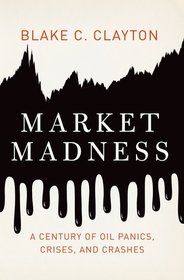
Market Madness
A Century of Oil Panics, Crises, and Crashes
-
10% KEDVEZMÉNY?
- A kedvezmény csak az 'Értesítés a kedvenc témákról' hírlevelünk címzettjeinek rendeléseire érvényes.
- Kiadói listaár GBP 26.99
-
12 185 Ft (11 605 Ft + 5% áfa)
Az ár azért becsült, mert a rendelés pillanatában nem lehet pontosan tudni, hogy a beérkezéskor milyen lesz a forint árfolyama az adott termék eredeti devizájához képest. Ha a forint romlana, kissé többet, ha javulna, kissé kevesebbet kell majd fizetnie.
- Kedvezmény(ek) 10% (kb. 1 218 Ft)
- Kedvezményes ár 10 967 Ft (10 445 Ft + 5% áfa)
Iratkozzon fel most és részesüljön kedvezőbb árainkból!
Feliratkozom
12 185 Ft

Beszerezhetőség
Megrendelésre a kiadó utánnyomja a könyvet. Rendelhető, de a szokásosnál kicsit lassabban érkezik meg.
Why don't you give exact delivery time?
A beszerzés időigényét az eddigi tapasztalatokra alapozva adjuk meg. Azért becsült, mert a terméket külföldről hozzuk be, így a kiadó kiszolgálásának pillanatnyi gyorsaságától is függ. A megadottnál gyorsabb és lassabb szállítás is elképzelhető, de mindent megteszünk, hogy Ön a lehető leghamarabb jusson hozzá a termékhez.
A termék adatai:
- Kiadó OUP USA
- Megjelenés dátuma 2015. február 19.
- ISBN 9780199990054
- Kötéstípus Keménykötés
- Terjedelem248 oldal
- Méret 236x157x22 mm
- Súly 454 g
- Nyelv angol 0
Kategóriák
Rövid leírás:
In Market Madness: A Century of Oil Panics, Crises, and Crashes, Blake Clayton uses four historical case studies to document claims about the future of the U.S. oil supply and discuss their impact on the market and policymaking. He explores the conditions in which oil supply fears arise, gain popularity, and eventually wane, and shows how important such stories can be in affecting financial markets. He takes an innovative approach commonly used to assess the role of "irrational exuberance" in the technology and housing markets to determine how unfounded pessimism affects markets in oil and other exhaustible resources.
TöbbHosszú leírás:
Stock market booms are cause for celebration. But when oil prices soar because supplies are failing to keep up with demand, the response is nearly always apocalyptic. Predictions of the end of oil can create anxiety on Wall Street and in Washington, stoking fears that production has hit a ceiling and prices will rise in perpetuity. Yet these dire visions have always proven wrong.
Market Madness is the story of four waves of American anxiety over the last 100 years about a looming end to oil reserves. Their sweeping pattern-as large price increases lead to widespread shortage fears that eventually dissipate when oil production rises again and prices moderate-has defined the wild price swings in the oil market down to the present day.
Blake Clayton, a Wall Street stock analyst and adjunct fellow at the Council on Foreign Relations, makes the case for the need for better information, communication and transparency. While these measures will not eliminate volatility and unpredictability completely, they would mitigate unnecessary price spikes and improve both investor and government decision-making.
Market Madness is the first study to employ Nobel Laureate economist Robert Shiller's "new era economics" beyond the markets to which he famously applied it-the 1990s dot-com equity market and the mid-2000s housing market-in order to better understand the dynamics of speculative bubbles and irrationality in the commodities markets. In so doing, it breaks new ground in illuminating how mass beliefs about the future of a vital asset like oil take shape and what the future of energy may hold.
Tartalomjegyzék:
1. Introduction
2. "A National Crisis of the First Magnitude": The United States Geological Survey in an Era of Booming Demand, 1909-1927
3. "A New Era of Scarcity and Higher Prices": Wartime Demand and the End of American Self-Reliance in Oil, 1940-1949
4. "A Problem Unprecedented in Our History": American Anxiety in the Early Days of OPEC, 1970-1986
5. "A Permanent Radical Rise in Oil Prices": Peak Oil Takes Wall Street, 1998-2013
6. Conclusion

