

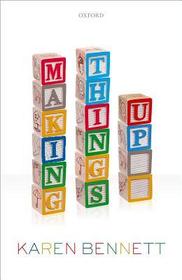
Making Things Up
-
10% KEDVEZMÉNY?
- A kedvezmény csak az 'Értesítés a kedvenc témákról' hírlevelünk címzettjeinek rendeléseire érvényes.
- Kiadói listaár GBP 91.00
-
43 475 Ft (41 405 Ft + 5% áfa)
Az ár azért becsült, mert a rendelés pillanatában nem lehet pontosan tudni, hogy a beérkezéskor milyen lesz a forint árfolyama az adott termék eredeti devizájához képest. Ha a forint romlana, kissé többet, ha javulna, kissé kevesebbet kell majd fizetnie.
- Kedvezmény(ek) 10% (cc. 4 348 Ft off)
- Kedvezményes ár 39 128 Ft (37 265 Ft + 5% áfa)
Iratkozzon fel most és részesüljön kedvezőbb árainkból!
Feliratkozom
43 475 Ft

Beszerezhetőség
Megrendelésre a kiadó utánnyomja a könyvet. Rendelhető, de a szokásosnál kicsit lassabban érkezik meg.
Why don't you give exact delivery time?
A beszerzés időigényét az eddigi tapasztalatokra alapozva adjuk meg. Azért becsült, mert a terméket külföldről hozzuk be, így a kiadó kiszolgálásának pillanatnyi gyorsaságától is függ. A megadottnál gyorsabb és lassabb szállítás is elképzelhető, de mindent megteszünk, hogy Ön a lehető leghamarabb jusson hozzá a termékhez.
A termék adatai:
- Kiadó OUP Oxford
- Megjelenés dátuma 2017. június 1.
- ISBN 9780199682683
- Kötéstípus Keménykötés
- Terjedelem274 oldal
- Méret 240x161x21 mm
- Súly 556 g
- Nyelv angol 0
Kategóriák
Rövid leírás:
We frequently speak of certain things or phenomena being built out of or based in others. Making Things Up concerns these relations, which connect more fundamental things to less fundamental things: Karen Bennett calls these 'building relations'. She aims to illuminate what it means to say that one thing is more fundamental than another.
TöbbHosszú leírás:
A certain kind of talk is ubiquitous among both philosophers and so-called "ordinary people": talk of one phenomenon generating or giving rise to another, or talk of one phenomenon being based in or constructed from another. For example, your computer screen is built of atoms in a complex configuration, and the picture on the screen is based in the local illumination of various individual pixels. Karen Bennett calls the family of relations invoked by such talk 'building relations'. Grounding is one currently popular such relation; so too are composition, property realization, and-controversially-causation. In chapters 2 and 3 Bennett argues that despite their differences, building relations form an interestingly unified family, and characterizes what all building relations have in common. In chapter 4 she argues that it's a mistake to think there is a strict divide between causal and noncausal determination. Chapters 5 and 6 turn to the connections between building and fundamentality. Bennett argues at length that both absolute and relative fundamentality are best understood in terms of building, and that to say that one thing is more fundamental than another is to say no more than that certain patterns of building obtain. In chapter 7 Bennett argues that facts about what builds what must be themselves built: if a builds b, there is something in virtue of which that is the case. She also argues that the answer is a itself. Finally, in chapter 8 she defends an assumption that runs throughout the rest of the book, namely that there indeed are nonfundamental, built entities. Doing so involves substantive discussion about the scope of Ockham's Razor. Bennett argues that some nonfundamentalia are among the proper subject-matter of metaphysics, and thus that metaphysics is not best understood as the study of the fundamental nature of reality.
Karen Bennett's Making Things Up is a well-written, engaging, and meaningful contribution to the ever-growing literature on metaphysical grounding and fundamentality.
Tartalomjegyzék:
Introduction
Building I: Breaking Ground
Building II: Characterizing the Class
Causing
Absolute Fundamentality
Relative Fundamentality
Building Building?
In Defense of the Nonfundamental

