

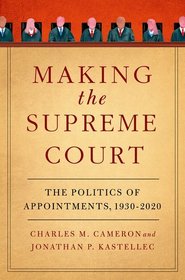
Making the Supreme Court
The Politics of Appointments, 1930-2020
-
10% KEDVEZMÉNY?
- A kedvezmény csak az 'Értesítés a kedvenc témákról' hírlevelünk címzettjeinek rendeléseire érvényes.
- Kiadói listaár GBP 91.00
-
41 086 Ft (39 130 Ft + 5% áfa)
Az ár azért becsült, mert a rendelés pillanatában nem lehet pontosan tudni, hogy a beérkezéskor milyen lesz a forint árfolyama az adott termék eredeti devizájához képest. Ha a forint romlana, kissé többet, ha javulna, kissé kevesebbet kell majd fizetnie.
- Kedvezmény(ek) 10% (cc. 4 109 Ft off)
- Kedvezményes ár 36 978 Ft (35 217 Ft + 5% áfa)
Iratkozzon fel most és részesüljön kedvezőbb árainkból!
Feliratkozom
41 086 Ft

Beszerezhetőség
Megrendelésre a kiadó utánnyomja a könyvet. Rendelhető, de a szokásosnál kicsit lassabban érkezik meg.
Why don't you give exact delivery time?
A beszerzés időigényét az eddigi tapasztalatokra alapozva adjuk meg. Azért becsült, mert a terméket külföldről hozzuk be, így a kiadó kiszolgálásának pillanatnyi gyorsaságától is függ. A megadottnál gyorsabb és lassabb szállítás is elképzelhető, de mindent megteszünk, hogy Ön a lehető leghamarabb jusson hozzá a termékhez.
A termék adatai:
- Kiadó OUP USA
- Megjelenés dátuma 2024. január 11.
- ISBN 9780197680537
- Kötéstípus Keménykötés
- Terjedelem504 oldal
- Méret 163x239x23 mm
- Súly 771 g
- Nyelv angol 453
Kategóriák
Rövid leírás:
In Making the Supreme Court, Charles M. Cameron and Jonathan P. Kastellec examine 90 years of American political history to show how the growth of federal judicial power from the 1930s onward inspired a multitude of groups struggling to shape judicial policy. As Cameron and Kastellec argue, the result is a new politics aimed squarely at selecting and placing judicial ideologues on the Court. They make the case that this new model gradually transformed how the Court itself operates, turning it into an ideologically driven and polarized branch. Based on rich data and qualitative evidence, Making the Supreme Court provides a sharp lens on the social and political transformations that created a new American politics.
TöbbHosszú leírás:
Appointments to the United States Supreme Court are now central events in American political life. Every vacancy unleashes a bitter struggle between Republicans and Democrats over nominees; and once the seat is filled, new justices typically vote in predictable ways. However, this has not always been the case. As late as the middle of the twentieth century, presidents invested little time and effort in finding and vetting nominees, often selecting personal cronies, who senators briskly confirmed. Media coverage was desultory, public opinion was largely non-existent, and the justices often voted independently and erratically.
In Making the Supreme Court, Charles M. Cameron and Jonathan P. Kastellec examine 90 years of American political history to show how the growth of federal judicial power from the 1930s onward inspired a multitude of groups struggling to shape judicial policy. Over time, some groups moved beyond lobbying the Court to changing who sits on it. Other groups formed expressly to influence appointments. These activists and organized groups penetrated the national party system so that after about 1980, presidential candidates increasingly pledged to select and confirm nominees who conformed to specific policy and ideological litmus tests. Once in office, these presidents re-shaped the executive selection system to deliver on their promises. Moreover, the selection process for justices turned into media events, often fueled by controversy. As Cameron and Kastellec argue, the result is a new politics aimed squarely at selecting and placing judicial ideologues on the Court. They make the case that this new model gradually transformed how the Court itself operates, turning it into an ideologically driven and polarized branch. Based on rich data and qualitative evidence, Making the Supreme Court provides a sharp lens on the social and political transformations that created a new American politics.
The book's discussion of the evolution of procedural dynamics is supported by relevant graphs, tables, and surveys. This book will become a classic illustration of the use of empirical analysis for explaining public policy.
Tartalomjegyzék:
I. What Happened
Then and Now
The Party Demands: Party Agendas for the Supreme Court
Selecting How to Select: Presidents and Organizational Design
The Candidates for the Court and the Nominees
Interest Groups
The Media, co-authored with Leeann Bass and Julian Dean
Public Opinion
Decision in the Senate
II. Why it Happened
The Logic of Presidential Selection, co-authored with Lauren Mattioli
What the Public Wanted
Voting in the Shadow of Accountability: Senators' Confirmation Decisions
III. How It Matters, and What the Future Holds
New Politics, New Justices, New Policies: The Courts That Politics Made
The Future: The Courts that Politics May Make
What Future Do We Want? Evaluating Judicial Independence
Conclusion

