

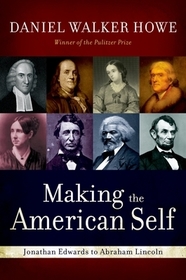
Making the American Self
Jonathan Edwards to Abraham Lincoln
-
10% KEDVEZMÉNY?
- A kedvezmény csak az 'Értesítés a kedvenc témákról' hírlevelünk címzettjeinek rendeléseire érvényes.
- Kiadói listaár GBP 19.99
-
9 025 Ft (8 595 Ft + 5% áfa)
Az ár azért becsült, mert a rendelés pillanatában nem lehet pontosan tudni, hogy a beérkezéskor milyen lesz a forint árfolyama az adott termék eredeti devizájához képest. Ha a forint romlana, kissé többet, ha javulna, kissé kevesebbet kell majd fizetnie.
- Kedvezmény(ek) 10% (kb. 903 Ft)
- Kedvezményes ár 8 122 Ft (7 736 Ft + 5% áfa)
Iratkozzon fel most és részesüljön kedvezőbb árainkból!
Feliratkozom
9 025 Ft

Beszerezhetőség
Megrendelésre a kiadó utánnyomja a könyvet. Rendelhető, de a szokásosnál kicsit lassabban érkezik meg.
Why don't you give exact delivery time?
A beszerzés időigényét az eddigi tapasztalatokra alapozva adjuk meg. Azért becsült, mert a terméket külföldről hozzuk be, így a kiadó kiszolgálásának pillanatnyi gyorsaságától is függ. A megadottnál gyorsabb és lassabb szállítás is elképzelhető, de mindent megteszünk, hogy Ön a lehető leghamarabb jusson hozzá a termékhez.
A termék adatai:
- Kiadó OUP USA
- Megjelenés dátuma 2009. október 15.
- ISBN 9780195387896
- Kötéstípus Puhakötés
- Terjedelem352 oldal
- Méret 231x155x20 mm
- Súly 499 g
- Nyelv angol 0
Kategóriák
Rövid leírás:
Many early Americans sought the opportunity to "make something of themselves"-not only to choose an occupation but to fulfill their potential, to engage in "self-improvement." This book reconstructs their project from the time of Jonathan Edwards and Benjamin Franklin to that of Abraham Lincoln, Margaret Fuller, and Frederick Douglass.
TöbbHosszú leírás:
Originally published in 1997 and now back in print, Making the American Self by Daniel Walker Howe, the Pulitzer Prize-winning author of What Hath God Wrought, charts the genesis and fascinating trajectory of a central idea in American history.
One of the most precious liberties Americans have always cherished is the ability to "make something of themselves"--to choose not only an occupation but an identity. Examining works by Benjamin Franklin, Jonathan Edwards, Abraham Lincoln, Frederick Douglass, Henry David Thoreau, Ralph Waldo Emerson, Margaret Fuller, and others, Howe investigates how Americans in the 18th and 19th centuries engaged in the process of "self-construction," "self-improvement," and the "pursuit of happiness." He explores as well how Americans understood individual identity in relation to the larger body politic, and argues that the conscious construction of the autonomous self was in fact essential to American democracy--that it both shaped and was in turn shaped by American democratic institutions. "The thinkers described in this book," Howe writes, "believed that, to the extent individuals exercised self-control, they were making free institutions--liberal, republican, and democratic--possible." And as the scope of American democracy widened so too did the practice of self-construction, moving beyond the preserve of elite white males to potentially all Americans. Howe concludes that the time has come to ground our democracy once again in habits of personal responsibility, civility, and self-discipline esteemed by some of America's most important thinkers.
Erudite, beautifully written, and more pertinent than ever as we enter a new era of individual and governmental responsibility, Making the American Self illuminates an impulse at the very heart of the American experience.
Tartalomjegyzék:
Introduction
I Virtue and Passion in the American Enlightenment
Benjamin Franklin, Jonathan Edwards, and the Problem of Human Nature
The American Founders and the Scottish Enlightenment
The Political Psychology of The Federalist
II Constructing Character in Antebellum America
The Emerging Ideal of Self-Improvement
Self-Made Men: Abraham Lincoln and Frederick Douglass
Shaping the Selves of Others
III The Cultivation of the Self Among the New England Romantics
The Platonic Quest in New England
Margaret Fuller's Heroic Ideal of Womanhood
The Constructed Self Against the State
Conclusion
Notes

