

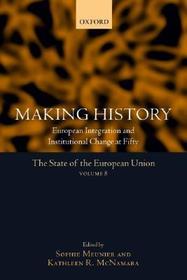
Making History
European Integration and Institutional Change at Fifty
-
10% KEDVEZMÉNY?
- A kedvezmény csak az 'Értesítés a kedvenc témákról' hírlevelünk címzettjeinek rendeléseire érvényes.
- Kiadói listaár GBP 94.00
-
42 441 Ft (40 420 Ft + 5% áfa)
Az ár azért becsült, mert a rendelés pillanatában nem lehet pontosan tudni, hogy a beérkezéskor milyen lesz a forint árfolyama az adott termék eredeti devizájához képest. Ha a forint romlana, kissé többet, ha javulna, kissé kevesebbet kell majd fizetnie.
- Kedvezmény(ek) 10% (cc. 4 244 Ft off)
- Kedvezményes ár 38 197 Ft (36 378 Ft + 5% áfa)
Iratkozzon fel most és részesüljön kedvezőbb árainkból!
Feliratkozom
42 441 Ft

Beszerezhetőség
Megrendelésre a kiadó utánnyomja a könyvet. Rendelhető, de a szokásosnál kicsit lassabban érkezik meg.
Why don't you give exact delivery time?
A beszerzés időigényét az eddigi tapasztalatokra alapozva adjuk meg. Azért becsült, mert a terméket külföldről hozzuk be, így a kiadó kiszolgálásának pillanatnyi gyorsaságától is függ. A megadottnál gyorsabb és lassabb szállítás is elképzelhető, de mindent megteszünk, hogy Ön a lehető leghamarabb jusson hozzá a termékhez.
A termék adatai:
- Kiadás sorszáma és címe Making History v. 8
- Kiadó OUP Oxford
- Megjelenés dátuma 2007. május 24.
- ISBN 9780199218684
- Kötéstípus Puhakötés
- Terjedelem376 oldal
- Méret 233x156x21 mm
- Súly 577 g
- Nyelv angol 0
Kategóriák
Rövid leírás:
The contributors to this volume, all leading specialists in the field of EU studies, examine the trajectory of the EU and draw on the theoretical tools of historical institutionalism to assess the central political challenges facing the EU.
TöbbHosszú leírás:
Fifty years ago, the leaders of six European states signed the Treaty of Rome, creating the European Economic Community and launching the process of European integration. From that starting point evolved today's European Union (EU), the most successful example of institutionalized political cooperation in history. The EU now encompasses a much broader array of responsibilities than originally planned, its membership has widened to 25 countries, and its legislation and jurisprudence has come to supersede national law. Contestation has accompanied success, however, and the intense debate in many European countries over the EU Constitution throughout the course of 2005 revealed deep divisions between and within European countries around issues such as EU institutions, the elusive European identity, a European economic malaise, and the role of the EU as a world power. Was the constitutional crisis a turning point for European integration? This volume argues that the EU today may be at a crossroads--not because of the failed referenda but rather because of the unresolved tensions in European governance not banished with the referenda's defeat. Meunier and McNamara's collection is the first to comprehensively examine these challenging issues using the tools of historical institutionalism to analyze the past and future political and institutional trajectory of the European Union across a wide variety of policy areas. Together, the volume's authors provide a remarkably coherent theoretical approach to the key questions facing Europe, drawing a portrait of the EU today that reveals a robust, but not invulnerable, set of institutions and practices
TöbbTartalomjegyzék:
Introduction
Part 1 The Past and Future of European Institutional Integration
The European Constitutional Settlement
Built to Last? The Durability of EU Federalism
Informal Decision-Making in the Council: The Secret of the EU's Success?
The Theory and Reality of the European Coal and Steel Community
Historical Institutionalism and the EU's Eastward Enlargement
Part 2 The Politics of Markets
Protecting Privacy in Europe: Administrative Feedbacks and Regional Politics
Financial Transformation in the European Union
The European Company Statute and the Governance Dilemma
The Politics of Competition and Institutional Change in European Union: The First Fifty Years
A Historical Institutionalist Analysis of the Road to Economic and Monetary Union: A Journey with Many Crossroads
Part 3 Law and Society
The Constitutionalization of the European Union: Explaining the Parliamentarization and Institutionalization of Human Rights
The Evolution of EU Citizenship
EU Social Policy, or, How Far Up Do You Like Your Safety Net?
Part 4 The EU as a Sovereign State in World Politics
Understanding the European Union as a Global Political Actor: Theory, Practice, and Impact
Trade and Transatlantic Relations: Old Dogs and New Tricks
From EU Model to External Policy?

