

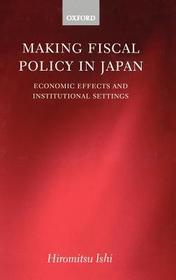
Making Fiscal Policy in Japan
Economic Effects and Institutional Settings
-
10% KEDVEZMÉNY?
- A kedvezmény csak az 'Értesítés a kedvenc témákról' hírlevelünk címzettjeinek rendeléseire érvényes.
- Kiadói listaár GBP 165.00
-
78 828 Ft (75 075 Ft + 5% áfa)
Az ár azért becsült, mert a rendelés pillanatában nem lehet pontosan tudni, hogy a beérkezéskor milyen lesz a forint árfolyama az adott termék eredeti devizájához képest. Ha a forint romlana, kissé többet, ha javulna, kissé kevesebbet kell majd fizetnie.
- Kedvezmény(ek) 10% (cc. 7 883 Ft off)
- Kedvezményes ár 70 946 Ft (67 568 Ft + 5% áfa)
Iratkozzon fel most és részesüljön kedvezőbb árainkból!
Feliratkozom
78 828 Ft

Beszerezhetőség
Megrendelésre a kiadó utánnyomja a könyvet. Rendelhető, de a szokásosnál kicsit lassabban érkezik meg.
Why don't you give exact delivery time?
A beszerzés időigényét az eddigi tapasztalatokra alapozva adjuk meg. Azért becsült, mert a terméket külföldről hozzuk be, így a kiadó kiszolgálásának pillanatnyi gyorsaságától is függ. A megadottnál gyorsabb és lassabb szállítás is elképzelhető, de mindent megteszünk, hogy Ön a lehető leghamarabb jusson hozzá a termékhez.
A termék adatai:
- Kiadó OUP Oxford
- Megjelenés dátuma 2000. december 7.
- ISBN 9780199240715
- Kötéstípus Keménykötés
- Terjedelem370 oldal
- Méret 242x164x24 mm
- Súly 700 g
- Nyelv angol
- Illusztrációk line figures, tables 0
Kategóriák
Rövid leírás:
Making Fiscal Policy in Japan is written for those who want to understand the role and performance of fiscal policy as an integral component of macroeconomic policy, and the attendant effects on economic growth. Ishi traces and analyses the central features of postwar Japanese fiscal policy and considers the institutional framework and policy objectives which shaped the budget process. The overall conclusion is that the Japanese government has been generally passive in guiding the state's economic activities, using fiscal policy to support the private market economy rather than directly to influence the economy through deliberate expenditure and tax policies.
TöbbHosszú leírás:
Making Fiscal Policy in Japan is written for those who want to understand the role and performance of fiscal policy as an integral component of macroeconomic policy, and the attendant effects on economic growth. The case explored here is post-Second World War Japan, but the approach is one of international comparison. Ishi traces and analyses the central features of postwar Japanese fiscal policy and considers the institutional framework and policy objectives which shaped the budget process. The first part of the book provides a detailed overview of the topic, with detailed institutional and empirical information. In particular, the role that government played in Japan's postwar economic growth is explored in depth, with specific focus on the four sub-periods of occupation, rapid economic growth, internationalization, and the bubble economy. Part II explains the basic framework of budgets, the budgetary process in Japan, and fundamental strategies of fiscal authority. It looks in depth at the unique aspects of the balanced budget policy for 1953-65 and then at how financial resources for budgeting were automatically generated in a growing economy. The final part analyses specific policy issues in the public sector, among them human resource development, the ageing population and the social security system, tax incentives for export promotion, the Fiscal Investment and Loan Programme, and intergovernmental grant policy. Ishi argues that the Japanese government has been generally passive in guiding the state's economic activities, using fiscal policy to support the private economy rather than directly to influence the economy through deliberate expenditure and tax policies. The approach has been one of enhancing the market rather than of government intervention.
Ishi provides the reader with important insights into why things worked well in the past but have gone terribly wrong more recently ... the volume provides important background for those seeking to understand how fiscal policy-making has worked in the past in Japan. Moreover, in clarifying the nature of this process, the volume helps illuminate the salience of changes either underway or at the centre of debate today.
Tartalomjegyzék:
Part I. Overview: The Policy Environment
The Preconditions for Post-war Economic Growth
Rapid Economic Growth and Its Effects
Structural Changes Towards a New Dimension
The Emergence of the Bubble Economy and its Aftermath
Part II. Fiscal Policy Responses
Budget and Budgetary Process
Budget Orthodoxy and Strategies of Fiscal Consolidation
An Empirical Analysis of Balanced Budget Policy, 1953-1965
How Financial Sources were Generated in a Growing Economy
Part III. Specific Aspects of Budgetary Activity
Public Expenditure Trends in Light of Human Resource Development
Ageing and the Social Security System
Tax Policy for Export Promotion, 1953-1964
The Role of the Fiscal Investment and Loan Programme
The Budgetary Behaviour of Local Government and Intergovernmental Grant Policies

