

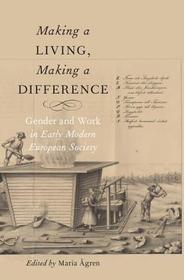
Making a Living, Making a Difference
Gender and Work in Early Modern European Society
-
10% KEDVEZMÉNY?
- A kedvezmény csak az 'Értesítés a kedvenc témákról' hírlevelünk címzettjeinek rendeléseire érvényes.
- Kiadói listaár GBP 52.00
-
23 478 Ft (22 360 Ft + 5% áfa)
Az ár azért becsült, mert a rendelés pillanatában nem lehet pontosan tudni, hogy a beérkezéskor milyen lesz a forint árfolyama az adott termék eredeti devizájához képest. Ha a forint romlana, kissé többet, ha javulna, kissé kevesebbet kell majd fizetnie.
- Kedvezmény(ek) 10% (cc. 2 348 Ft off)
- Kedvezményes ár 21 130 Ft (20 124 Ft + 5% áfa)
Iratkozzon fel most és részesüljön kedvezőbb árainkból!
Feliratkozom
23 478 Ft

Beszerezhetőség
Megrendelésre a kiadó utánnyomja a könyvet. Rendelhető, de a szokásosnál kicsit lassabban érkezik meg.
Why don't you give exact delivery time?
A beszerzés időigényét az eddigi tapasztalatokra alapozva adjuk meg. Azért becsült, mert a terméket külföldről hozzuk be, így a kiadó kiszolgálásának pillanatnyi gyorsaságától is függ. A megadottnál gyorsabb és lassabb szállítás is elképzelhető, de mindent megteszünk, hogy Ön a lehető leghamarabb jusson hozzá a termékhez.
A termék adatai:
- Kiadó OUP USA
- Megjelenés dátuma 2017. január 5.
- ISBN 9780190240622
- Kötéstípus Puhakötés
- Terjedelem274 oldal
- Méret 231x155x17 mm
- Súly 431 g
- Nyelv angol
- Illusztrációk 14 illus. 30
Kategóriák
Rövid leírás:
Making a Living, Making a Difference offers an eye-opening perspective on what men and women in early modern European society did all day. Based on an innovative method and a large data collection of everyday activities, the authors show the ways in which gender and work were linked in early modern society by revealing household, unpaid, and hidden, as well as paid labor.
TöbbHosszú leírás:
What do people do all day? What did women and men do to make a living in early modern Europe, and what did their work mean? As this book shows, the meanings depended both on the worker and on the context.
With an innovative analytic method that is yoked to a specially-built database of source materials, this book revises many received opinions about the history of gender and work in Europe. The applied verb-oriented method finds the 'work verbs' that appear incidentally in a wide variety of early modern sources and then analyzes the context in which they appear. By tying information technologies and computer-assisted analysis to the analytic powers - both quantitative and qualitative - of professional historians, the method gets much closer to a participatory observation of the micro-patterns of early modern life than was once believed possible.
It directly addresses a number of broad problems often debated by historians of gender and early modern Europe. First, it discusses the problem of assessing more accurately the incidence, character and division of work. Second, it analyzes the configurations of work and human difference. Third, it deals with the extent to which work practices created notions of difference - gender difference but also other forms of difference - and, conversely, to what extent work practices contributed to notions of sameness and gender convergence. Finally, it studies the impact of processes of change. Drawing on sources from Sweden, the authors show the importance of multiple employment, the openness of early modern households, the significance of marriage and marital status, the gendered nature of specific tasks, and the ways in which state formation and commercialization were entangled in people's everyday lives.
By shedding light on work and gender in a relatively poorly known kingdom that was a major power in the early modern period, this book makes a valuable contribution to the comparative study of early modern women.
Tartalomjegyzék:
Acknowledgments
Contributors
Introduction: Making a Living, Making a Difference- Maria ÅÅgren
Chapter 1: The Diversity of Work- Jonas Lindström, Rosemarie Fiebranz, and Göran Rydén
Chapter 2: Working Together- Dag Lindström, Rosemarie Fiebranz, Jonas Lindström, Jan Mispelaere, and Göran Rydén
Chapter 3: Marriage and Work: Intertwined Sources of Agency and Authority- Sofia Ling, Karin Hassan Jansson, Marie Lennersand, Christopher Pihl, and Maria Ågren
Chapter 4: Less than Ideal? Making a Living Before and Outside Marriage- Hanna Östholm and Cristina Prytz
Chapter 5: Constitutive Tasks: Performances of Hierarchy and Identity- Karin Hassan Jansson, Rosemarie Fiebranz, and Ann-Catrin Östman
Chapter 6: The Dark Side of the Ubiquity of Work: Vulnerability and Destitution among the Elderly- Erik Lindberg, Benny Jacobsson, and Sofia Ling
Chapter 7: Gender, Work, and the Fiscal-Military State- Marie Lennersand, Jan Mispelaere, Christopher Pihl, and Maria Ågren
Chapter 8: Conclusion- Maria Ågren
Appendix
Bibliography
Index

