

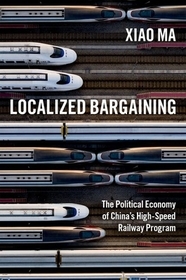
Localized Bargaining
The Political Economy of China's High-Speed Railway Program
-
10% KEDVEZMÉNY?
- A kedvezmény csak az 'Értesítés a kedvenc témákról' hírlevelünk címzettjeinek rendeléseire érvényes.
- Kiadói listaár GBP 93.00
-
41 989 Ft (39 990 Ft + 5% áfa)
Az ár azért becsült, mert a rendelés pillanatában nem lehet pontosan tudni, hogy a beérkezéskor milyen lesz a forint árfolyama az adott termék eredeti devizájához képest. Ha a forint romlana, kissé többet, ha javulna, kissé kevesebbet kell majd fizetnie.
- Kedvezmény(ek) 10% (cc. 4 199 Ft off)
- Kedvezményes ár 37 791 Ft (35 991 Ft + 5% áfa)
Iratkozzon fel most és részesüljön kedvezőbb árainkból!
Feliratkozom
41 989 Ft

Beszerezhetőség
Becsült beszerzési idő: A Prosperónál jelenleg nincsen raktáron, de a kiadónál igen. Beszerzés kb. 3-5 hét..
A Prosperónál jelenleg nincsen raktáron.
Why don't you give exact delivery time?
A beszerzés időigényét az eddigi tapasztalatokra alapozva adjuk meg. Azért becsült, mert a terméket külföldről hozzuk be, így a kiadó kiszolgálásának pillanatnyi gyorsaságától is függ. A megadottnál gyorsabb és lassabb szállítás is elképzelhető, de mindent megteszünk, hogy Ön a lehető leghamarabb jusson hozzá a termékhez.
A termék adatai:
- Kiadó OUP USA
- Megjelenés dátuma 2022. július 7.
- ISBN 9780197638910
- Kötéstípus Keménykötés
- Terjedelem244 oldal
- Méret 159x241x18 mm
- Súly 481 g
- Nyelv angol
- Illusztrációk 7 figures; 31 tables 210
Kategóriák
Rövid leírás:
In Localized Bargaining, Xiao Ma offers a rich description and a novel theory of intergovernmental bargaining that explains the unfolding of China's high-speed railway. He shows that the bottom-up bargaining efforts by territorial authorities--whom the central bureaucracies rely on to implement various infrastructure projects--shaped the allocation of investment in the railway system. Demonstrating how localities of different types invoke institutional and extra-institutional sources of bargaining power in their competition for railway stations, Ma sheds new light on the how the nation's massive economy actually functions.
TöbbHosszú leírás:
Looks at the rollout of one of the largest infrastructure programs in human history to show how local governments play a complex role.
China's high-speed railway network is one of the largest infrastructure programs in human history. Despite global media coverage, we know very little about the political process that led the government to invest in the railway program and the reasons for the striking regional and temporal variation in such investments. In Localized Bargaining, Xiao Ma offers a novel theory of intergovernmental bargaining that explains the unfolding of China's unprecedented high-speed railway program. Drawing on a wealth of in-depth interviews, original data sets, and surveys with local officials, Ma details how the bottom-up bargaining efforts by territorial authorities—whom the central bureaucracies rely on to implement various infrastructure projects—shaped the allocation of investment in the railway system. Demonstrating how localities of different types invoke institutional and extra-institutional sources of bargaining power in their competition for railway stations, Ma sheds new light on how the nation's massive bureaucracy actually functions.
Localized Bargaining is an important addition to the literature, providing insights into one of the most salient aspects of Chinese politics-the triangulated relationship between top decision makers, local bureaucrats, and the masses. Ma is to be applauded for providing insight into "a regularized, controllable mechanism" for the bottom up articulating of interests.
Tartalomjegyzék:
Dedication
Acknowledgements
Abbreviations
List of Figures
List of Tables
Chapter 1: Introduction
Chapter 2: Bureaucracies and Localized Bargaining
Chapter 3: Local Ambitions in Central Policymaking
Chapter 4: The "Cardinals" and the "Clerics"
Chapter 5: The Political Geography of High-speed Railways
Chapter 6: The Power of the Masses
Chapter 7: Conclusion
Bibliography
Index

