

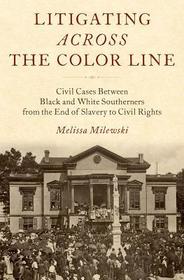
Litigating Across the Color Line
Civil Cases Between Black and White Southerners from the End of Slavery to Civil Rights
-
10% KEDVEZMÉNY?
- A kedvezmény csak az 'Értesítés a kedvenc témákról' hírlevelünk címzettjeinek rendeléseire érvényes.
- Kiadói listaár GBP 42.49
-
19 184 Ft (18 270 Ft + 5% áfa)
Az ár azért becsült, mert a rendelés pillanatában nem lehet pontosan tudni, hogy a beérkezéskor milyen lesz a forint árfolyama az adott termék eredeti devizájához képest. Ha a forint romlana, kissé többet, ha javulna, kissé kevesebbet kell majd fizetnie.
- Kedvezmény(ek) 10% (kb. 1 919 Ft)
- Kedvezményes ár 17 265 Ft (16 443 Ft + 5% áfa)
Iratkozzon fel most és részesüljön kedvezőbb árainkból!
Feliratkozom
19 184 Ft

Beszerezhetőség
Megrendelésre a kiadó utánnyomja a könyvet. Rendelhető, de a szokásosnál kicsit lassabban érkezik meg.
Why don't you give exact delivery time?
A beszerzés időigényét az eddigi tapasztalatokra alapozva adjuk meg. Azért becsült, mert a terméket külföldről hozzuk be, így a kiadó kiszolgálásának pillanatnyi gyorsaságától is függ. A megadottnál gyorsabb és lassabb szállítás is elképzelhető, de mindent megteszünk, hogy Ön a lehető leghamarabb jusson hozzá a termékhez.
A termék adatai:
- Kiadó OUP USA
- Megjelenés dátuma 2017. december 28.
- ISBN 9780190249182
- Kötéstípus Keménykötés
- Terjedelem360 oldal
- Méret 157x239x33 mm
- Súly 621 g
- Nyelv angol
- Illusztrációk 8 hts 0
Kategóriák
Rövid leírás:
In a largely previously untold story, from 1865 to 1950, black litigants throughout the South took on white southerners in civil suits. Drawing on almost a thousand cases, Milewski shows how African Americans negotiated the southern legal system and won suits against whites after the Civil War and before the Civil Rights struggle.
TöbbHosszú leírás:
In a largely previously untold story, Melissa Milewski explores how, when the financial futures of their families were on the line, black litigants throughout the South took on white southerners in civil suits. Between 1865 and 1950, in almost a thousand civil cases across eight southern states, former slaves took their former masters to court, black sharecroppers litigated against white landowners, and African Americans with little formal education brought disputes against wealthy white members of their communities.
As black southerners negotiated a legal system with almost all white gatekeepers, they displayed pragmatism and a savvy understanding of how to get whites on their side. They found that certain kinds of cases were much easier to gain whites' support for than others. But they also found that, in the kinds of civil cases that they could litigate in the highest courts of eight states, they were also surprisingly successful. In a tremendously restricted environment in which they were often shut out of other government institutions, seen as racially inferior, and segregated, African Americans found a way to fight for their rights in one of the only ways they could.
This book examines how African Americans adapted and at times made a biased system work for them under enormous constraints. At the same time, it considers the limitations of working within a white-dominated system at a time of great racial discrimination, and the choices black litigants had to make to have their cases heard.
Milewski (Univ. of Sussex, UK) offers a different story by looking at how African American litigants fared during Jim Crow in civil cases against white Southerners in former Confederate states... Outstanding for collections on US legal history, civil rights, and discrimination... Essential
Tartalomjegyzék:
Acknowledgments
Introduction
Prologue
Part 1: Civil Cases Between Black and White Southerners, 1861-1899
Chapter 1 A Revolution in the Courts
Chapter 2 How to Litigate a Case Against a White Southerner
Chapter 3 Challenging Whites' Bequests
Chapter 4 The Law of Contracts and Property
Part 2: Civil Cases Between Black and White Southerners, 1900-1950
Chapter 5 The New South and the Law
Chapter 6 Confronting Fraud Through the Courts
Chapter 7 The Law of Bodily Injury
Chapter 8 Fighting for Rights in the Courts
Epilogue
Appendix A: Notes on Methodology, Sources, and Findings
Appendix B: Tables
Notes
Bibliography
Index

