

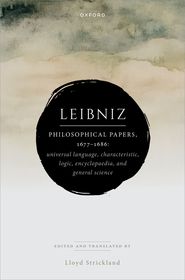
Leibniz: Philosophical Papers, 1677–1686
Universal Language, Characteristic, Logic, Encyclopaedia, and General Science
Sorozatcím: Leibniz from Oxford;
-
10% KEDVEZMÉNY?
- A kedvezmény csak az 'Értesítés a kedvenc témákról' hírlevelünk címzettjeinek rendeléseire érvényes.
- Kiadói listaár GBP 134.00
-
64 018 Ft (60 970 Ft + 5% áfa)
Az ár azért becsült, mert a rendelés pillanatában nem lehet pontosan tudni, hogy a beérkezéskor milyen lesz a forint árfolyama az adott termék eredeti devizájához képest. Ha a forint romlana, kissé többet, ha javulna, kissé kevesebbet kell majd fizetnie.
- Kedvezmény(ek) 10% (cc. 6 402 Ft off)
- Kedvezményes ár 57 617 Ft (54 873 Ft + 5% áfa)
Iratkozzon fel most és részesüljön kedvezőbb árainkból!
Feliratkozom
64 018 Ft

Beszerezhetőség
Még nem jelent meg, de rendelhető. A megjelenéstől számított néhány héten belül megérkezik.
Why don't you give exact delivery time?
A beszerzés időigényét az eddigi tapasztalatokra alapozva adjuk meg. Azért becsült, mert a terméket külföldről hozzuk be, így a kiadó kiszolgálásának pillanatnyi gyorsaságától is függ. A megadottnál gyorsabb és lassabb szállítás is elképzelhető, de mindent megteszünk, hogy Ön a lehető leghamarabb jusson hozzá a termékhez.
A termék adatai:
- Kiadó OUP Oxford
- Megjelenés dátuma 2026. április 30.
- ISBN 9780198959786
- Kötéstípus Keménykötés
- Terjedelem720 oldal
- Méret 234x156 mm
- Nyelv angol 700
Kategóriák
Rövid leírás:
The writings in this volume trace the evolution and interconnection of these projects during Leibniz's formative first decade in Hanover (1677–1686), and is the most extensive collection of such writings in English to date.
TöbbHosszú leírás:
This volume brings together 124 of Leibniz's writings on some of his most distinctive and ambitious projects including developing a new logic or art of discovery as a tool for uncovering new truths; creating a universal language with a rational, philosophical grammar structured to reflect human reasoning; designing a symbolic script (the characteristic) to facilitate discoveries across all fields of knowledge; planning an encyclopaedia in which existing knowledge would be systematically arranged to yield new insights; and advancing his vision of a collaborative, higherorder science (the general science) that would encompass the foundational principles of all other sciences.
The writings in this volume trace the evolution and interconnection of these projects during Leibniz's formative first decade in Hanover (1677–1686), and is the most extensive collection of such writings in English to date. Strickland has returned to Leibniz's original manuscripts to produce accurate, carefully annotated translations that document textual variations, deletions, and marginalia. Of the 124 texts included, 86 appear here in English for the first time, while five have never been published in any language.
In addition to the translations, the volume features a substantial introductory essay on Leibniz's life, work, and writings on a universal language, the characteristic, logic, the encyclopaedia, and general science from 1677 to 1686, along with detailed explanatory notes on each text, providing context, background, and the rationale for their dating.
Tartalomjegyzék:
Abbreviations
Introduction
1. Leibniz's Life
2. Leibniz's Writings
3. Overview: Logic, Universal Language, Characteristic, General Science and Encyclopaedia
4. About the Volumes, Selections of Texts, Apparatus and Typographical Conventions
Logic, Universal Language, Characteristic
1. After So Many Logics, The Logic I Want Has Not Yet Been Written
2. Definition
3. Empirical Notions
4. On the Natural Origin of Languages
5. A Dialogue
6. Words
7. Didactic Method
8. On Teaching Languages
9. General Language
10. Universal Language
11. Chrysippus' Heap
12. On a Rational Grammar and the Art of Memory
13. Paradoxes
14. Rational Language
15. On Estimating the Uncertain
16. Analysis of Languages
17. Logical-Grammatical Notes
18. Grammatical Thoughts
19. Tables. Divisions. Method. Genera and Subaltern Species
20. On the Logical Characteristic
21. Primitive Propositions
22. On a General Analytical Calculus
23. On Principles
24. Elements for Building a Calculus
25. Through the Characteristic, We Can Set Up Experiments in Metaphysics
26. Logical Conversion
27. What is Prior by Nature
28. On Negation
29. My Characteristic Requires a New Encyclopaedia
30. Elements of a Universal Characteristic
31. Elements of a Calculus
32. Elements of a Universal Calculus
33. Investigations for a Universal Calculus
34. A Calculus of Inferences
35. A Method of Examining Inferences by Numbers
36. Rules for the Validity of Inferences
37. Rules from which the Validity of Inferences and the Forms and Moods of Categorical Syllogisms Can Be Judged by Means of Numbers
38. Characteristic Numbers Expressed in Latin, Greek, and Hebrew
39. On the Universal Characteristic Language and the Art of Discovery
40. Reasoning Calculus, or, the Art of Reasoning Easily and Infallibly
41. Specimen of the Universal Calculus
42. Addenda to Specimen of the Universal Calculus
43. Verbal Characteristic
44. Whether Ideas Have Parts
45. Characteristic
46. Giving a Specimen of the Philosophical Language in Geometry
47. On Primary and Secondary Syllogistic Moods
48. On Mathematically Determining the Forms of Syllogisms
49. On the Demonstration of Non-identical Axioms
50. Method of Disputing Until the Subject is Exhausted
51. On Overcoming an Opponent Quickly
52. A Thread for Thinking, or, on Founding a New Logic
53. The Synthetic Method, that is, the Art of Ordering Theorems and Problems
54. On the Rational Language
55. On True and False, Affirmation and Negation, and Contradictories
56. General Investigations concerning the Analysis of Notions and Truths
57. Specimens of the Rational Calculus
58. Demonstration of the Axioms of Identity and Diversity
59. Definitions: Alike, Similar, Species, Affection
60. A Calculus of Coincidents
61. The Composition of One Thing by Another
62. Specimen of a Calculus of Coincidents and Inexistents
63. Grammatical Analysis for Creating a General Characteristic or Language
64. Principles of Human Knowledge
65. On the Principles of Contradiction and That There Is Nothing Without a Reason
General Science and Encyclopaedia
66. The True Method
67. Deleted Remarks on Methods
68. On the Art of Discovery in General
69. On the Most Excellent Use of the Combinatorial Art, Which Is to Write an Encyclopaedia
70. Two Methods of Geometry
71. Universal Atlas
72. A Society or Order of Charity
73. Society of the Friends of God for Celebrating God's Praises and in Opposition to the Atheism Spreading Throughout the World
74. On the Organon or Great Art of Thinking
75. On the Alphabet of Human Thoughts
76. Definitions: Something, Nothing, Substance
77. A Plan for a New Encyclopaedia to Be Written Using the Method of Discovery
78. On the Combinatorial Art of Discovery
79. The Art of Mathematics
80. Preface for The Key to Secret Mathematics
81. On the Synthetic and Analytic Methods
82. On the Usefulness of the Analytic and Synthetic Methods
83. Combinatorics
84. Elements of Mathesis for the Use of Beginners
85. On the Characteristic Art and Analytical or Combinatorial Discoveries in Universal Mathesis
86. Definitions: Good, Perfect, Privative
87. Formulas for Commands in All the Mechanical Arts Following the Example of Military Commands concerning the Handling of Arms and Evolutions
88. Reduction of the Sciences to Figures and Formulas
89. Precognita to the Encyclopaedia, that is, to Universal Science
90. Directing Studies to Happiness
91. Foundations and Specimens of the General Science concerning a New System for the Renewal and Enhancement of the Sciences
92. Foundations and Specimens of the General Science concerning the Renewal and Enhancement of the Sciences
93. Foundations of the General Science
94. Preface for Foundations of the General Science
95. Introduction to the General Science
96. On the Notions that Form the Basis of Everything We Think About
97. On the Literary Republic
98. On Joining the Advances of the Ancients with Ours
99. Preface for a Work on the Renewal of the Sciences
100. On the Elements of Truth
101. Mathematical Reflection on the Transformation of Bodies
102. Synopsis of Foundations and Specimens of the New General Science
103. Foundations and Specimens of the General Science
104. A Rule of Discovery
105. On the Use of the Combinatorial Art in the General Science
106. Idea for a Book Whose Title Will Be New Elements of Universal Mathesis
107. On the Division of the Whole World of the Sciences
108. Introduction to a Secret Encyclopaedia
109. Short Definition of General Science
110. On Universal Synthesis and Analysis, or the Art of Discovery and Judgement
111. General Observations
112. Division of Terms and Enumeration of Attributes
113. Genera of Terms
114. Divisions
115. A Popular Method of Teaching, and a More Perfect Scientific One
116. On the True Perfection of Humankind
117. Plus Ultra
118. Definitions of Metaphysical and Logical Notions
119. New Proposals
120. Recommendations for Founding the General Science
121. On the Obscuring of Primary Propositions
122. The Elements of Universal Truth
123. For the Preface to The Elements of Eternal Truth
124. The Elements of Reason
Bibliography
Index

