

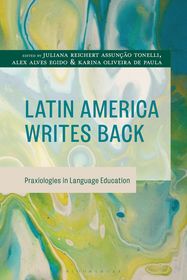
Latin America Writes Back
Praxiologies in Language Education
-
18% KEDVEZMÉNY?
- Kiadói listaár GBP 80.00
-
38 220 Ft (36 400 Ft + 5% áfa)
Az ár azért becsült, mert a rendelés pillanatában nem lehet pontosan tudni, hogy a beérkezéskor milyen lesz a forint árfolyama az adott termék eredeti devizájához képest. Ha a forint romlana, kissé többet, ha javulna, kissé kevesebbet kell majd fizetnie.
- Kedvezmény(ek) 18% (cc. 6 880 Ft off)
- Kedvezményes ár 31 340 Ft (29 848 Ft + 5% áfa)
- A kedvezmény érvényes eddig: 2026. március 31.
31 340 Ft

Beszerezhetőség
Becsült beszerzési idő: A Prosperónál jelenleg nincsen raktáron, de a kiadónál igen. Beszerzés kb. 3-5 hét..
A Prosperónál jelenleg nincsen raktáron.
Why don't you give exact delivery time?
A beszerzés időigényét az eddigi tapasztalatokra alapozva adjuk meg. Azért becsült, mert a terméket külföldről hozzuk be, így a kiadó kiszolgálásának pillanatnyi gyorsaságától is függ. A megadottnál gyorsabb és lassabb szállítás is elképzelhető, de mindent megteszünk, hogy Ön a lehető leghamarabb jusson hozzá a termékhez.
A termék adatai:
- Kiadó Bloomsbury Publishing (UK)
- Megjelenés dátuma 2026. január 8.
- Kötetek száma Hardback
- ISBN 9781666967401
- Kötéstípus Keménykötés
- Terjedelem224 oldal
- Méret 232x154x18 mm
- Súly 465 g
- Nyelv angol
- Illusztrációk 8 bw illus 686
Kategóriák
Rövid leírás:
This book unveils the harmful impacts of outside cultures imposed on local educators and presents, in a culturally sensitive manner, praxiologies that are nurtured in Latin American language education classrooms.
TöbbHosszú leírás:
"
In Latin America, and other historically exploited former colonies, people were told to unlearn their language and culture in order to acquire what some privileged voices classify as ""valid"" or ""legitimate"" ways of thinking.
Throughout history, various teaching approaches and methodologies have emerged, each bringing unique insights to foreign language classrooms all over the world. These methods have played a pivotal role in shaping language pedagogy, enhancing learners' experiences, and fostering communication in an increasingly interconnected world. As societies become aware of the need for cultural inclusivity and equity, educators are recognizing the importance of adopting praxiologies that honor diverse languages and perspectives.
In the last couple of years, language educators have seen an unprecedented expansion of discussions related to the questioning of naturalized practices in language education. Nowadays, these questions are the core of language teacher education programs in Latin America. Educators have developed and implemented another way experiencing and assessing language education; one that is not focused on the mere application of predetermined methods and techniques, but that is born from-and sensitive to-the local contexts, and which considers context-dependent struggles, hopes, needs, and agency (or lack thereof). In such a manner, the concept of praxiologies seems to be central, as understood by Paulo Freire as the inseparable connection between action and reflection. In the context of Latin American language education, praxiologies refer to the constant action-reflection that extends beyond the implementation of pre-determined methods and techniques created by those who have never interacted with the local contexts.
Tartalomjegyzék:
"
Foreword: Calling for Critical Praxis Across the Americas, Kevin Donley and Magdalena Madany-Saï¿1⁄2
Introduction, Juliana Reichert Assunï¿1⁄2ï¿1⁄2o Tonelli, Karina Oliveira de Paula, and Alex Alves Egido
Part 1: Latin America and Language Teaching in Early Childhood
1. Ideological Clarity for English Language Teachers in Paraguay, Valentina Canes, (Universidad Nacional de Asunciï¿1⁄2n, Paraguay) and Christian Faltis (Texas A&M International University, United States)
2. The National English Program in Mexico: Perspectives from EFL Young Learner Language Teachers, Elsa Fernanda Gonzï¿1⁄2lez (Universidad Autï¿1⁄2noma de Tamaulipas, Mï¿1⁄2xico), Xochitl Gï¿1⁄2mez-Cordero (Universidad Autï¿1⁄2noma de Tamaulipas, Mï¿1⁄2xico), and Norma Alicia Vega-Lï¿1⁄2pez (Universidad Autï¿1⁄2noma de Tamaulipas, Mï¿1⁄2xico)
3. ""We Don't Need Another Hero"": Valuing Ongoing Local Praxiologies in the Teaching of English to (Very) Young Learners in Brazil, Alex Alves Egido (Federal University of Maranhï¿1⁄2o, Brazil) and Juliana Reichert Assunï¿1⁄2ï¿1⁄2o Tonelli (State University of Londrina, Brazil)
Part 2: Latin America and Language Teaching in English Teachers' Education
4. Teaching as Identity Performance, Gabriel Dï¿1⁄2az Maggioli
5. Language teaching and other pedagogies in the context of migration and refugee situations in Brazil: The Role of Civil Society Organizations, Lï¿1⁄2via Mï¿1⁄2rcia Tiba Rï¿1⁄2dis Baptista (Federal University of Bahia, Brazil) and Rafaela Santos de Souza (Federal University of Bahia, Brazil)
6. Breaking Silences: Poetic Reflections on Liberation in the Brazilian American Classroom, Karina Oliveira de Paula(Texas Tech University, United States)
7. The Education of English Teachers in Brazil: Transforming a Foreign Language into an Object of Knowledge and of Critical Reflection, Lucas Araujo Chagas (Mato Grosso do Sul State University, Brazil) and Paola Barbosa Dias (Mato Grosso do Sul State University, Brazil)
8. Universities, Teacher Education Programs, and Coloniality in Latin America: The Need For Disruption and Alteration in Research, Yamith Josï¿1⁄2 Fandiï¿1⁄2o Parra
9. Deconstructing the Curriculum: A Postmodern Critique of Language Teacher Education Programs in Ecuador, Jardel Coutinho dos Santos and Alina Martï¿1⁄2nez Hernandez

