

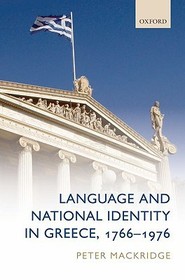
Language and National Identity in Greece, 1766-1976
-
10% KEDVEZMÉNY?
- A kedvezmény csak az 'Értesítés a kedvenc témákról' hírlevelünk címzettjeinek rendeléseire érvényes.
- Kiadói listaár GBP 135.00
-
60 952 Ft (58 050 Ft + 5% áfa)
Az ár azért becsült, mert a rendelés pillanatában nem lehet pontosan tudni, hogy a beérkezéskor milyen lesz a forint árfolyama az adott termék eredeti devizájához képest. Ha a forint romlana, kissé többet, ha javulna, kissé kevesebbet kell majd fizetnie.
- Kedvezmény(ek) 10% (kb. 6 095 Ft)
- Kedvezményes ár 54 857 Ft (52 245 Ft + 5% áfa)
Iratkozzon fel most és részesüljön kedvezőbb árainkból!
Feliratkozom
60 952 Ft

Beszerezhetőség
Megrendelésre a kiadó utánnyomja a könyvet. Rendelhető, de a szokásosnál kicsit lassabban érkezik meg.
Why don't you give exact delivery time?
A beszerzés időigényét az eddigi tapasztalatokra alapozva adjuk meg. Azért becsült, mert a terméket külföldről hozzuk be, így a kiadó kiszolgálásának pillanatnyi gyorsaságától is függ. A megadottnál gyorsabb és lassabb szállítás is elképzelhető, de mindent megteszünk, hogy Ön a lehető leghamarabb jusson hozzá a termékhez.
A termék adatai:
- Kiadó OUP Oxford
- Megjelenés dátuma 2009. április 2.
- ISBN 9780199214426
- Kötéstípus Keménykötés
- Terjedelem402 oldal
- Méret 241x162x25 mm
- Súly 767 g
- Nyelv angol
- Illusztrációk 2 maps, 2 figures 0
Kategóriák
Rövid leírás:
Peter Mackridge explores the ideological, social, and linguistic causes and effects of the Greek language question in its many and passionate manifestations over two turbulent centuries. He shows the crucial way in which Greek linguistic identities have interacted in the creation of the modern nation since the War of Independence in 1821.
TöbbHosszú leírás:
This is a history of the great language controversy that has occupied and impassioned Greeks - sometimes with fatal results - for over two hundred years. It begins in the late eighteenth century when a group of Greek intellectuals sought to develop a new, Hellenic, national identity alongside the traditional identity supplied by Orthodox Christianity. The ensuing controversy focused on the language, fuelled on the one hand by a desire to develop a form of Greek that expressed the Greeks' relationship to the ancients, and on the other by the different groups' contrasting notions of what the national image so embodied should be. The purists wanted a written language close to the ancient. The vernacularists - later known as demoticists - sought to match written language to spoken, claiming the latter to be the product of the unbroken development of Greek since the time of Homer. Peter Mackridge explores the political, social, and linguistic causes and effects of the controversy in its many manifestations. Drawing on a wide range of evidence from literature, language, history, and anthropology, he traces its effects on spoken and written varieties of Greek and shows its impact on those in use today. He describes the efforts of linguistic elites and the state to achieve language standardization and independence from languages such as Turkish, Albanian, Vlach, and Slavonic.
This is a timely book. The sense of national and linguistic identity that has been inculcated into generations of Greeks since the start of the War of Independence in 1821 has, in the last 25 years, received blows from which it may not recover. Immigration from Eastern Europe and elsewhere has introduced new populations whose religions, languages, and cultures are transforming Greece into a country quite different from what it has been and from what it once aspired to be.
Mackridge has absorbed [such] recent work not only in linguistics but also history and cultural studies and it informs his new book, which is the fruit of a whole career pondering the language. It is probably the most comprehensive and authoritative account of the development of the Greek language (or languages) since the late 18th century.
Tartalomjegyzék:
Preface
Transliteration from Greek and pronunciation of Greek Words
Maps and illustrations
Acknowledgements
Theoretical background
The preconditions for the Greek language controversy
The early stages of the controversy, 1766-1804
Adamantios Korais as language reformer
Alternative proposals to Korais' project, 1804-1830
Language in the two Greek states, 1830-1880
The beginning of the demoticist campaign, 1880-1897
Educational demoticism and political reform, 1897-1922
The political polarization of the language question, 1922-1976
Epilogue
Glossary
Bibliography
Index

