

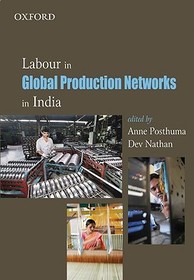
Labour in Global Production Networks
-
10% KEDVEZMÉNY?
- A kedvezmény csak az 'Értesítés a kedvenc témákról' hírlevelünk címzettjeinek rendeléseire érvényes.
- Kiadói listaár GBP 32.50
-
14 673 Ft (13 975 Ft + 5% áfa)
Az ár azért becsült, mert a rendelés pillanatában nem lehet pontosan tudni, hogy a beérkezéskor milyen lesz a forint árfolyama az adott termék eredeti devizájához képest. Ha a forint romlana, kissé többet, ha javulna, kissé kevesebbet kell majd fizetnie.
- Kedvezmény(ek) 10% (kb. 1 467 Ft)
- Kedvezményes ár 13 206 Ft (12 578 Ft + 5% áfa)
Iratkozzon fel most és részesüljön kedvezőbb árainkból!
Feliratkozom
14 673 Ft

Beszerezhetőség
A kiadónál véglegesen elfogyott, nem rendelhető. Érdemes újra keresni a címmel, hátha van újabb kiadás.
Why don't you give exact delivery time?
A beszerzés időigényét az eddigi tapasztalatokra alapozva adjuk meg. Azért becsült, mert a terméket külföldről hozzuk be, így a kiadó kiszolgálásának pillanatnyi gyorsaságától is függ. A megadottnál gyorsabb és lassabb szállítás is elképzelhető, de mindent megteszünk, hogy Ön a lehető leghamarabb jusson hozzá a termékhez.
A termék adatai:
- Kiadó Oxford University Press
- Megjelenés dátuma 2010. február 18.
- ISBN 9780198064138
- Kötéstípus Keménykötés
- Terjedelem390 oldal
- Méret 222x146x30 mm
- Súly 616 g
- Nyelv angol 0
Kategóriák
Rövid leírás:
This volume examines the engagement of global production networks and practices on labour - both skilled and unskilled - in India's liberalized economy. It further discusses how global production could be harnessed to yield better quality and more evenly spread opportunities for firms and workers.
TöbbHosszú leírás:
Since the advent of liberalization in India in 1991, much attention has been directed towards India's substantial economic growth rates, the pressures of globalisation on its labour market, and its potential role in the global economy in future. Though there have been studies on India's position in the global economy, relatively few studies have examined how engagement with global production networks is impacting upon companies and workers in India.
This volume reveals that economic growth in India has created new opportunities for large and small firms, as well as new jobs for both highly-skilled workers and relatively low-skilled workers. However, the impact is uneven, even as opportunities for larger firms at the top of supply chains filter downwards. Moreover, economic upgrading does not necessarily translate into improved terms and conditions in the job, especially for workers embedded in lower tiers of global production networks.
Instead, vulnerable jobs are on the rise for workers in the unorganised sector, and for some workers in the organised sector as well. With detailed sector-level studies spanning labour-intensive, skill-intensive and knowledge-intensive industries, this volume provides an analytical perspective on
labour in an increasingly globalised economy. It further discusses how global production could be harnessed to yield better quality and more evenly-spread opportunities for firms and workers. Timely and topical, this book will appeal to scholars and researchers working on labour and employment studies, urban studies and gender studies; economists, political scientists, sociologists, administrators and policymakers, industry associations, and international institutions.
Tartalomjegyzék:
Foreword; Acknowledgements; Introduction: Scope for Aligning Economic and Social Upgrading within Global Production Networks in India (Anne Posthuma and Dev Nathan);
Section I: Conceptual and Governance Issues Related to Economic and Social Upgrading in Global Production Networks;
Global Aggregate Demand, Inequality and the Prospects for Decent Work (Dev Nathan);
Beyond 'Regulatory Enclaves': Challenges and Opportunities to Promote Decent Work in Global Production Networks (Anne Posthuma);
Reach and Depth of Responsible Production: Towards a Research Agenda (Peter Knorringa);
Section II: Sectoral Case Studies of Engagement in Global Production Networks by Indian Companies;
Global Production Networks and Decent Work in India and China Evidence from the Apparel, Automotive and Information Technology Industries (Gary Gereffi and Esra Güler);
Decent Work in Global Production Networks: Challenges for Vulnerable Workers (Stephanie Barrientos, Kanchan Mathur, and Atul Sood);
Footloose Capital, Intermediation and the Search for a 'High Road' in Low-Wage Industries (Meenu Tewari);
Labour Market Adjustment and Female Workers: Global Production and Expiry of Quotas in India's Textile and Garments Industry (Indira Hirway);
Global Value Chains and Small Producers and Workers in the Indian Agribusiness Sector: Governance, Upgrading Opportunities, Policies and Strategies (Sukhpal Singh);
Gender, Labour and Global Production Networks: Indigenous Women and NTFP-Based Livelihood (Govind Kelkar, Meenakshi Ahluwalia and Meenakshi Kumar);
Upgradation or Flexible Casualisation? Exploring the Dynamics of Global Value Chain Incorporation in the Indian Leather Industry (Sumangala Damodaran);
Cost Cutting Pressures and Labour Relations in Tamil Nadu's Automobile Components Supply Chain (T.G. Suresh);
Small Producers and Labour Conditions in Auto-parts and Components Industry in North India (Dinesh Awasthi, Sanjay Pal and Jignasu Yagnik);
Employment and Work in the Indian Software Outsourcing Industry (Carol Upadhya);
Labour Market Patterns and Trends in India's ICT Sector (Balwant Singh Mehta and Sandip Sarkar);
Conclusions (Dev Nathan and Anne Posthuma); List of Contributors

