

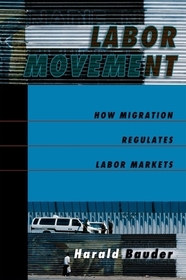
Labor Movement
How Migration Regulates Labor Markets
-
10% KEDVEZMÉNY?
- A kedvezmény csak az 'Értesítés a kedvenc témákról' hírlevelünk címzettjeinek rendeléseire érvényes.
- Kiadói listaár GBP 48.99
-
22 118 Ft (21 065 Ft + 5% áfa)
Az ár azért becsült, mert a rendelés pillanatában nem lehet pontosan tudni, hogy a beérkezéskor milyen lesz a forint árfolyama az adott termék eredeti devizájához képest. Ha a forint romlana, kissé többet, ha javulna, kissé kevesebbet kell majd fizetnie.
- Kedvezmény(ek) 10% (kb. 2 212 Ft)
- Kedvezményes ár 19 906 Ft (18 959 Ft + 5% áfa)
Iratkozzon fel most és részesüljön kedvezőbb árainkból!
Feliratkozom
22 118 Ft

Beszerezhetőség
Megrendelésre a kiadó utánnyomja a könyvet. Rendelhető, de a szokásosnál kicsit lassabban érkezik meg.
Why don't you give exact delivery time?
A beszerzés időigényét az eddigi tapasztalatokra alapozva adjuk meg. Azért becsült, mert a terméket külföldről hozzuk be, így a kiadó kiszolgálásának pillanatnyi gyorsaságától is függ. A megadottnál gyorsabb és lassabb szállítás is elképzelhető, de mindent megteszünk, hogy Ön a lehető leghamarabb jusson hozzá a termékhez.
A termék adatai:
- Kiadó OUP USA
- Megjelenés dátuma 2006. március 9.
- ISBN 9780195180886
- Kötéstípus Puhakötés
- Terjedelem288 oldal
- Méret 234x156x15 mm
- Súly 399 g
- Nyelv angol
- Illusztrációk Numerous halftones, maps, tables, and line drawings 0
Kategóriák
Rövid leírás:
In Labor Movement, Bauder attacks the conventional view of international migration as a function of spatial economic inequalities, and shows that social, cultural, legal and institutional processes, rather than the invisible hand of the market, shape migration patterns and labor market outcomes. In empirical case studies from North America and Europe, Bauder applies his theoretical ideas to a variety of geographical contexts. The studies illustrate how different legal, social, and cultural strategies towards international migrants are deployed and coordinated, and how this complex web of regulatory labor market processes relates to international migration. Bauder also integrates social, cultural and economic forms of capital, and includes citizenship as a form of cultural or institutional capital for migrants, a welcome and novel contribution to social scientists' methods of examining immigration and labor markets.
TöbbHosszú leírás:
Throughout the industrialized world, international migrants serve as nannies, construction workers, gardeners and small-business entrepreneurs. Labor Movement suggests that the international migration of workers is necessary for the survival of industrialized economies. The book thus turns the conventional view of international migration on its head: it investigates how migration regulates labor markets, rather than labor markets shaping migration flows. Assuming a critical view of orthodox economic theory, the book illustrates how different legal, social and cultural strategies towards international migrants are deployed and coordinated within the wider neo-liberal project to render migrants and immigrants vulnerable, pushing them into performing distinct economic roles and into subordinate labor market situations.
Drawing on social theories associated with Pierre Bourdieu and other prominent thinkers, Labor Movement suggests that migration regulates labor markets through processes of social distinction, cultural judgement and the strategic deployment of citizenship. European and North American case studies illustrate how the labor of international migrants is systematically devalued and how popular discourse legitimates the demotion of migrants to subordinate labor. Engaging with various immigrant groups in different cities, including South Asian immigrants in Vancouver, foreigners and Spätaussiedler in Berlin, and Mexican and Caribbean offshore workers in rural Ontario, the studies seek to unravel the complex web of regulatory labor market processes related to international migration.
Recognizing and understanding these processes, Bauder argues, is an important step towards building effective activist strategies and for envisioning new roles for migrating workers and people. The book is a valuable resource to researchers and students in economics, ethnic and migration studies, geography, sociology, political science, and to frontline activists in Europe, North America and beyond.

