

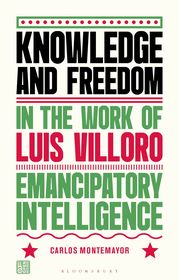
Knowledge and Freedom in the Work of Luis Villoro
Emancipatory Intelligence
-
10% KEDVEZMÉNY?
- A kedvezmény csak az 'Értesítés a kedvenc témákról' hírlevelünk címzettjeinek rendeléseire érvényes.
- Kiadói listaár GBP 19.99
-
9 025 Ft (8 595 Ft + 5% áfa)
Az ár azért becsült, mert a rendelés pillanatában nem lehet pontosan tudni, hogy a beérkezéskor milyen lesz a forint árfolyama az adott termék eredeti devizájához képest. Ha a forint romlana, kissé többet, ha javulna, kissé kevesebbet kell majd fizetnie.
- Kedvezmény(ek) 10% (kb. 903 Ft)
- Kedvezményes ár 8 122 Ft (7 736 Ft + 5% áfa)
Iratkozzon fel most és részesüljön kedvezőbb árainkból!
Feliratkozom
9 025 Ft

Beszerezhetőség
Még nem jelent meg, de rendelhető. A megjelenéstől számított néhány héten belül megérkezik.
Why don't you give exact delivery time?
A beszerzés időigényét az eddigi tapasztalatokra alapozva adjuk meg. Azért becsült, mert a terméket külföldről hozzuk be, így a kiadó kiszolgálásának pillanatnyi gyorsaságától is függ. A megadottnál gyorsabb és lassabb szállítás is elképzelhető, de mindent megteszünk, hogy Ön a lehető leghamarabb jusson hozzá a termékhez.
A termék adatai:
- Kiadó Bloomsbury Publishing (UK)
- Megjelenés dátuma 2026. július 23.
- ISBN 9781350527935
- Kötéstípus Puhakötés
- Terjedelem248 oldal
- Méret 218x138x24 mm
- Súly 240 g
- Nyelv angol 700
Kategóriák
Hosszú leírás:
This open access introduction to the major Mexican philosopher and activist Luis Villoro shows how his ideas can reshape contemporary thought.
Carlos Montemayor tells the story, through a philosophical lens, of this leading Mexican thinker and his quest for justice and freedom. At the heart of the book is Villoro's liberational approach to knowledge production. He believed an education aimed at integrating freedom with knowledge stands in opposition to escapist epistemologies which unfortunately dominate our times.
From Villoro's early writings on epistemology and Mexican history to his involvement in Zapatismo, we find out how his ideas turned into actions. This is a compelling portrait of one of the most important figures in 20th-century Mexican philosophy. For anyone interested in Latin American perspectives it is an essential guide to the work of a philosopher who spent most of his life trying to understand the complexity of the American continent and its original habitants.
The ebook editions of this book are available open access under a CC BY-NC-ND 4.0 licence on bloomsburycollections.com. Open access was funded by San Francisco State University.
Tartalomjegyzék:
List of Figures
Foreword
Acknowledgments
Introduction
Chapter 1: From the cubicle to Zapatista territory
Indigenous Mexico
The question of Mexican identity: the Hiperión group
The unity of thought and action
Philosophy and intellectual commitment
Political activism
Chapter 2: The practice of non-exclusion: A linguistic analogy
The concreteness and situatedness of non-exclusion
A linguistic analogy
Social epistemology: Rationality, cooperation, and reasonableness
Toward an ethics of attention
Chapter 3: Truth, knowledge, and freedom
The claim of reason
The origins of reason and meaning: Villoro on Wittgenstein
Joint attention and common ground: the case of mathematics
Wittgenstein and Turing on the instruments of reason
Automatism, spontaneity, and purpose in action
Chapter 4: Reforming intelligence
The concreteness and familiarity of the world
On genuine philosophy
Belief and reasonable communication
Communication and concreteness
Attention and reasonableness
Chapter 5: Pragmatism, attentive engagement, and contemporary epistemology
A pragmatic account of belief
A pragmatic account of truth and knowledge
Strong belief and the figure of the world: Ortega y Gasset and Wittgenstein
Western epistemology turned inwards: a diagnosis
Chapter 6: The figure and mind of the world: Ideology and collective memory
Epistemology, ethics, and politics
The figure of the world and the mind of the world
Villoro, Rawls, and the politics of language
Collective memory and collective attention
Chapter 7: True revolutions: A bureaucracy of intimacy
Intellectual upheavals and the importance of clarity in opposing ideology
True revolutions: politics and culture
A bureaucracy of intimacy: Villoro's capability approach

