

-
10% KEDVEZMÉNY?
- A kedvezmény csak az 'Értesítés a kedvenc témákról' hírlevelünk címzettjeinek rendeléseire érvényes.
- Kiadói listaár GBP 19.99
-
9 025 Ft (8 595 Ft + 5% áfa)
Az ár azért becsült, mert a rendelés pillanatában nem lehet pontosan tudni, hogy a beérkezéskor milyen lesz a forint árfolyama az adott termék eredeti devizájához képest. Ha a forint romlana, kissé többet, ha javulna, kissé kevesebbet kell majd fizetnie.
- Kedvezmény(ek) 10% (cc. 903 Ft off)
- Kedvezményes ár 8 122 Ft (7 736 Ft + 5% áfa)
Iratkozzon fel most és részesüljön kedvezőbb árainkból!
Feliratkozom
9 025 Ft

Beszerezhetőség
Még nem jelent meg, de rendelhető. A megjelenéstől számított néhány héten belül megérkezik.
Why don't you give exact delivery time?
A beszerzés időigényét az eddigi tapasztalatokra alapozva adjuk meg. Azért becsült, mert a terméket külföldről hozzuk be, így a kiadó kiszolgálásának pillanatnyi gyorsaságától is függ. A megadottnál gyorsabb és lassabb szállítás is elképzelhető, de mindent megteszünk, hogy Ön a lehető leghamarabb jusson hozzá a termékhez.
A termék adatai:
- Kiadó OUP USA
- Megjelenés dátuma 2026. május 27.
- ISBN 9780190089146
- Kötéstípus Puhakötés
- Terjedelem320 oldal
- Méret 226x150x20 mm
- Súly 454 g
- Nyelv angol 700
Kategóriák
Rövid leírás:
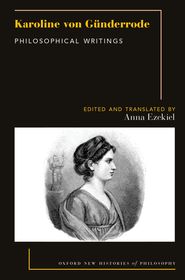
Philosophical Fragments is a volume of translations of short pieces by the German philosopher and poet Karoline von Günderrode (1780-1806), with accompanying introductions. Günderrode was a nuanced thinker with a gift for using literary forms to engage readers with philosophical ideas. Her work provides original responses to the same questions that concerned male philosophers of her time, especially those in the German Idealist and Early German Romantic traditions: What is it to be an individual human being? What is the nature of the universe? Do we have free will, or are our actions determined by operations beyond our control? What can we know about the world, and how? What happens to us after we die? How should we behave while we are alive? What forms of social and political life should we foster?
TöbbHosszú leírás:
At the start of the nineteenth century, Karoline von Günderrode burst onto the German intellectual scene with multi-genre collections of philosophical literature that were read by Goethe, Clemens Brentano, and other famous writers and academics. But Günderrode's philosophical insights were largely ignored or adopted without credit and in 1806 she died by suicide, leaving behind a small but powerful set of reflections on the nature of the self, friendship, life after death, human-nature relations, social progress, epistemology, religion, ethics, and many other topics. Long celebrated as an embodiment of tragic Romantic poetry, Günderrode has recently been rediscovered as the author of an original and exciting philosophy.
Günderrode was a nuanced thinker with a gift for using literary forms to engage readers with philosophical ideas. This volume makes many of Günderrode's most significant published and unpublished works, along with excerpts from her letters and notes on philosophical topics, available for the first time in English. The short introductions accompanying each text explicate the ideas embedded in Günderrode's writing, connecting them to intellectual debates of the day and to relevant work by better-known philosophers including Kant, Plato, Schelling, Herder, Schleiermacher, Hemsterhuis, Schlegel, and Novalis. The general introduction provides a more comprehensive orientation to Günderrode's philosophy, considering her metaphysics, epistemology, social and political thought, ethics, aesthetics, and reflections on gender, death, friendship, and human identity.
Tartalomjegyzék:
Dedication
Acknowledgements
Introduction
Günderrode's Life and Works
Günderrode as a Philosopher
Metaphysics
Identity, Consciousness, and Death
Epistemology
Social and Political Thought
Ethics
Aesthetics
Gender
Günderrode and Genre
Overview of This Volume
Part 1 Works
1 Idea of the Earth
Introduction
Idea of the Earth
2 Letters of Two Friends
Introduction
Letters of Two Friends
3 The Manes
Introduction
The Manes
4 The Malabarian Widows
Introduction
The Malabarian Widows
5 "An Apocalyptic Fragment" and "A Dream"
Introduction
An Apocalyptic Fragment
A Dream
6 The Wanderer's Descent
Introduction
The Wanderer's Descent
7 The Adept
Introduction
The Adept
8 The Frank in Egypt
Introduction
The Frank in Egypt
9 Immortalita
Introduction
Immortalita
10 Story of a Brahmin
Introduction
Story of a Brahmin
11 Fragments on Ethics and Aesthetics
Introduction
(Excellence is a whole)
(Love and Beauty)
(Tendency of the Artist)
Change and Constancy
(Only One and One to Serve)
12 Fragments on Music
Introduction
The Realm of Tones
Music
Music for Me
The Nightingale (Fragment)
The Tones
The Cathedral in Cologne. A Fragment
13 The Aeronaut
Introduction
The Aeronaut
14 Once I Lived Sweet Life
Introduction
Once I Lived Sweet Life
15 Mora
Introduction
Mora
16 Udohla
Introduction
Udohla
Part 2 Notebooks
17 Introduction to Günderrode's Notebooks
18 Notes on Philosophy of Nature
Introduction
(The true idea of materialism...)
(Nature is an eternal activity)
Idea of Nature
(All things are)
19 Notes on Chemistry
Introduction
Notes on Chemistry
20 Notes on the Early German Romantics
Introduction
Notes on the Early German Romantics
21 Notes on Schleiermacher
Introduction
Notes on Schleiermacher
22 Notes on Hemsterhuis
Introduction
Notes on Hemsterhuis
23 Miscellaneous Notes
Introduction
Philosophical Dictionary and Other Definitions
Philosophical Dictionary
(Reason and Understanding)
Mathematical Definitions
Other Definitions
Notes from Jean Paul, Hesperus
Notes from Summer 1804 to Early 1806
Part 3 Letters
24 Günderrode's Letters
Introduction
Letters
Bibliography
Appendix: Sources for the Translations

