

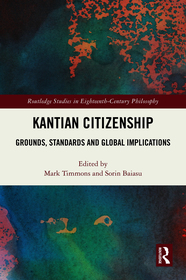
Kantian Citizenship
Grounds, Standards and Global Implications
Sorozatcím: Routledge Studies in Eighteenth-Century Philosophy;
-
10% KEDVEZMÉNY?
- Kiadói listaár GBP 47.99
-
21 667 Ft (20 635 Ft + 5% áfa)
Az ár azért becsült, mert a rendelés pillanatában nem lehet pontosan tudni, hogy a beérkezéskor milyen lesz a forint árfolyama az adott termék eredeti devizájához képest. Ha a forint romlana, kissé többet, ha javulna, kissé kevesebbet kell majd fizetnie.
- Kedvezmény(ek) 10% (cc. 2 167 Ft off)
- Kedvezményes ár 19 500 Ft (18 572 Ft + 5% áfa)
19 500 Ft

Beszerezhetőség
Még nem jelent meg, de rendelhető. A megjelenéstől számított néhány héten belül megérkezik.
Why don't you give exact delivery time?
A beszerzés időigényét az eddigi tapasztalatokra alapozva adjuk meg. Azért becsült, mert a terméket külföldről hozzuk be, így a kiadó kiszolgálásának pillanatnyi gyorsaságától is függ. A megadottnál gyorsabb és lassabb szállítás is elképzelhető, de mindent megteszünk, hogy Ön a lehető leghamarabb jusson hozzá a termékhez.
A termék adatai:
- Kiadás sorszáma 1
- Kiadó Taylor & Francis
- Megjelenés dátuma 2026. augusztus 27.
- ISBN 9781032978505
- Kötéstípus Puhakötés
- Terjedelem246 oldal
- Méret 229x152 mm
- Nyelv angol 700
Kategóriák
Rövid leírás:
This book is a collection of new essays on the topic of Kant’s account of citizenship, the first book-length text on this topic. It features leading scholars who specialize in Kant’s ethics, philosophy of religion and political philosophy. Their chapters connect Kant’s philosophy with contemporary issues concerning citizenship.
TöbbHosszú leírás:
This book is a collection of 12 new essays on the topic of Kant’s account of citizenship, the first book-length text on this topic. It features an international cast of leading scholars who specialize in Kant’s ethics, philosophy of religion and political philosophy. The contributors connect Kant’s philosophy with contemporary issues concerning citizenship, including the moral grounds of citizenship rights, the relation between citizenship, human rights and dignity, civic virtues, citizenship in the ethical commonwealth, in particular the moral function of religious rituals, the link between ethical duties and faith, and the relation between religious freedom and political power, democratic participation, the legitimacy of international courts, just war theory, cosmopolitanism and the contemporary relevance of a Kantian account of citizenship.
The topic is of interest given some of the currently urgent citizenship-related challenges that we are facing today. Kant’s account of justice stipulates that, in a fair and peaceful world, the legal framework that establishes rights and obligations should be effective at national, international and cosmopolitan levels. Kant’s legal and political philosophy also features the unique combination of a realistic appraisal of the human condition and powerful normative recommendations concerning action and principles of ethics and law. Together with Kant’s emphasis on the requirement of consistency, the approaches discussed in the volume are better able to orient thinking and guide action for currently urgent ethical, legal, political and social problems.
Kantian Citizenship will appeal to scholars and graduate students working on Kant’s legal and political philosophy, as well as scholars from other fields who are interested in legal philosophy and the politics of citizenship.
TöbbTartalomjegyzék:
1. Aspects of Kantian Citizenship Sorin Baiasu and Mark Timmons Part I: The Nature and Grounds of Citizenship 2. Enforcing the Law of Nature: The Background to Kant’s Conception of the Relation between Morality and Recht Paul Guyer 3. Dignity, Human Rights and Citizenship Sorin Baiasu 4. Civic Action, Idealization and Kantian Citizenship Sarah Holtman Part II: Citizenship and Ethical Commonwealth 5. Moses Mendelssohn on Religious Freedom Allen Wood 6. ‘Counteracting Evil with United Forces’: On Citizenship in a Religious Community with Special Attention to Church Rituals Mark Timmons 7. Kant’s Moral Amphiboly: Ethics, Religion and the Politics of Faith Susan Meld Shell Part III: Citizenship and Juridical Community 8. Kantian Lessons for Democratic Theory Luigi Caranti 9. The Separation of Powers and the Legitimacy of International Courts: A Kantian View Reidar Maliks 10. Kant’s ‘Unjust Enemy’: Test Case for a ‘Critical Theory of War Today’ Oliver Eberl and Peter Niesen 11. Two Sources of Cosmopolitan Right Peter Niesen Part IV: Postscript 12. Kant’s View of Citizenship: A Model for the 21st Century? Howard Williams
Több
