

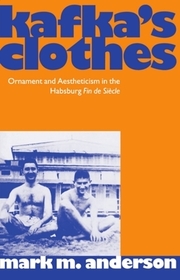
Kafka's Clothes
Ornament and Aestheticism in the Habsburg Fin de Siècle
Sorozatcím: Clarendon Paperbacks;
-
10% KEDVEZMÉNY?
- A kedvezmény csak az 'Értesítés a kedvenc témákról' hírlevelünk címzettjeinek rendeléseire érvényes.
- Kiadói listaár GBP 53.00
-
25 320 Ft (24 115 Ft + 5% áfa)
Az ár azért becsült, mert a rendelés pillanatában nem lehet pontosan tudni, hogy a beérkezéskor milyen lesz a forint árfolyama az adott termék eredeti devizájához képest. Ha a forint romlana, kissé többet, ha javulna, kissé kevesebbet kell majd fizetnie.
- Kedvezmény(ek) 10% (cc. 2 532 Ft off)
- Kedvezményes ár 22 789 Ft (21 704 Ft + 5% áfa)
Iratkozzon fel most és részesüljön kedvezőbb árainkból!
Feliratkozom
25 320 Ft

Beszerezhetőség
Megrendelésre a kiadó utánnyomja a könyvet. Rendelhető, de a szokásosnál kicsit lassabban érkezik meg.
Why don't you give exact delivery time?
A beszerzés időigényét az eddigi tapasztalatokra alapozva adjuk meg. Azért becsült, mert a terméket külföldről hozzuk be, így a kiadó kiszolgálásának pillanatnyi gyorsaságától is függ. A megadottnál gyorsabb és lassabb szállítás is elképzelhető, de mindent megteszünk, hogy Ön a lehető leghamarabb jusson hozzá a termékhez.
A termék adatai:
- Kiadó Clarendon Press
- Megjelenés dátuma 1994. december 29.
- ISBN 9780198159070
- Kötéstípus Puhakötés
- Terjedelem244 oldal
- Méret 215x188x18 mm
- Súly 373 g
- Nyelv angol
- Illusztrációk 16 pp halftone plates 0
Kategóriák
Rövid leírás:
This highly acclaimed study explores Kafka's early dandyism and interest in fashion, literary decadence, and the `superficial' spectacle of modern urban life as well as his subsequent repudiation of these phenomena in forging a literary identity as isolated, otherwordly `poet' of modern alienation. In its discussion of Jugendstil aesthetics, Otto Weininger's `egoless' woman, the Viennese critique of architectural ornament, the clothing-reform movement, anti-Semitism, and the question of Jewish-German writing, Kafka's Clothes paints a startlingly unconventional portrait of Kafka and Prague at the turn of the century.
TöbbHosszú leírás:
`One should either be a work of art, or wear one' proclaimed Oscar Wilde at the end of the nineteenth century; `I am made of literature, I am nothing else, and cannot be anything else' Franz Kafka proclaimed a brief decade later. Between these two claims lies the largely unexplored region in which the European decadent movement turned into the modernist avant-garde. In this original historical study, Mark Anderson explores Kafka's early dandyism, his interest in fashion, literary decadence and the `superficial' spectacle of modern urban life, as well as his subsequent repudiation of these phenomena in forging a literary identity as the isolated, otherworldly `poet' of modern alienation.
Rather than posit a break between these two personae, Anderson charts the historical continuities between the young Kafka and the author of The Metamorphosis and The Trial. The book demonstrates how clothing functions as a semi-private code of meaning in his literary works and the extent to which the aestheticist notion of becoming the work of art haunts Kafka's conception of writing throughout his life. The result is a startlingly unconventional portrait of Kafka and Prague at the turn of the century, involving such issues as Jugendstil aesthetics, Otto Weininger's `egoless' woman, the Viennese critique of architectural ornament, the clothing-reform movement, anti-Semitism, and the question of Jewish-German writing.
`This rich and subtle study sets new standards for historical and textual interpretation of Kafka.' Modern Language Review

