

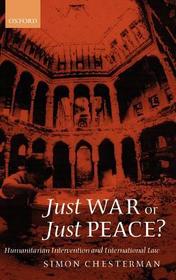
Just War or Just Peace?
Humanitarian Intervention and International Law
Sorozatcím: Oxford Monographs in International Law;
-
10% KEDVEZMÉNY?
- A kedvezmény csak az 'Értesítés a kedvenc témákról' hírlevelünk címzettjeinek rendeléseire érvényes.
- Kiadói listaár GBP 120.00
-
54 180 Ft (51 600 Ft + 5% áfa)
Az ár azért becsült, mert a rendelés pillanatában nem lehet pontosan tudni, hogy a beérkezéskor milyen lesz a forint árfolyama az adott termék eredeti devizájához képest. Ha a forint romlana, kissé többet, ha javulna, kissé kevesebbet kell majd fizetnie.
- Kedvezmény(ek) 10% (kb. 5 418 Ft)
- Kedvezményes ár 48 762 Ft (46 440 Ft + 5% áfa)
Iratkozzon fel most és részesüljön kedvezőbb árainkból!
Feliratkozom
54 180 Ft

Beszerezhetőség
Megrendelésre a kiadó utánnyomja a könyvet. Rendelhető, de a szokásosnál kicsit lassabban érkezik meg.
Why don't you give exact delivery time?
A beszerzés időigényét az eddigi tapasztalatokra alapozva adjuk meg. Azért becsült, mert a terméket külföldről hozzuk be, így a kiadó kiszolgálásának pillanatnyi gyorsaságától is függ. A megadottnál gyorsabb és lassabb szállítás is elképzelhető, de mindent megteszünk, hogy Ön a lehető leghamarabb jusson hozzá a termékhez.
A termék adatai:
- Kiadó OUP Oxford
- Megjelenés dátuma 2001. január 25.
- ISBN 9780199243372
- Kötéstípus Keménykötés
- Terjedelem326 oldal
- Méret 242x163x22 mm
- Súly 616 g
- Nyelv angol 0
Kategóriák
Rövid leírás:
This book, winner of an ASIL Certificate of Merit 2002, critically examines the right of humanitarian intervention, asserted most spectacularly by NATO during its 1999 air strikes over Kosovo. The UN Charter prohibits the unilateral use of force, but there have long been arguments that such a right might exist as an exception to this rule, or linked to the changing role of the Security Council. Through an analysis of these questions, the book puts NATO's action in Kosovo in its proper legal and historical perspective.
TöbbHosszú leírás:
The question of the legality of humanitarian intervention is, at first blush, a simple one. The Charter of the United Nations clearly prohibits the use of force, with the only exceptions being self-defence and enforcement actions authorized by the Security Council. There are, however, long-standing arguments that a right of unilateral intervention pre-existed the Charter.
This book, winner of an ASIL Certificate of Merit 2002, begins with an examination of the genealogy of that right, and argues that it might have survived the passage of the Charter, either through a loophole in Article 2(4) or as part of customary international law. It has also been argued that certain `illegitimate' regimes lose the attributes of sovereignty and thereby the protection given by the prohibition of the use of force. None of these arguments is found to have merit, either in principle or in the practice of states.
A common justification for a right of unilateral humanitarian intervention concerns the failure of the collective security mechanism created after the Second World War. Chapters 4 and 5, therefore, examine Security Council activism in the 1990s, notable for the plasticity of the circumstances in which the Council was prepared to assert its primary responsibility for international peace and security, and the contingency of its actions on the willingness of states to carry them out. This reduction of the Council's role from a substantive one to a formal one partly explains the recourse to unilateralism in that decade, most spectacularly in relation to the situation in Kosovo.
Crucially, the book argues that such unilateral enforcement is not a substitute for but the opposite of collective action. Though often presented as the only alternative to inaction, incorporating a `right' of intervention would lead to more such interventions being undertaken in bad faith, it would be incoherent as a principle, and it would be inimical to the emergence of an international rule of law.
... admirably thorough ... well-researched and articulate arguments.
Tartalomjegyzék:
Introduction
The Just War: The origins of humanitarian intervention
The Scourge of War: Humanitarian intervention and the prohibition of the use of force in the UN Charter
'You, the People': Unilateral intervention to promote democracy
The New Interventionism: Threats to international peace and security and Security Council actions under Chapter VII of the UN Charter
Passing the Baton: The delegation of Security Council enforcement powers from Kuwait to Kosovo
Just War or Just Peace? Humanitarian intervention, inhumanitarian non-intervention and other peace strategies
Bibliography

