

-
10% KEDVEZMÉNY?
- A kedvezmény csak az 'Értesítés a kedvenc témákról' hírlevelünk címzettjeinek rendeléseire érvényes.
- Kiadói listaár GBP 107.50
-
48 536 Ft (46 225 Ft + 5% áfa)
Az ár azért becsült, mert a rendelés pillanatában nem lehet pontosan tudni, hogy a beérkezéskor milyen lesz a forint árfolyama az adott termék eredeti devizájához képest. Ha a forint romlana, kissé többet, ha javulna, kissé kevesebbet kell majd fizetnie.
- Kedvezmény(ek) 10% (kb. 4 853 Ft)
- Kedvezményes ár 43 683 Ft (41 603 Ft + 5% áfa)
Iratkozzon fel most és részesüljön kedvezőbb árainkból!
Feliratkozom
48 536 Ft

Beszerezhetőség
Megrendelésre a kiadó utánnyomja a könyvet. Rendelhető, de a szokásosnál kicsit lassabban érkezik meg.
Why don't you give exact delivery time?
A beszerzés időigényét az eddigi tapasztalatokra alapozva adjuk meg. Azért becsült, mert a terméket külföldről hozzuk be, így a kiadó kiszolgálásának pillanatnyi gyorsaságától is függ. A megadottnál gyorsabb és lassabb szállítás is elképzelhető, de mindent megteszünk, hogy Ön a lehető leghamarabb jusson hozzá a termékhez.
A termék adatai:
- Kiadó OUP USA
- Megjelenés dátuma 2018. november 29.
- ISBN 9780190689414
- Kötéstípus Keménykötés
- Terjedelem264 oldal
- Méret 145x211x17 mm
- Súly 420 g
- Nyelv angol 0
Kategóriák
Rövid leírás:
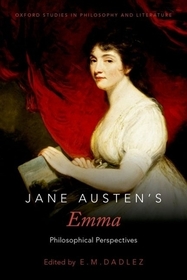
What has Emma Woodhouse to say to a discipline like philosophy? The minutia of daily living on which Jane Austen's Emma concentrates our attention permit a closer look at human emotions and motives. Emma shows how friendships can affect one's ways of dealing with the world, how shame can reconfigure self-understanding. That is, Emma leads us to think philosophically.
TöbbHosszú leírás:
What has Emma Woodhouse, "handsome, clever, and rich, with a comfortable home and very little to distress or vex her" to say to a discipline like philosophy? How is a novel like Emma, inaccurately but not infrequently caricatured as a high-toned version of a pedestrian romance, to supply material for philosophical insight or speculation?
Jane Austen's Emma is many things to many readers but it is as inaccurate as it is reductive to consider it just a romance. The minutia of daily living on which it concentrates permit not a rehearsal of platitudes, but a closer look at human emotions and motives, as well as the opportunity to hone our interpretive and empathetic skills. Emma flies in the face of conventional notions of femininity by presenting a heroine with hubris. It shows how friendships can affect one's ways of dealing with the world, how shame can reconfigure self-understanding, how gossip functions in sustaining a community. Emma rehabilitates conceptions of romance by rejecting melodrama in favor of naturalism. It explores the waywardness of the imagination and the myriad ways in which different people with different biases and agendas may evaluate the same evidence. It dwells on the limits of autonomy in that it explores the ease with which one may submit to the will of another.
Emma is not itself a work of philosophy. Rather, it leads us to think philosophically. In this volume, a myriad group of scholars and philosophers explore the philosophical resonances of Emma.
What distinguishes this anthology is that it connects Jane Austen's literary masterpiece to a number of classical and contemporary philosophical texts and viewpoints. The result is a fresh set of insights into a novel whose textual ambiguities have met with wide disagreement among literary critics over how to make sense of the many subtleties Austen has woven into her literary tapestry. An equally penetrating critical spirit extends toward the philosophy side. And not just because literary works frequently convey complex narrative situations that enrich the store of truncated examples more abstract works of philosophy are able to provide. But also because literary presentations themselves often presuppose philosophical views...
Tartalomjegyzék:
Series Editor's Foreword, Richard Eldridge
Contributors
Introduction, E.M Dadlez
1. Love and Friendship: Achieving Happiness in Jane Austen's Emma Neera Badhwar and E.M. Dadlez
2. Emma's Pensive Meditations Cynthia Freeland
3. Emma and Defective Action Eileen John
4. 'A danger at present unperceived': Self-Understanding, Imagination, and Social Relations in Emma Richard Eldridge
5. The Many Faces of Gossip in Emma Heidi Silcox and Mark Silcox
6. The Reconstrual of Imagination and Romance Peter Knox-Shaw
7. Misreading Emma David Davies
8. The Dilemma of Emma: Substance, Style, and Story Peter Kivy

