

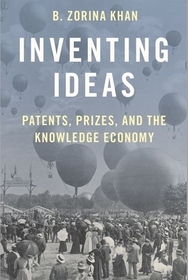
Inventing Ideas
Patents, Prizes, and the Knowledge Economy
-
10% KEDVEZMÉNY?
- A kedvezmény csak az 'Értesítés a kedvenc témákról' hírlevelünk címzettjeinek rendeléseire érvényes.
- Kiadói listaár GBP 107.50
-
48 536 Ft (46 225 Ft + 5% áfa)
Az ár azért becsült, mert a rendelés pillanatában nem lehet pontosan tudni, hogy a beérkezéskor milyen lesz a forint árfolyama az adott termék eredeti devizájához képest. Ha a forint romlana, kissé többet, ha javulna, kissé kevesebbet kell majd fizetnie.
- Kedvezmény(ek) 10% (cc. 4 854 Ft off)
- Kedvezményes ár 43 683 Ft (41 603 Ft + 5% áfa)
Iratkozzon fel most és részesüljön kedvezőbb árainkból!
Feliratkozom
48 536 Ft

Beszerezhetőség
Megrendelésre a kiadó utánnyomja a könyvet. Rendelhető, de a szokásosnál kicsit lassabban érkezik meg.
Why don't you give exact delivery time?
A beszerzés időigényét az eddigi tapasztalatokra alapozva adjuk meg. Azért becsült, mert a terméket külföldről hozzuk be, így a kiadó kiszolgálásának pillanatnyi gyorsaságától is függ. A megadottnál gyorsabb és lassabb szállítás is elképzelhető, de mindent megteszünk, hogy Ön a lehető leghamarabb jusson hozzá a termékhez.
A termék adatai:
- Kiadó OUP USA
- Megjelenés dátuma 2020. július 21.
- ISBN 9780190936075
- Kötéstípus Keménykötés
- Terjedelem478 oldal
- Méret 160x243x30 mm
- Súly 798 g
- Nyelv angol 22
Kategóriák
Rövid leírás:
Based on original archival research, Inventing Ideas sheds light on the origins of the knowledge economy through empirical analysis of over one hundred thousand inventors and innovations in Britain, France, and the United States during the first and second industrial revolutions.
TöbbHosszú leírás:
What determines why some countries succeed and others fall behind?
Economists have long debated the sources of economic growth, resulting in conflicting and often inaccurate claims about the role of the state, knowledge, patented ideas, monopolies, grand innovation prizes, and the nature of disruptive technologies.
B. Zorina Khan's Inventing Ideas overturns conventional thinking and meticulously demonstrates how and why the mechanism design of institutions propels advances in the knowledge economy and ultimately shapes the fate of nations. Drawing on the experiences of over 100,000 inventors and innovations from Britain, France, and the United States during the first and second industrial revolutions (1750-1930), Khan's comprehensive empirical analysis provides a definitive micro-foundation for endogenous macroeconomic growth models.
This groundbreaking study uses comparative analysis across time and place to show how different institutions affect technological innovation and growth. Khan demonstrates how top-down innovation systems, in which elites, state administrators, or panels make key economic decisions about prizes, rewards and the allocation of resources, prove to be ineffective and unproductive. By contrast, open-access markets in patented ideas increase the scale and scope of creativity, foster diversity and inclusiveness, generate greater knowledge spillovers, and enhance social welfare in the wider population.
When institutions are associated with rewards that are misaligned with economic value and productivity, the negative consequences can accumulate and reduce comparative advantage at the level of individuals and nations alike. So who will arise as the global leader of the twenty-first century? The answer depends on the extent to which we learn and implement the lessons from the history of innovation and enterprise.
Drawing on records of over 100,000 inventors and innovators in Britain, France, and the US, Khan builds a solid case. She is especially adept at debunking the idea that innovation prizes work better than patents, and she includes pathbreaking work on female innovators.
Tartalomjegyzék:
Chapter 1 Introduction: Knowledge, Institutions and Progress
Chapter 2 Trolls and Other Patent Inventions
Chapter 3 Inventing Prizes
Chapter 4 Elites and Useful Knowledge in Britain
Chapter 5 Prestige and Profit: The Royal Society of Arts
Chapter 6 Administered Invention in France
Chapter 7 Going for Gold: Prizing Innovation
Chapter 8 “Creative Destruction:” War and Technology
Chapter 9 Of Apples and Ideas: Knowledge Spillovers in Patents and Prizes
Chapter 10 Designing Women: Gender and Innovation
Chapter 11 Selling Ideas: Global Markets for Patented Inventions
Chapter 12 Innovations in Law
Chapter 13 National Innovation Systems and Innovation in Nations
Chapter 14 Conclusion: Now and Then
Appendix

