

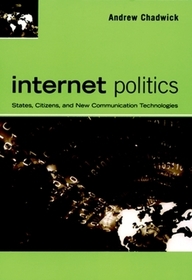
Internet Politics
States, Citizens, and New Communication Technologies
-
10% KEDVEZMÉNY?
- A kedvezmény csak az 'Értesítés a kedvenc témákról' hírlevelünk címzettjeinek rendeléseire érvényes.
- Kiadói listaár GBP 127.99
-
57 787 Ft (55 035 Ft + 5% áfa)
Az ár azért becsült, mert a rendelés pillanatában nem lehet pontosan tudni, hogy a beérkezéskor milyen lesz a forint árfolyama az adott termék eredeti devizájához képest. Ha a forint romlana, kissé többet, ha javulna, kissé kevesebbet kell majd fizetnie.
- Kedvezmény(ek) 10% (kb. 5 779 Ft)
- Kedvezményes ár 52 008 Ft (49 532 Ft + 5% áfa)
Iratkozzon fel most és részesüljön kedvezőbb árainkból!
Feliratkozom
57 787 Ft

Beszerezhetőség
Megrendelésre a kiadó utánnyomja a könyvet. Rendelhető, de a szokásosnál kicsit lassabban érkezik meg.
Why don't you give exact delivery time?
A beszerzés időigényét az eddigi tapasztalatokra alapozva adjuk meg. Azért becsült, mert a terméket külföldről hozzuk be, így a kiadó kiszolgálásának pillanatnyi gyorsaságától is függ. A megadottnál gyorsabb és lassabb szállítás is elképzelhető, de mindent megteszünk, hogy Ön a lehető leghamarabb jusson hozzá a termékhez.
A termék adatai:
- Kiadó OUP USA
- Megjelenés dátuma 2006. március 23.
- ISBN 9780195177732
- Kötéstípus Puhakötés
- Terjedelem400 oldal
- Méret 233x167x18 mm
- Súly 585 g
- Nyelv angol
- Illusztrációk Numerous tables and figures 0
Kategóriák
Rövid leírás:
In the wake of the Howard Dean campaign, digital technologies are changing not only the way politics is conducted, but also political institutions themselves. This book synthesizes the rapidly growing literature from both media studies and political science that looks at how political actors are seeking to use, and regulate the use of, technologies. Chadwick examines some of the key questions in the matter: has the 'information age' caused a fundamental shift in global politics? Has the Internet reconfigured the relationships between states, and between citizens and states? The book's approach is comparative and includes pedagogy such as chapter summaries, boxes with key facts and quotations, case studies, and a brief guide to the best Web resources available to the topic at hand.
TöbbHosszú leírás:
In the developed world, there is no longer an issue of whether the Internet affects politics--but how, why and with what consequences. With the Internet now spreading at a breathtaking rate in the developing world, the new medium is fraught with tensions, paradoxes, and contradictions. How do we make sense of these? In this major new work, Andrew Chadwick addresses such concerns, providing the first comprehensive overview of Internet politics.
Internet Politics examines the impact of new communication technologies on political parties and elections, pressure groups, social movements, local democracy, public bureaucracies, and global governance. It also analyzes persistent and controversial policy problems, including the digital divide; the governance of the Internet itself; the tensions between surveillance, privacy and security; and the political economy of the Internet media sector. The approach is explicitly comparative, providing numerous examples from the U.S., Britain, and many other countries. Written in a clear and accessible style, this theoretically sophisticated and up-to-date text reveals the key difference the Internet makes in how we "do" politics and how we "think about" political life.
Featuring numerous figures, tables, and text boxes, Internet Politics is ideal for undergraduate and graduate courses in political science, international relations, and communication studies.
"Well researched, timely and readable... manages to impress both in its scope and its depth... Internet Politics should be required reading for anyone attempting to understanding the way in which the Internet affects our lives." - Dr Mathias Klang, University of Göteborg, in Journal of Information, Communication & Ethics in Society 5 (1), 2007.
Tartalomjegyzék:
Preface
List of Figures, Tables, and Panels
1. Introduction
Part One: Contexts
2. Internet Politics: Some Conceptual Tools
3. Network Logic: A Political Pre-History of the Internet
4. Access, Inclusion, and the Digital Divide
Part Two: Institutions
5. Community, Deliberation and Participation: E-Democracy
6. Interest Groups and Social Movements: E-Mobilization
7. Parties, Candidates, and Elections: E-Campaigning
8. Executives and Bureaucracies: E-Government
Part Three: Issues and Controversies
9. Constructing the "Global Information Society"
10. The Rise of Internet Governance
11. Surveillance, Privacy, and Security
12. The Political Economy of New Media
13. Conclusion: The Future of Internet Politics
Glossary
Abbreviations and Acronyms
Bibliography
Index

