

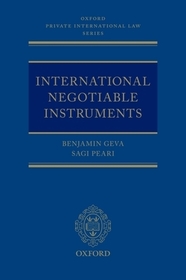
International Negotiable Instruments
Sorozatcím: Oxford Private International Law Series;
-
10% KEDVEZMÉNY?
- A kedvezmény csak az 'Értesítés a kedvenc témákról' hírlevelünk címzettjeinek rendeléseire érvényes.
- Kiadói listaár GBP 147.50
-
70 468 Ft (67 112 Ft + 5% áfa)
Az ár azért becsült, mert a rendelés pillanatában nem lehet pontosan tudni, hogy a beérkezéskor milyen lesz a forint árfolyama az adott termék eredeti devizájához képest. Ha a forint romlana, kissé többet, ha javulna, kissé kevesebbet kell majd fizetnie.
- Kedvezmény(ek) 10% (cc. 7 047 Ft off)
- Kedvezményes ár 63 421 Ft (60 401 Ft + 5% áfa)
Iratkozzon fel most és részesüljön kedvezőbb árainkból!
Feliratkozom
70 468 Ft

Beszerezhetőség
Megrendelésre a kiadó utánnyomja a könyvet. Rendelhető, de a szokásosnál kicsit lassabban érkezik meg.
Why don't you give exact delivery time?
A beszerzés időigényét az eddigi tapasztalatokra alapozva adjuk meg. Azért becsült, mert a terméket külföldről hozzuk be, így a kiadó kiszolgálásának pillanatnyi gyorsaságától is függ. A megadottnál gyorsabb és lassabb szállítás is elképzelhető, de mindent megteszünk, hogy Ön a lehető leghamarabb jusson hozzá a termékhez.
A termék adatai:
- Kiadás sorszáma 1
- Kiadó OUP Oxford
- Megjelenés dátuma 2020. december 10.
- ISBN 9780198828686
- Kötéstípus Keménykötés
- Terjedelem300 oldal
- Méret 240x160x25 mm
- Súly 596 g
- Nyelv angol 69
Kategóriák
Rövid leírás:
This book provides a comprehensive and thorough analysis of the legal framework for the treatment of international negotiable instruments. It considers the approach within and across major legal systems and pinpoints the key distinctions for the application of choice of law rules.
TöbbHosszú leírás:
For centuries, bills of exchange, cheques, and promissory notes ('negotiable instruments') have played a vital role in the smooth operation of domestic and international commerce. The payment mechanisms have been subject to rapid technological progress and law has needed to adapt and respond to ensure that the legal framework remains relevant and effective.
This book provides a comprehensive and thorough analysis of the question of applicable law to negotiable instruments. Given significant differences in the treatment of important issues under the laws governing negotiable instruments of the various jurisdictions, the question of applicable law plays a key role in contemporary commerce. Resolution of such issues frequently has cross-border dimensions, affecting residents from different countries, and meeting the needs of commerce as it rapidly moves towards an online mode of communication and documentation. To such ends, the book elaborates on the conceptual underpinnings of negotiable instruments law, provides an overview of the key differences between the systems in this area of law and contemplates the question of applicable law.
The book provides a systematic inquiry into the relevant principles of law, statutes, and international conventions, and analyses the underlying rationale for both applicable and negotiable instruments laws' rules. In this way, it aims to identify and resolve some of the existing uncertainties in the case law and literature with respect to one of the central aspects of commerce.
Specifically, the authors challenge the conventional view according to which the fundamentals of negotiable instruments law are excluded from the scope and insights of general contract and property law doctrines and as such not subject to the general conflict of laws rules governing them. The authors make concrete suggestions for reform and contemplate on the nature of the legal rules that can also be applied in the digital age of communication.
...the authors have delved very deeply into their subject, and, and have identified sources with which many readers may be unfamiliar. The writers are to be congratulated on producing such a comprehensive work.
Tartalomjegyzék:
Negotiability, Negotiable Instruments, and the Law of Bills, Notes, and Cheques
General Law and Negotiable Instruments: A Brief Historical Perspective
Choice of Law Question, Three Major Developments, and the Need for Harmonization
Negotiable Instruments Choice-of-Law Rules in the Various Systems
The Foreign Element and Party Autonomy in Negotiable Instruments Law
Choice-of-Law Rules in the Absence of Party Autonomy: The Most Significant Relationship Principle
The Boundaries of the Proposed Argument
International Negotiable Instruments in the Electronic Age
Conclusion

