

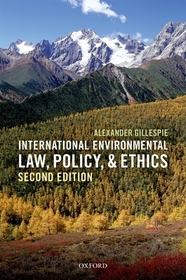
International Environmental Law, Policy, and Ethics
-
10% KEDVEZMÉNY?
- A kedvezmény csak az 'Értesítés a kedvenc témákról' hírlevelünk címzettjeinek rendeléseire érvényes.
- Kiadói listaár GBP 127.50
-
57 566 Ft (54 825 Ft + 5% áfa)
Az ár azért becsült, mert a rendelés pillanatában nem lehet pontosan tudni, hogy a beérkezéskor milyen lesz a forint árfolyama az adott termék eredeti devizájához képest. Ha a forint romlana, kissé többet, ha javulna, kissé kevesebbet kell majd fizetnie.
- Kedvezmény(ek) 10% (kb. 5 756 Ft)
- Kedvezményes ár 51 810 Ft (49 343 Ft + 5% áfa)
Iratkozzon fel most és részesüljön kedvezőbb árainkból!
Feliratkozom
57 566 Ft

Beszerezhetőség
Megrendelésre a kiadó utánnyomja a könyvet. Rendelhető, de a szokásosnál kicsit lassabban érkezik meg.
Why don't you give exact delivery time?
A beszerzés időigényét az eddigi tapasztalatokra alapozva adjuk meg. Azért becsült, mert a terméket külföldről hozzuk be, így a kiadó kiszolgálásának pillanatnyi gyorsaságától is függ. A megadottnál gyorsabb és lassabb szállítás is elképzelhető, de mindent megteszünk, hogy Ön a lehető leghamarabb jusson hozzá a termékhez.
A termék adatai:
- Kiadás sorszáma 2
- Kiadó OUP Oxford
- Megjelenés dátuma 2014. augusztus 21.
- ISBN 9780198713456
- Kötéstípus Keménykötés
- Terjedelem220 oldal
- Méret 242x163x20 mm
- Súly 490 g
- Nyelv angol 0
Kategóriák
Rövid leírás:
International Environmental Law, Policy, and Ethics investigates the ethical and political justifications for the international legal regime protecting the environment, and analyses in detail the myriad challenges these justifications can face.
TöbbHosszú leírás:
This second edition of International Environmental Law, Policy, and Ethics revises and expands this groundbreaking study into the question of why the environment is protected in the international arena. This question is rarely asked because it is assumed that each member of the international community wants to achieve the same ends. However, in his innovative study of international environmental ethics, Alexander Gillespie explodes this myth. He shows how nations, like individuals, create environmental laws and policies which are continually inviting failure, as such laws can often be riddled with inconsistencies, and be ultimately contradictory in purpose. Specifically, he seeks a nexus between the reasons why nations protect the environment, how these reasons are reflected in law and policy, and what complications arise from these choices.
This book takes account of the numerous developments in international environmental law and policy that have taken place the publication of the first edition, most notably at the 2002 World Summit on Sustainable Development and the 2012 'Rio + 20' United Nations Conference on Sustainable Development. Furthermore, it addresses recent debates on the economic value of nature, and the problems of the illegal trade in species and toxic waste. The cultural context has also been considerably advanced in the areas of both intangible and tangible heritage, with increasing attention being given to conservation, wildlife management, and the notion of protected areas. The book investigates the ways in which progress has been made regarding humane trapping and killing of animals, and how, in contrast, the Great Apes initiative, and similar work with whales, have failed. Finally, the book addresses the fact that while the notion of ecosystem management has been embraced by a number of environmental regimes, it has thus far failed as an international philosophy.
Review from previous edition ... a short but incisive review of the foundations of international environmental law ... Gillespie is impressive in his use of a plethora of international environmental conventions, declarations and statements to support his arguments. ...thought-provoking ... raises questions about IEL which to date have rarely been seriously addressed ...
Tartalomjegyzék:
Anthropocentricism
The Self Interest Justification for Environmental Protection
The Use of Economic Rationale As A Justification for Environmental Protection
Religious Justifications for Environmental Protection
Aesthetic, Cultural, and Recreational Justifications
The Rights of Future Generations as a Justification for Environmental Protection
The Growth of New, Non-Anthropocentric Ideals Within International Environmental Law
The Moral Considerability of Animals
Respect for Life
The Land Ethic
Conclusion

