

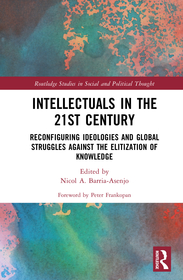
Intellectuals in the 21st Century
Reconfiguring Ideologies and Global Struggles Against the Elitization of Knowledge
Sorozatcím: Routledge Studies in Social and Political Thought;
-
10% KEDVEZMÉNY?
- Kiadói listaár GBP 145.00
-
65 467 Ft (62 350 Ft + 5% áfa)
Az ár azért becsült, mert a rendelés pillanatában nem lehet pontosan tudni, hogy a beérkezéskor milyen lesz a forint árfolyama az adott termék eredeti devizájához képest. Ha a forint romlana, kissé többet, ha javulna, kissé kevesebbet kell majd fizetnie.
- Kedvezmény(ek) 10% (cc. 6 547 Ft off)
- Kedvezményes ár 58 921 Ft (56 115 Ft + 5% áfa)
58 921 Ft

Beszerezhetőség
Még nem jelent meg, de rendelhető. A megjelenéstől számított néhány héten belül megérkezik.
Why don't you give exact delivery time?
A beszerzés időigényét az eddigi tapasztalatokra alapozva adjuk meg. Azért becsült, mert a terméket külföldről hozzuk be, így a kiadó kiszolgálásának pillanatnyi gyorsaságától is függ. A megadottnál gyorsabb és lassabb szállítás is elképzelhető, de mindent megteszünk, hogy Ön a lehető leghamarabb jusson hozzá a termékhez.
A termék adatai:
- Kiadás sorszáma 1
- Kiadó Routledge
- Megjelenés dátuma 2026. május 19.
- ISBN 9781041193999
- Kötéstípus Keménykötés
- Terjedelem300 oldal
- Méret 234x156 mm
- Nyelv angol 700
Kategóriák
Rövid leírás:
This book sees international academics from across five continents come together to critique the role of the present-day intellectual. It will appeal to scholars, intellectuals, and postgraduate students with interests in social and political theory, social and political philosophy, epistemology, social class, neoliberalism, and academia.
TöbbHosszú leírás:
This book sees international academics from across five continents come together to critique the role of the present-day intellectual.
Arguing that the elitization of the social sciences and humanities has reached a major climax in the 21st century, owing to the commercialisation of knowledge and the advent of the capitalist model, it asks how intellectuals can free themselves of the ideological labyrinth in which they now find themselves, and reshape the contributions of the social sciences and humanities as adequate tools for the needs of our time. The international academy has the aim and the responsibility to look at, criticise, and work against the dominant logic and to allow knowledge and international debates to reach the farthest corners of the globe. Intellectuals from different areas of the social sciences and humanities offer unique insights along this theme to offer critical analysis and reflection on our current situation, asking: what are now the duties and responsibility of intellectuals?
Bringing together relevant and influential voices from diverse perspectives, it will appeal to scholars, intellectuals, and postgraduate students with interests in social and political theory, social and political philosophy, epistemology, social class, neoliberalism, and academia.
‘It is impossible to overstate the significance of this collection of essays, which assembles an impressive array of intellectuals to reflect on the current status and responsibilities of the social sciences and humanities. A truly monumental achievement.’
Alenka Zupančič, Philosopher, Slovenia.
‘For some time now, since the crisis of the neoliberal system in 2008, we have been facing various episodes including the outbreak of the Covid-19 pandemic, the hot period following the outbreak of the conflicts in Ukraine and Gaza – not to mention the importance of the irruption of AI in the midst of the Trump phase of US domination. Faced with these events, humanity feels the need to take a reflective pause to find schemes by which to reorient itself. This reflective halt must meet two conditions: To be radical and to be cooperative, and thus capable of involving the world’s intelligentsia. Nicol A. Barria-Asenjo fulfils these conditions with this book and it will therefore be indispensable as a starting point for thinking about the future.’
José Luis Villacañas, Emeritus Professor of the Universidad Complutense de Madrid, Spain.
‘This remarkable collection is at once a map and a compass. Its authors represent multiple locations, generations, languages and critical traditions. With a powerful organizing voice from Chile, Prof. Barria-Asenjo generates a new geography of intellectual exchange and debate, which also offers a new territory of dialogue across disciplines from philosophy to critical theory, and from politics to psychoanalysis. Bringing together authors who refuse to accept their historical limits and contexts, this volume offers an unflinching claim on a variety of unclaimed and unsafe political futures.’
Arjun Appadurai, Emeritus Professor in Media, Culture and Communication, New York University, USA
‘In times of uncertainty, the Universidad de Los Lagos, from the south of the world, takes on the challenge of being a space where critical voices from the five continents converge to rethink the present and project possible futures. This book demonstrates that critical thinking and international collaboration are powerful tools to open horizons of justice, dignity, and emancipation amid the tensions of the 21st century. Intellectual work, understood as an act of responsibility and commitment, is not the heritage of an elite: it is nourished by plurality, dialogue, and difference. Bringing together thinkers of diverse trajectories constitutes a resistance against the elitization of knowledge and, at the same time, an invitation to reflect on the issues of our time.’
Oscar Garrido, University Chancellor, Universidad de Los Lagos, Chile.
TöbbTartalomjegyzék:
Foreword by Peter Frankopan Introduction: Intellectuals in the Age of Politics Section I: The Academy as Counter-ideology of the Academy: Towards a Reconfiguration of the Neoliberal Labyrinth 1. Crossing the Walls Between Disciplines in the 21st Century 2. Communisation, Materialisation and Transformation: Three Pending Tasks of Left-Wing Intellectuals in the 21st Century 3. Five Duties of the Intellectual Today (and a Hegelian Riddle) 4. For a Clitoral Revolution: Transfeminism as a Community of Jouissance 5. Against Trench Warfare 6. Nelly Richard and the Journal Revista de Crítica Cultural (1990-2008): The Construction of an Intellectual Scene 7. To Be Truly Decolonial 8. Urgent Engagement of Critical Intellectuals: The Foundation of Counter-Institutions 9. Looking Through the Concave and Convex Mirrors: Centering Arab Indigeneity and Decolonizing Theory 10. The Untimely Intellectual 11. Lenin: the (Un)beloved Madman 12. This Shift to the Right Among Intellectuals was Foreseeable Section II: A General Cartography of the 21st Century. Intellectuals Against the Elitization of Knowledge 13. The Ambiguities of Populism and the Challenges of Psychoanalytic Political Theory in the 21st Century 14. Three Spaces of Practice in and against the University 15. The Mandate of the Marginal: Psychoanalytic Ethics between Duty and Responsibility 16. Tomás Moulian: Between Macchiavello and Lenin 17. The Dialectic of Formalization and Philosophy Under Conditions 18. Edward Said and the Intelligentsia’s Consciousness in the Twenty-first Century 19. Reactionarism Closes the Door. Revisiting Kant’s Aufklarung and The Conflict of the Faculties in the Age of Post-Truth 20. “They do not move”: Salto Vitale in Fascizing Times 21. The Social Embedding of Truth: The Role of the Intellectual and the Inevitability of the Ideological 22. From Prophetic Intellectual to Democratic Intellectual Section III: A Critical Turn against the Hybris of the Social Sciences and Humanities: The Subversive Power of Collectivity 23. The Liminal Time in Politics of the 21st Century: State, Common Sense, Society and Community 24. Sartre´s Engagement: Some Reflections on a Complex Concept in the Light of the Responsibility and Duty of Intellectuals in the 21st Century 25. Recognizing Our Global Indigeneities: Our Duty and Responsibility 26. Theory and Demos: The “Red” Memory of French Philosophy in South Korea 27. The Role of Progressive Thinkers Face to the Global Conflict 28. The Diffidence of the Intellectual: Mediatory Uncertainty and Critical Consciousness 29. The Rearguard Intellectual 30. Intellectuals in Education: Emergencies and Ethical-political Challenges 31. Gramsci and Lukács in Dialogue: Revolutionary Legacies and the Role of the Intellectual Today 32. The Epistemology of Participation: To Heal and Integrate the Indigenous Practices 33. Parrhesia in Contemporary Academy: Challenges and Potentials of Frank Speech 34. Along a Shady Road: The Non-Listening Section IV: A New Era of Intellectuals Effort: Between Historical Changes and Global Struggles 35. Another Politics, a New Communism: Intellectual and Political Dialogues on the 21st Century and Beyond 36. The Political Commitment of Intellectuals in the University of the 21st Century 37. The Intellectual and Technology 38. Intellectual Autonomy under the Crisis of Revolution: Post-Soviet Trajectories 39. The Deleuzo-Guattarian Century Has Come 40. What Comes After What Comes After?: Towards a ‘New Realism’ 41. Which Intellectuals for the New Time of Authoritarianisms? 42. Queer Eco-Feminist Counterpublics for the New Millennium 43. A (Lacanian) Taxi Driver’s Notebook 44. Intellectuals Against Neocolonialism: Fostering Knowledge, Resistance, and Agency 45. The Metamodernity and Digimodernity Hypothesis at the Crossroads of the 21st Century 46. How to Reinvent Ethics, Our Role and Responsibility in a World Defaced? 47. What is an Intellectual Today? 48. The Mystery of the Public Intellectual
Több
