

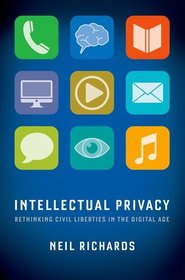
Intellectual Privacy
Rethinking Civil Liberties in the Digital Age
-
10% KEDVEZMÉNY?
- A kedvezmény csak az 'Értesítés a kedvenc témákról' hírlevelünk címzettjeinek rendeléseire érvényes.
- Kiadói listaár GBP 33.49
-
15 999 Ft (15 237 Ft + 5% áfa)
Az ár azért becsült, mert a rendelés pillanatában nem lehet pontosan tudni, hogy a beérkezéskor milyen lesz a forint árfolyama az adott termék eredeti devizájához képest. Ha a forint romlana, kissé többet, ha javulna, kissé kevesebbet kell majd fizetnie.
- Kedvezmény(ek) 10% (cc. 1 600 Ft off)
- Kedvezményes ár 14 399 Ft (13 713 Ft + 5% áfa)
Iratkozzon fel most és részesüljön kedvezőbb árainkból!
Feliratkozom
15 999 Ft

Beszerezhetőség
Megrendelésre a kiadó utánnyomja a könyvet. Rendelhető, de a szokásosnál kicsit lassabban érkezik meg.
Why don't you give exact delivery time?
A beszerzés időigényét az eddigi tapasztalatokra alapozva adjuk meg. Azért becsült, mert a terméket külföldről hozzuk be, így a kiadó kiszolgálásának pillanatnyi gyorsaságától is függ. A megadottnál gyorsabb és lassabb szállítás is elképzelhető, de mindent megteszünk, hogy Ön a lehető leghamarabb jusson hozzá a termékhez.
A termék adatai:
- Kiadó OUP USA
- Megjelenés dátuma 2015. március 5.
- ISBN 9780199946143
- Kötéstípus Keménykötés
- Terjedelem240 oldal
- Méret 234x155x30 mm
- Súly 476 g
- Nyelv angol 0
Kategóriák
Rövid leírás:
How should we think about the problems of privacy and free speech? Neil Richards argues that when privacy and free speech truly conflict, free speech should almost always win, but contends that, contrary to conventional wisdom, speech and privacy are only rarely in conflict.
TöbbHosszú leírás:
Most people believe that the right to privacy is inherently at odds with the right to free speech. Courts all over the world have struggled with how to reconcile the problems of media gossip with our commitment to free and open public debate for over a century. The rise of the Internet has made this problem more urgent. We live in an age of corporate and government surveillance of our lives. And our free speech culture has created an anything-goes environment on the web, where offensive and hurtful speech about others is rife.
How should we think about the problems of privacy and free speech? In Intellectual Privacy, Neil Richards offers a different solution, one that ensures that our ideas and values keep pace with our technologies. Because of the importance of free speech to free and open societies, he argues that when privacy and free speech truly conflict, free speech should almost always win. Only when disclosures of truly horrible information are made (such as sex tapes) should privacy be able to trump our commitment to free expression. But in sharp contrast to conventional wisdom, Richards argues that speech and privacy are only rarely in conflict. America's obsession with celebrity culture has blinded us to more important aspects of how privacy and speech fit together. Celebrity gossip might be a price we pay for a free press, but the privacy of ordinary people need not be. True invasions of privacy like peeping toms or electronic surveillance will rarely merit protection as free speech. And critically, Richards shows how most of the law we enact to protect online privacy pose no serious burden to public debate, and how protecting the privacy of our data is not censorship.
More fundamentally, Richards shows how privacy and free speech are often essential to each other. He explains the importance of 'intellectual privacy,' protection from surveillance or interference when we are engaged in the processes of generating ideas - thinking, reading, and speaking with confidantes before our ideas are ready for public consumption. In our digital age, in which we increasingly communicate, read, and think with the help of technologies that track us, increased protection for intellectual privacy has become an imperative. What we must do, then, is to worry less about barring tabloid gossip, and worry much more about corporate and government surveillance into the minds, conversations, reading habits, and political beliefs of ordinary people.
A timely and provocative book on a subject that affects us all, Intellectual Privacy will radically reshape the debate about privacy and free speech in our digital age.
Intellectual Privacy is a book that every privacy scholar needs to read and a book that deserves a much wider readership than that. Though it is a legal book the detailed legal and historical analyses that Richards provides throughout the book are scholarly and yet accessible it has implications well beyond the law, from business practices to personal responsibilities.
Tartalomjegyzék:
Introduction
Part One: Tort Privacy
1. Tort Privacy
2. Speech
3. Disclosure
4. Invasion
5. Data
Part Two: Intellectual Privacy
6. Intellectual Privacy
7. Thinking
8. Reading
9. Confiding
Part Three: Information Policy and Civil Liberties
10. Beyond Tort Privacy
11. Beyond Law
12. Conclusion
Acknowledgements

