

-
10% KEDVEZMÉNY?
- A kedvezmény csak az 'Értesítés a kedvenc témákról' hírlevelünk címzettjeinek rendeléseire érvényes.
- Kiadói listaár GBP 29.99
-
13 540 Ft (12 895 Ft + 5% áfa)
Az ár azért becsült, mert a rendelés pillanatában nem lehet pontosan tudni, hogy a beérkezéskor milyen lesz a forint árfolyama az adott termék eredeti devizájához képest. Ha a forint romlana, kissé többet, ha javulna, kissé kevesebbet kell majd fizetnie.
- Kedvezmény(ek) 10% (kb. 1 354 Ft)
- Kedvezményes ár 12 186 Ft (11 606 Ft + 5% áfa)
Iratkozzon fel most és részesüljön kedvezőbb árainkból!
Feliratkozom
13 540 Ft

Beszerezhetőség
Megrendelésre a kiadó utánnyomja a könyvet. Rendelhető, de a szokásosnál kicsit lassabban érkezik meg.
Why don't you give exact delivery time?
A beszerzés időigényét az eddigi tapasztalatokra alapozva adjuk meg. Azért becsült, mert a terméket külföldről hozzuk be, így a kiadó kiszolgálásának pillanatnyi gyorsaságától is függ. A megadottnál gyorsabb és lassabb szállítás is elképzelhető, de mindent megteszünk, hogy Ön a lehető leghamarabb jusson hozzá a termékhez.
A termék adatai:
- Kiadó OUP USA
- Megjelenés dátuma 2021. április 12.
- ISBN 9780197577233
- Kötéstípus Puhakötés
- Terjedelem300 oldal
- Méret 206x137x20 mm
- Súly 363 g
- Nyelv angol 78
Kategóriák
Rövid leírás:
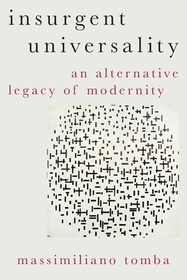
Scholars commonly take the Declaration of the Rights of Man and Citizen of 1789, written during the French Revolution, as the starting point for the modern conception of human rights. According to the Declaration, the rights of man are held to be universal, at all times and all places. But as recent crises around migrants and refugees have made obvious, this idea, sacred as it might be among human rights advocates, is exhausted. This book suggests that we need to think of a different idea of universality that exceeds the juridical universialism of the Declaration. Insurgent Universality investigates alternative trajectories of modernity that have been repressed, hindered, and forgotten. Investigating radical upheavals, Tomba excavates an alternative idea of universality that is based on popular political practices that disrupt and reject the existing political and economic order. The book shows how this tradition builds bridges between European and non-European political and social experiments.
TöbbHosszú leírás:
Scholars commonly take the Declaration of the Rights of Man and Citizen of 1789, written during the French Revolution, as the starting point for the modern conception of human rights. According to the Declaration, the rights of man are held to be universal, at all times and all places. But as recent crises around migrants and refugees have made obvious, this idea, sacred as it might be among human rights advocates, is exhausted. It's long past time to reconsider the principles on which Western economic and political norms rest.
This book advocates for a tradition of political universality as an alternative to the juridical universalism of the Declaration. Insurgent universality isn't based on the idea that we all share some common humanity but, rather, on the democratic excess by which people disrupt and reject an existing political and economic order. Going beyond the constitutional armor of the representative state, it brings into play a plurality of powers to which citizens have access, not through the funnel of national citizenship but in daily political practice. We can look to recent history to see various experiments in cooperative and insurgent democracy: the Indignados in Spain, the Arab Spring, Occupy, the Zapatistas in Mexico, and, going further back, the Paris Commune, the 1917 peasant revolts during the Russian Revolution, and the Haitian Revolution. This book argues that these movements belong to the common legacy of insurgent universality, which is characterized by alternative trajectories of modernity that have been repressed, hindered, and forgotten. Massimiliano Tomba examines these events to show what they could have been and what they can still be. As such he explores how their common legacy can be reactivated. Insurgent Universality analyzes the manifestos and declarations that came out of these experiments considering them as collective works of an alternative canon of political theory that challenges the great names of the Western pantheon of political thought and builds bridges between European and non-European political and social experiments.
Tomba's Insurgent Universality may be one of the most ambitious works of political philosophy to appear in a decade.
Tartalomjegyzék:
Preface and Acknowledgments
Chapter 1. Introduction: Decolonizing Modern History
Chapter 2. 1793: The Neglected Legacy of Insurgent Universality
Chapter 3. 1871: The Institutions of Insurgent Universality
Chapter 4. 1918: The Constitutional Anomaly of Insurgent Universality
Chapter 5. 1994: Zapatistas and the Dispossessed of History
In Lieu of a Conclusion
Notes
References
Index

