

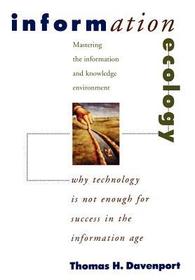
Information Ecology
Mastering the Information and Knowledge Environment
-
10% KEDVEZMÉNY?
- A kedvezmény csak az 'Értesítés a kedvenc témákról' hírlevelünk címzettjeinek rendeléseire érvényes.
- Kiadói listaár GBP 63.00
-
28 444 Ft (27 090 Ft + 5% áfa)
Az ár azért becsült, mert a rendelés pillanatában nem lehet pontosan tudni, hogy a beérkezéskor milyen lesz a forint árfolyama az adott termék eredeti devizájához képest. Ha a forint romlana, kissé többet, ha javulna, kissé kevesebbet kell majd fizetnie.
- Kedvezmény(ek) 10% (cc. 2 844 Ft off)
- Kedvezményes ár 25 600 Ft (24 381 Ft + 5% áfa)
Iratkozzon fel most és részesüljön kedvezőbb árainkból!
Feliratkozom
28 444 Ft

Beszerezhetőség
Megrendelésre a kiadó utánnyomja a könyvet. Rendelhető, de a szokásosnál kicsit lassabban érkezik meg.
Why don't you give exact delivery time?
A beszerzés időigényét az eddigi tapasztalatokra alapozva adjuk meg. Azért becsült, mert a terméket külföldről hozzuk be, így a kiadó kiszolgálásának pillanatnyi gyorsaságától is függ. A megadottnál gyorsabb és lassabb szállítás is elképzelhető, de mindent megteszünk, hogy Ön a lehető leghamarabb jusson hozzá a termékhez.
A termék adatai:
- Kiadó OUP USA
- Megjelenés dátuma 1997. november 20.
- ISBN 9780195111682
- Kötéstípus Keménykötés
- Terjedelem272 oldal
- Méret 245x164x25 mm
- Súly 544 g
- Nyelv angol
- Illusztrációk line figures, tables 0
Kategóriák
Rövid leírás:
This is a book about creating information systems within firms that will truly give managers the information they need to make informed business decisions. The author contends that information is part of an ecological system in which it undergoes a process of evolution and adaptation to the requirements of the local users. The book explains ecological planning tools that guide managers to develop information systems to meet their changing needs.
TöbbHosszú leírás:
According to virtually every business writer, we are in the midst of a new "information age," one that will revolutionize how workers work, how companies compete, perhaps even how thinkers think. And it is certainly true that Information Technology has become a giant industry. In America, more that 50% of all capital spending goes into IT, accounting for more than a third of the growth of the entire American economy in the last four years. Over the last decade, IT spending in the U.S. is estimated at 3 trillion dollars. And yet, by almost all accounts, IT hasn't worked all that well. Why is it that so many of the companies that rave invested in these costly new technologies never saw the returns they had hoped for? And why do workers, even CEOs, find it so hard to adjust to new IT systems?
In Information Ecology, Thomas Davenport proposes a revolutionary new way to look at information management, one that takes into account the total information environment within an organization. Arguing that the information that comes from computer systems may be considerably less valuable to managers than information that flows in from a variety of other sources, the author describes an approach that encompasses the company's entire information environment, the management of which he calls information ecology. Only when organizations are able to combine and integrate these diverse sources of information, and to take them to a higher level where information becomes knowledge, will they realize the full power of their information ecology. Thus, the author puts people, not technology, at the centre of the information world. Information and knowledge are human creations, he points out, and we will never excel at managing them until we give people a primary role. Citing examples drawn from his own extensive research and consulting including such major firms as A.T. & T., American Express, Ford, General Electric, Hallmark, Hoffman La Roche, IBM, Polaroid, Pacific Bell, and Toshiba Davenport illuminates the critical components of information ecology, and at every step along the way, he provides a quick assessment survey for managers to see how their organization measures up. He discusses the importance of developing an overall strategy for information use; explores the infighting, jealousy over resources, and political battles that can frustrate information sharing; underscores the importance of looking at how people really use information (how they search for it, modify it, share it, hoard it, and even ignore it) and the kinds of information they want; describes the ideal information staff, who not only store and retrive information, but also prune, provide context, enhance style, and choose the right presentation medium (in an age of work overload, vital information must be presented compellingly so the appropriate people recognize and use it); examines how information management should be done on a day to day basis; and presents several alternatives to the machine engineering approach to structuring and modeling information. Davenport makes explicit what many managers already know in their gut: that useful information flow depends on people, not equipment. In Information Ecology he paves the way for all managers to build a more competitive, creative, practical information environment for their companies.
"An important, must-read book about managers and their information needs."--F.Warren McFarlan, Albert H. Gordon Professor of Business Administration, Harvard University

