

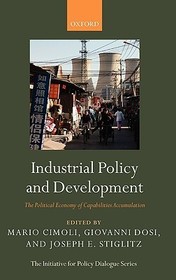
Industrial Policy and Development
The Political Economy of Capabilities Accumulation
Sorozatcím: Initiative for Policy Dialogue;
-
10% KEDVEZMÉNY?
- A kedvezmény csak az 'Értesítés a kedvenc témákról' hírlevelünk címzettjeinek rendeléseire érvényes.
- Kiadói listaár GBP 160.00
-
72 240 Ft (68 800 Ft + 5% áfa)
Az ár azért becsült, mert a rendelés pillanatában nem lehet pontosan tudni, hogy a beérkezéskor milyen lesz a forint árfolyama az adott termék eredeti devizájához képest. Ha a forint romlana, kissé többet, ha javulna, kissé kevesebbet kell majd fizetnie.
- Kedvezmény(ek) 10% (kb. 7 224 Ft)
- Kedvezményes ár 65 016 Ft (61 920 Ft + 5% áfa)
Iratkozzon fel most és részesüljön kedvezőbb árainkból!
Feliratkozom
72 240 Ft

Beszerezhetőség
Megrendelésre a kiadó utánnyomja a könyvet. Rendelhető, de a szokásosnál kicsit lassabban érkezik meg.
Why don't you give exact delivery time?
A beszerzés időigényét az eddigi tapasztalatokra alapozva adjuk meg. Azért becsült, mert a terméket külföldről hozzuk be, így a kiadó kiszolgálásának pillanatnyi gyorsaságától is függ. A megadottnál gyorsabb és lassabb szállítás is elképzelhető, de mindent megteszünk, hogy Ön a lehető leghamarabb jusson hozzá a termékhez.
A termék adatai:
- Kiadó OUP Oxford
- Megjelenés dátuma 2009. szeptember 24.
- ISBN 9780199235261
- Kötéstípus Keménykötés
- Terjedelem596 oldal
- Méret 242x163x35 mm
- Súly 1034 g
- Nyelv angol
- Illusztrációk numerous tables and figures 0
Kategóriák
Rövid leírás:
This volume addresses the issue of state intervention in industry and markets. It provides a comprehensive critique of the policies informed by the Washington Consensus. Building on this critique, the editors bring together essays by leading experts in the field which focus on instances of successful industrial policies and interventions.
TöbbHosszú leírás:
In the 1990s, development policy advocated by international financial institutions was influenced by Washington Consensus thinking. This strategy, based largely on liberalization, privatization, and price-flexibility, downplayed, if not disregarded, the role of government in steering the processes of technological learning and economic growth. With the exception of the Far East, many developing countries adopted the view that industrial policy resulted in inefficiency and poor economic growth.
Ample historical evidence shows that industrial policy does work, when the right technologies and industries are supported and when appropriate combinations of policy measures are implemented. This book provides an in-depth exploration of which industrial policies have been successful, the trade-offs associated with these microeconomic approaches to growth and development, and the opportunities and constraints associated with the current organization of international economic relations.
Tartalomjegyzék:
Preface
The Political Economy of Capabilities Accumulation: The Past and Future of Policies for Industrial Development
General Introduction
Institutions and Policies Shaping Industrial Development: An Introductory Note
Technological Learning, Policy Regimes and Growth: The Long Term Patterns and Some Specificities of a 'Globalized' Economy
Industrial Policies in an historical perspective
Emulation v. Comparative Advantage: Competing and Complementary Principles in the History of Economic Policy
Industrial Policies in Developing Countries: History and Perspectives
Industrial Tariffs, International Trade And Development
The (Slow) Return of Industrial Policies in Latin America and the Caribbean
National and regional experiences
Flying Geese and Waddling Ducks: the Different Capabilities of East Asia and Latin America to 'Demand-Adapt' and 'Supply-Upgrade' their Export Productive Capacity
Microeconomic Evolution in High Uncertainty Contexts: The Manufacturing Sector in Argentina
The Impact of Public Policies in Brazil Along the Path from Semi-Stagnation to Growth in a Sino-Centric Market
The Past, Present and Future of Industrial Policy in India: Adapting to the Changing Domestic and International Environment
Growth and Development in China and India: The Role of Industrial and Innovation Policy in Rapid Catch-up
The Political Economy of Industrial Policy in Asia and Latin America
The Roles of Research at Universities and Public Labs in Economic Catch-up
Nationality of Firm Ownership in Developing Countries: Who Should Crowd Out Whom in Imperfect Markets?
A Question of Trust: Historical Lessons for Current Development
Competition Policy and Industrial Development
Latecomer Entrepreneurship: a Policy Perspective
Intellectual Property and Industrial Development: A Critical Assessment
Conclusion
The Future of Industrial Policies in the New Millennium: Toward a Knowledge-centered Development Agenda

