

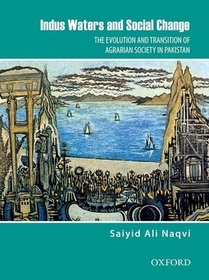
Indus Waters and Social Change: The Evolution and Transition of Agrarian Society in Pakistan
-
10% KEDVEZMÉNY?
- A kedvezmény csak az 'Értesítés a kedvenc témákról' hírlevelünk címzettjeinek rendeléseire érvényes.
- Kiadói listaár GBP 45.00
-
20 317 Ft (19 350 Ft + 5% áfa)
Az ár azért becsült, mert a rendelés pillanatában nem lehet pontosan tudni, hogy a beérkezéskor milyen lesz a forint árfolyama az adott termék eredeti devizájához képest. Ha a forint romlana, kissé többet, ha javulna, kissé kevesebbet kell majd fizetnie.
- Kedvezmény(ek) 10% (kb. 2 031 Ft)
- Kedvezményes ár 18 286 Ft (17 415 Ft + 5% áfa)
Iratkozzon fel most és részesüljön kedvezőbb árainkból!
Feliratkozom
20 317 Ft

Beszerezhetőség
A kiadónál véglegesen elfogyott, nem rendelhető. Érdemes újra keresni a címmel, hátha van újabb kiadás.
Why don't you give exact delivery time?
A beszerzés időigényét az eddigi tapasztalatokra alapozva adjuk meg. Azért becsült, mert a terméket külföldről hozzuk be, így a kiadó kiszolgálásának pillanatnyi gyorsaságától is függ. A megadottnál gyorsabb és lassabb szállítás is elképzelhető, de mindent megteszünk, hogy Ön a lehető leghamarabb jusson hozzá a termékhez.
A termék adatai:
- Kiadó OUP Pakistan
- Megjelenés dátuma 2012. november 29.
- ISBN 9780199063963
- Kötéstípus Keménykötés
- Terjedelem844 oldal
- Méret 247x189x47 mm
- Súly 1676 g
- Nyelv angol
- Illusztrációk 17 total (16 coloured, 1 b & w) 0
Kategóriák
Rövid leírás:
The book surveys the socio-economic history of the Indus region from the earliest times to the present and argues that the social change process in Pakistan is inextricably linked to the harnessing of the Indus Waters. The book provides the research, historical facts and insights for an informed public debate on the policy measures that need to be implemented for accelerating the social change process.
TöbbHosszú leírás:
Saiyid Ali Naqvi has brought a wealth of knowledge in water resources development, acquired over a 58-year career, to this study of the impact of the harnessing of the Indus waters on the evolution and development of the fabric of society in the region. He follows the Indus in its journey from around 7000 bc to present times, as he develops his thesis that the processes of social change in the region that now constitutes Pakistan are inextricably linked to the harnessing of the Indus waters.
At its inception in 1947, Pakistan, with 85 percent of its population dependent on agriculture, was an agrarian country. Today, with two-thirds of its population still living in villages, the country remains dependent on agriculture. Despite the use of machinery by big landowners, the agrarian social structure remains fettered by quasi-feudal and tribal customs. The book makes a critical assessment of the pace of the social change process in Pakistan and finds that it has reached a phase which
could at best be characterized as 'quasi-industrial'. This disappointing situation is due to the slow pace of industrialization of the agriculture sector.
The book provides the research, historical facts, and insights for an informed public debate on the policy measures for overcoming impediments and accelerating the social change process.
Tartalomjegyzék:
Contents List:
List of Illustrations (Images, Maps, and Diagrams)
List of Tables and Figures
Preface
Acknowledgements
Abbreviations
Glossary
Introduction
Part I: Indus Region in Ancient to Early Medieval Period
1. The Indus: An Introduction
2. Pre-History, Indus Civilization, and Early (Vedic) Aryans
3. The Historical Period
Part II: Indus Region in Medieval Times (1206-1843)
4. Harnessing the Indus Waters in Medieval Times (1206-1843)
5. Economy and Society in Medieval Times (1206-1843)
Part III: Indus Region in the British Colonial Times (1843-1900)
6. Harnessing the Indus Waters (1843-1900)
7. Economy and Society (1843-1900)
Part IV: Indus Region in the British Colonial Times (1900-1947)
8. Harnessing the Indus Waters (1901-1940)
9. Economy and Society (1901-1940)
10. The Final Years of Colonial Rule (1941-1947)
Part V: Inception and Formative Years of Pakistan (1947-1961)
11. The Early Years of Pakistan (1947-1950)
12. Harnessing the Indus Waters (1951-1962)
13. Economy and Society (1951-1962)
Part VI: The Years of Accomplishments and Debacles (1961-1980)
14. Harnessing the Indus Waters (1961-1980)
15. Economy and Society (1961-1980)
Part VII: Harnessing the Indus Waters and the State of Economy and Society in the Turbulent Era
(1981-2008)
16. Harnessing the Indus Waters (1981 to 2008)
17. A Panorama of the Agricultural Situation (1981- 2008)
18. Agriculture, Economic Growth and Industrialism during Military Rule (1981-82 to 1987-88)
19. Agriculture, Economic Growth and Industrialism during the Quasi-Civilian Rule (1988-89 to 1998-99)
20. Agriculture, Economic Growth and Industrialism during the Turbulent Era (1999-2008)
21. Selected Key Indicators of Social Dynamics (1981-2008)
Epilogue
Notes
Bibliography
Index

