

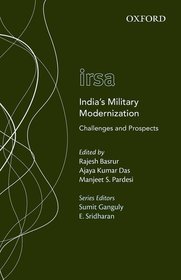
India's Military Modernization
Challenges and Prospects
Sorozatcím: Oxford International Relations in South Asia;
-
10% KEDVEZMÉNY?
- A kedvezmény csak az 'Értesítés a kedvenc témákról' hírlevelünk címzettjeinek rendeléseire érvényes.
- Kiadói listaár GBP 27.99
-
12 637 Ft (12 035 Ft + 5% áfa)
Az ár azért becsült, mert a rendelés pillanatában nem lehet pontosan tudni, hogy a beérkezéskor milyen lesz a forint árfolyama az adott termék eredeti devizájához képest. Ha a forint romlana, kissé többet, ha javulna, kissé kevesebbet kell majd fizetnie.
- Kedvezmény(ek) 10% (kb. 1 264 Ft)
- Kedvezményes ár 11 373 Ft (10 832 Ft + 5% áfa)
Iratkozzon fel most és részesüljön kedvezőbb árainkból!
Feliratkozom
12 637 Ft

Beszerezhetőség
Csak rendelésre kapható a kiadónál, kissé időigényes.
Why don't you give exact delivery time?
A beszerzés időigényét az eddigi tapasztalatokra alapozva adjuk meg. Azért becsült, mert a terméket külföldről hozzuk be, így a kiadó kiszolgálásának pillanatnyi gyorsaságától is függ. A megadottnál gyorsabb és lassabb szállítás is elképzelhető, de mindent megteszünk, hogy Ön a lehető leghamarabb jusson hozzá a termékhez.
A termék adatai:
- Kiadó OUP India
- Megjelenés dátuma 2014. január 9.
- ISBN 9780198092384
- Kötéstípus Keménykötés
- Terjedelem346 oldal
- Méret 225x148x27 mm
- Súly 504 g
- Nyelv angol
- Illusztrációk 4 line drawings, 1 map 0
Kategóriák
Rövid leírás:
Post-Cold War India's rise to power involves a major thrust toward the modernization of its armed forces. This book attempts a deeper understanding of India's response to the strategic demands of the new era, and of the nature of the military modernization process, its links to strategy, and its effectiveness.
TöbbHosszú leírás:
The end of the Cold War era marked a watershed in India's strategic history as it began to shift its strategic worldview from that of a relatively weak player with a defensive worldview to that of a more confident emerging power. The pros and cons of India's power potential have been debated at length in terms of its economic capacities, its expanding strategic horizons, and its internal strengths and weaknesses. But there has been relatively little detailed investigation of its military forces and the ways in which they have responded to the changing environment. This book aims to look closely at the modernization of the Indian armed forces and to ask:
How have the Indian armed forces sought to mould themselves in response to the demands of an entirely new strategic setting?
How do they view their roles in an increasingly complex world marked by a tightening web of interactions and its attendant frictions?
Is the process of modernization under way in tune with the needs of the armed forces and the overall strategic approach of policy makers?
Tartalomjegyzék:
Acknowledgements
1. Introduction, Rajesh Basrur, Ajaya Kumar Das, and Manjeet S. Pardesi
2. The Navy in India's Socio-Economic Growth and Development, Ashok Sawhney
3. The Indian Air Force Tomorrow: Challenges, Pramod K. Mehra
4. India's Nuclear Forces: Doctrine and Operationalization, Gurmeet Kanwal
5. Indian Defence Industry: Struggling with Change, Richard A. Bitzinger
6. India's Defence Acquisition and Offset Strategy, Ron Matthews and Alma Lozano
7. Internal Security Challenges and the Role of the Central Armed Police Forces, Bibhu Prasad Routray
8. Civil-Military Relations and Military Effectiveness in India, Anit Mukherjee
9. The Indo-US Defence Relationship: Prospects and Limitations, Manjeet S. Pardesi
10. Indo-Russian Defence Ties: An Overdependence Dilemma, P. L. Dash
Afterword: India's Military as a Stabilizer, Prakash Menon
About the Editors and Contributors
Index

