

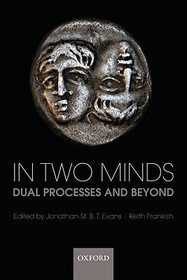
In Two Minds
Dual Processes and Beyond
-
10% KEDVEZMÉNY?
- A kedvezmény csak az 'Értesítés a kedvenc témákról' hírlevelünk címzettjeinek rendeléseire érvényes.
- Kiadói listaár GBP 59.00
-
26 638 Ft (25 370 Ft + 5% áfa)
Az ár azért becsült, mert a rendelés pillanatában nem lehet pontosan tudni, hogy a beérkezéskor milyen lesz a forint árfolyama az adott termék eredeti devizájához képest. Ha a forint romlana, kissé többet, ha javulna, kissé kevesebbet kell majd fizetnie.
- Kedvezmény(ek) 10% (cc. 2 664 Ft off)
- Kedvezményes ár 23 975 Ft (22 833 Ft + 5% áfa)
Iratkozzon fel most és részesüljön kedvezőbb árainkból!
Feliratkozom
26 638 Ft

Beszerezhetőség
Megrendelésre a kiadó utánnyomja a könyvet. Rendelhető, de a szokásosnál kicsit lassabban érkezik meg.
Why don't you give exact delivery time?
A beszerzés időigényét az eddigi tapasztalatokra alapozva adjuk meg. Azért becsült, mert a terméket külföldről hozzuk be, így a kiadó kiszolgálásának pillanatnyi gyorsaságától is függ. A megadottnál gyorsabb és lassabb szállítás is elképzelhető, de mindent megteszünk, hogy Ön a lehető leghamarabb jusson hozzá a termékhez.
A termék adatai:
- Kiadó OUP Oxford
- Megjelenés dátuma 2009. január 29.
- ISBN 9780199230167
- Kötéstípus Puhakötés
- Terjedelem382 oldal
- Méret 233x156x20 mm
- Súly 580 g
- Nyelv angol
- Illusztrációk 22 line figures 0
Kategóriák
Rövid leírás:
This book explores the idea that we have two minds - one automatic, unconscious, and fast, the other controlled, conscious, and slow. It brings together leading researchers on dual-process theory to summarize the state of the art highlight key issues, present different perspectives, and provide a stimulus to further work.
TöbbHosszú leírás:
This book explores the idea that we have two minds - automatic, unconscious, and fast, the other controlled, conscious, and slow. In recent years there has been great interest in so-called dual-process theories of reasoning and rationality. According to such theories, there are two distinct systems underlying human reasoning - an evolutionarily old system that is associative, automatic, unconscious, parallel, and fast, and a more recent, distinctively human system that is rule-based, controlled, conscious, serial, and slow. Within the former, processes the former, processes are held to be innate and to use heuristics that evolved to solve specific adaptive problems. In the latter, processes are taken to be learned, flexible, and responsive to rational norms.
Despite the attention these theories are attracting, there is still poor communication between dual-process theorists themselves, and the substantial bodies of work on dual processes in cognitive psychology and social psychology remain isolated from each other. This book brings together leading researchers on dual processes to summarize the state-of-the-art, highlight key issues, present different perspectives, explore implications, and provide a stimulus to further work.
It includes new ideas about the human mind both by contemporary philosophers interested in broad theoretical questions about mental architecture and by psychologists specialising in traditionally distinct and isolated fields. For all those in the cognitive sciences, this is a book that will advance dual-process theorizing, promote interdisciplinary communication, and encourage further applications of dual-process approaches.
Inarguably, this edited collection by Evans and Frankish is the definitive statement of the status quo in this area of work
Tartalomjegyzék:
The duality of mind: a historical perspective
Part I - Foundations
How many dual process theories do we need: one, two or many?
Distinguishing the reflective, algorithmic, and autonomous minds: is it time for a tri-process theory?
Systems and levels: dual-system theories and the personal-subpersonal distinction
An architecture for dual reasoning
The magical number two, plus or minus: dual process theory as a theory of cognitive kinds
Part II - Perspectives
Intuitive and reflective inferences
Dual-process theories: a metacognitve perspective
Dual-process models: a social psychological model
Thinking across cultures: implications for dual processes
The two systems of learning: an architectural perspective
Part III - Applications
Cognitive and social cognitive development: dual-process research and theory
What zombies can't do: a social cognitive neuroscience approach to the irreducibility of reflective consciousness
In two minds about rationality?
Reason and intuition in the moral life: a dual-process account of moral justification

