

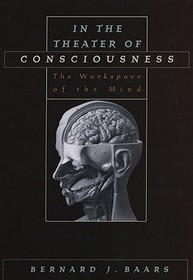
In the Theater of Consciousness
The Workspace of the Mind
-
10% KEDVEZMÉNY?
- A kedvezmény csak az 'Értesítés a kedvenc témákról' hírlevelünk címzettjeinek rendeléseire érvényes.
- Kiadói listaár GBP 38.49
-
18 388 Ft (17 512 Ft + 5% áfa)
Az ár azért becsült, mert a rendelés pillanatában nem lehet pontosan tudni, hogy a beérkezéskor milyen lesz a forint árfolyama az adott termék eredeti devizájához képest. Ha a forint romlana, kissé többet, ha javulna, kissé kevesebbet kell majd fizetnie.
- Kedvezmény(ek) 10% (cc. 1 839 Ft off)
- Kedvezményes ár 16 549 Ft (15 761 Ft + 5% áfa)
Iratkozzon fel most és részesüljön kedvezőbb árainkból!
Feliratkozom
18 388 Ft

Beszerezhetőség
Megrendelésre a kiadó utánnyomja a könyvet. Rendelhető, de a szokásosnál kicsit lassabban érkezik meg.
Why don't you give exact delivery time?
A beszerzés időigényét az eddigi tapasztalatokra alapozva adjuk meg. Azért becsült, mert a terméket külföldről hozzuk be, így a kiadó kiszolgálásának pillanatnyi gyorsaságától is függ. A megadottnál gyorsabb és lassabb szállítás is elképzelhető, de mindent megteszünk, hogy Ön a lehető leghamarabb jusson hozzá a termékhez.
A termék adatai:
- Kiadás sorszáma New ed
- Kiadó OUP Oxford
- Megjelenés dátuma 2001. november 29.
- ISBN 9780195147032
- Kötéstípus Puhakötés
- Terjedelem210 oldal
- Méret 147x226x20 mm
- Súly 306 g
- Nyelv angol
- Illusztrációk 1 colour plate, numerous line illustrations 0
Kategóriák
Rövid leírás:
Written by eminent psychologist Bernard J. Baars, In the Theater of Consciousness brings us to the frontlines of the consciousness debate, offering the general reader a fascinating overview of how top scientists currently understand the processes underlying conscious experience. The study of conscious experience has seen remarkable strides in the last ten years, reflecting important technological breakthroughs and the enormous efforts of researchers in disciplines as varied as neuroscience, cognitive science, and philosophy. This is an invaluable introduction to the field, brilliantly weaving together the various theories that have emerged as scientists continue their quest to uncover the profound mysteries of the mind - and of human nature itself.
TöbbHosszú leírás:
The study of conscious experience has seen remarkable strides in the last ten years, reflecting important technological breakthroughs and the enormous efforts of researchers in disciplines as varied as neuroscience, cognitive science, and philosophy. Although still embroiled in debate, scientists are now beginning to find common ground in their understanding of consciousness, which may pave the way for a unified explanation of how and why we experience and understand the world around us. Written by eminent psychologist Bernard J. Baars, In the Theater of Consciousness: The Workspace of the Mind brings us to the frontlines of this exciting discipline, offering the general reader a fascinating overview of how top scientists currently understand the processes underlying conscious experience.
Combining psychology with brain science, Baars brilliantly brings his subject to life with a metaphor that has been used to understand consciousness since the time of Aristotle--the mind as theater. Here consciousness is seen as a "stage" on which our sensations, perceptions, thoughts, and feelings play to a vast, silent audience (the immensely complicated inner-workings of the brain's unconscious processes). Behind the scenes, silent context operators shape conscious experience; they include implicit expectations, self systems, and scene setters. Using this framework, Baars presents compelling evidence that human consciousness rides on top of biologically ancient mechanisms. In humans it manifests itself in inner speech, imagery, perception, and voluntary control of thought and action. Topics like hypnosis, absorbed states of mind, adaptation to trauma, and the human propensity to project expectations on uncertainty, all fit into the expanded theater metaphor.
As Baars explores our present understanding of the mind, he takes us to the top laboratories around the world, where we witness some of the field's most exciting breakthroughs and discoveries. (For instance, Baars recounts one extraordinary sequence of experiments, in which state-of-the-art PET scans--reproduced here in full color--capture in fascinating, graphic detail how brain activity changes as people learn how to play the computer game Tetris.) And throughout the book, Baars has sprinkled numerous and often highly amusing on-the-spot demonstrations that illuminate the ideas under discussion.
Understanding consciousness is perhaps the most difficult puzzle facing the sciences today. In the Theater of Consciousness offers an invaluable introduction to the field, brilliantly weaving together the various theories that have emerged as scientists continue their quest to uncover the profound mysteries of the mind--and of human nature itself.
An impressive tour, centered around the question of what we might be able to discover scientifically regarding the role played by conscious experience in the functioning of the mind.
Tartalomjegyzék:
Prologue: The Metaphor
Part 1: Carving Nature at the Joints
Treating Consciousness as a Variable
Part 2: A Unified Image
The Theater Stage Has Limited Capacity but Creates Vast Access
Onstage: Sensations, Images and Ideas
The Spotlight: Attention, Absorption, and the Construction of Reality
Part 3: Using the Theater
Behind the Scenes: The Contexts that Shape Our Experience
Volition: Conscious Control of Action
The Director: Self as a Unifying Context of Consciousness
Part 4: Concluding Thoughts
What Is It Good For? The Functions of Consciousness
Epilogue: A Tiny Bit of Philosophy
Appendix: Make Your Own Theory: A Summary of the Evidence
Selected References
Index

