

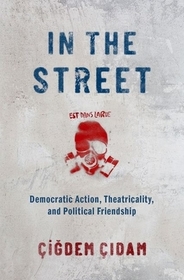
In the Street
Democratic Action, Theatricality, and Political Friendship
-
10% KEDVEZMÉNY?
- A kedvezmény csak az 'Értesítés a kedvenc témákról' hírlevelünk címzettjeinek rendeléseire érvényes.
- Kiadói listaár GBP 74.00
-
35 353 Ft (33 670 Ft + 5% áfa)
Az ár azért becsült, mert a rendelés pillanatában nem lehet pontosan tudni, hogy a beérkezéskor milyen lesz a forint árfolyama az adott termék eredeti devizájához képest. Ha a forint romlana, kissé többet, ha javulna, kissé kevesebbet kell majd fizetnie.
- Kedvezmény(ek) 10% (cc. 3 535 Ft off)
- Kedvezményes ár 31 818 Ft (30 303 Ft + 5% áfa)
Iratkozzon fel most és részesüljön kedvezőbb árainkból!
Feliratkozom
35 353 Ft

Beszerezhetőség
Becsült beszerzési idő: A Prosperónál jelenleg nincsen raktáron, de a kiadónál igen. Beszerzés kb. 3-5 hét..
A Prosperónál jelenleg nincsen raktáron.
Why don't you give exact delivery time?
A beszerzés időigényét az eddigi tapasztalatokra alapozva adjuk meg. Azért becsült, mert a terméket külföldről hozzuk be, így a kiadó kiszolgálásának pillanatnyi gyorsaságától is függ. A megadottnál gyorsabb és lassabb szállítás is elképzelhető, de mindent megteszünk, hogy Ön a lehető leghamarabb jusson hozzá a termékhez.
A termék adatai:
- Kiadó OUP USA
- Megjelenés dátuma 2021. szeptember 24.
- ISBN 9780190071684
- Kötéstípus Keménykötés
- Terjedelem264 oldal
- Méret 152x236x22 mm
- Súly 544 g
- Nyelv angol 173
Kategóriák
Rövid leírás:
If there is one thing that people agree about concerning the massive, leaderless, spontaneous protests that have spread across the globe over the past decade, it's that they were failures. Simply put, the protesters could not organize; nor could they formulate clear demands or bring about change. In the Street argues that in seeking to find the reasons behind these alleged "failures," we are asking the wrong questions. It argues that when our analysis of such events is confined by a framework of success and failure, we blind ourselves to the working reality of democratic politics, namely the on-the-ground efforts of political actors who, in becoming "political friends," demonstrate, if for a fleeting moment, that another way of being together is possible. The book develops an alternative conceptualization of democratic action through a close reading of Antonio Negri, Jürgen Habermas, and Jacques Rancière and the global protests of 1968 that inspired these political theorists and their work.
TöbbHosszú leírás:
If there is one thing that people agree about concerning the massive, leaderless, spontaneous protests that have spread across the globe over the past decade, it's that they were failures. The protesters, many claim, simply could not organize; nor could they formulate clear demands. As a result, they failed to bring about long-lasting change.
In the Street challenges this seemingly forgone conclusion. It argues that when analyses of such events are confined to a framework of success and failure, they lose sight of the on-the-ground efforts of political actors who demonstrate, if for a fleeting moment, that another way of being together is possible. The conception of democratic action developed here helps us see that events like Occupy Wall Street, the Gezi uprising, or the weeks-long protests that took place all around the US after George Floyd's killing by the police are best understood as democratic enactments created in and through "intermediating practices," which include contestation, deliberation, judging, negotiation, artistic production, and common use. Through these intermediating practices, people become "political friends"; they act in ways other than expected of them to reach out to others unlike themselves, establish relations with strangers, and constitute a common amidst disagreements. These democratic enactments are fleeting, but what remains in their aftermath are new political actors and innovative practices.
The book demonstrates that the current obsession with the "failure" of spontaneous protests is the outcome of a commonly accepted way of thinking about democratic action, which casts organization as a technical matter that precedes politics and moments of spontaneous popular action as sudden explosions. The origins of this widely shared understanding lie in Jean-Jacques Rousseau's conception of popular sovereignty, shaped by his rejection of theatricality and idealization of immediacy. Insofar as contemporary thinkers see democratic moments as the unmediated expressions of people's will and/or instantaneous eruptions, they, like Rousseau, reduce spontaneity to immediacy and erase the rich and creative practices of political actors. In the Street counters this Rousseauian influence by appropriating Aristotle's notion of "political friendship," and developing an alternative conceptualization of democratic action through a close reading of Antonio Negri, Jürgen Habermas, and Jacques Rancière and the global protests of 1968 that inspired these thinkers and their work.
In the Street expands our understanding of democracy, putting texts of political theory into an innovative conversation with the lived experience of citizens working to articulate opposition, express civic desires, and claim and occupy public space. By exploring how various subjects reconceptualize state power through mass action and by placing political friendship at the center of her analysis, Çidam reminds us that there is nothing futile about the shared struggle for a better world.
Tartalomjegyzék:
Acknowledgments
Prologue: Setting up the Stage: "Beauty is in the Street" in Istanbul
Chapter 1: Democratic Action, Spontaneity, and the Intermediating Practices of Political Friendship
Chapter 2: Jean-Jacques Rousseau: From the Unsettling Reality of the Theater to the Dream of Immediacy
Chapter 3: Antonio Negri: Insurgencies, the Multitude, and the Search for Permanence
Chapter 4: Jürgen Habermas: Embracing Transience, Containing Unpredictability
Chapter 5: Jacques Rancière: The Theatrical Paradigm and the Messiness of Democratic Politics
Chapter 6: Enacting Political Friendship in Gezi
Epilogue: Fanning the Spark of Hope

