

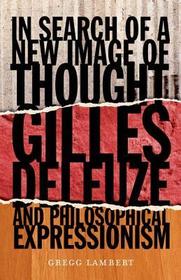
In Search of a New Image of Thought
Gilles Deleuze and Philosophical Expressionism
-
10% KEDVEZMÉNY?
- A kedvezmény csak az 'Értesítés a kedvenc témákról' hírlevelünk címzettjeinek rendeléseire érvényes.
- Kiadói listaár GBP 60.00
-
27 090 Ft (25 800 Ft + 5% áfa)
Az ár azért becsült, mert a rendelés pillanatában nem lehet pontosan tudni, hogy a beérkezéskor milyen lesz a forint árfolyama az adott termék eredeti devizájához képest. Ha a forint romlana, kissé többet, ha javulna, kissé kevesebbet kell majd fizetnie.
- Kedvezmény(ek) % (cc. 0 Ft off)
- Kedvezményes ár 0 Ft (0 Ft + 5% áfa)
Iratkozzon fel most és részesüljön kedvezőbb árainkból!
Feliratkozom
27 090 Ft

Beszerezhetőség
A kiadónál véglegesen elfogyott, nem rendelhető. Érdemes újra keresni a címmel, hátha van újabb kiadás.
Why don't you give exact delivery time?
A beszerzés időigényét az eddigi tapasztalatokra alapozva adjuk meg. Azért becsült, mert a terméket külföldről hozzuk be, így a kiadó kiszolgálásának pillanatnyi gyorsaságától is függ. A megadottnál gyorsabb és lassabb szállítás is elképzelhető, de mindent megteszünk, hogy Ön a lehető leghamarabb jusson hozzá a termékhez.
A termék adatai:
- Kiadó University Of Minnesota Press
- Megjelenés dátuma 2012. szeptember 11.
- ISBN 9780816678020
- Kötéstípus Keménykötés
- Lásd még 9780816678037
- Terjedelem256 oldal
- Méret 216x140x23 mm
- Súly 438 g
- Nyelv angol 0
Kategóriák
Hosszú leírás:
Gregg Lambert demonstrates that since the publication of Proust and Signs in 1964 Gilles Deleuze’s search for a new means of philosophical expression became a central theme of all of his oeuvre, including those written with psychoanalyst FÉlix Guattari. Lambert, like Deleuze, calls this “the image of thought.”
Lambert’s exploration begins with Deleuze’s earliest exposition of the Proustian image of thought and then follows the “tangled history” of the image that runs through subsequent works, such as Kafka: Toward a Minor Literature, The Rhizome (which serves as an introduction to Deleuze’s A Thousand Plateaus), and several later writings from the 1980s collected in Essays Critical and Clinical. Lambert shows how this topic underlies Deleuze’s studies of modern cinema, where the image of thought is predominant in the analysis of the cinematic image-particularly in The Time-Image. Lambert finds it to be the fundamental concern of the brain proposed by Deleuze in the conclusion of What Is Philosophy?
By connecting the various appearances of the image of thought that permeate Deleuze’s entire corpus, Lambert reveals how thinking first assumes an image, how the images of thought become identified with the problem of expression early in the works, and how this issue turns into a primary motive for the more experimental works of philosophy written with Guattari. The study traces a distinctly modern relationship between philosophy and non-philosophy (literature and cinema especially) that has developed into a hallmark of the term “Deleuzian.” However, Lambert argues, this aspect of the philosopher’s vision has not been fully appreciated in terms of its significance for philosophy: “not only ‘for today’ but, to quote Nietzsche, meaning also ‘for tomorrow, and for the day after tomorrow.’”
Tartalomjegyzék:
Contents
Preface and Acknowledgments
Introduction: What Is an Image of Thought?
1. The Image of Thought in Proust, or the First Literary Machine (ca. 1964)
2. Notes from a Thought Experiment: What Is a Rhizome? (ca. 1976)
3. The Image of Thought in Kafka, or the Second Literary Machine (ca. 1975)
4. A Minor Question of Literature, or the Bachelor-Machine (ca. 1975)
5. A Question of Style in the Philosophy of Difference: The “Bartleby-Formula” (c. 1989)
6. The Image of Thought in Modern Cinema: The Brain-Machine (ca. 1985)
Conclusion: We Will Speak of the Brain . . .
Notes
Index

